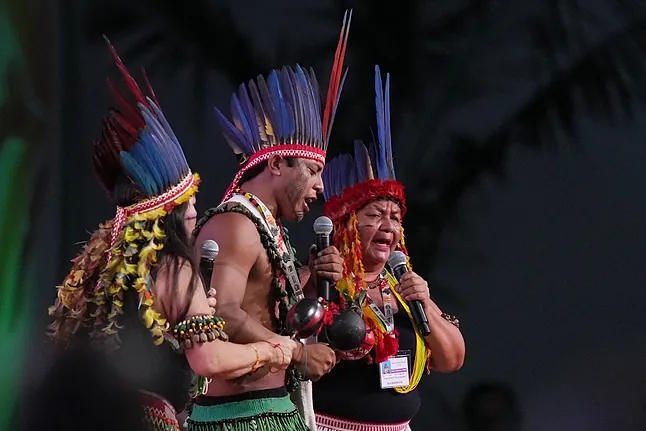
"We are gathered here to try to change things... This is a Climate Summit that must offer solutions." The President of COP30, André Corrêa do Lago, officially inaugurated this Monday in Belém the United Nations conference that, until November 21, will bring together representatives from 194 countries in the Brazilian city. Corrêa do Lago stated during his speech that he hopes this conference "will be an implementation summit" and will be remembered as "the adaptation COP, where science will be heard and believed."
"Multilateralism is the way to combat climate change," defended Corrêa do Lago, who gave a positive assessment of what the international community has achieved when it has joined forces: "The Montreal Protocol has managed to eliminate 95% of the gases that caused the ozone hole. The Paris Agreement [signed 10 years ago] took place at a time when it was predicted that we would exceed four degrees of temperature [by the end of the century]. We have managed to reduce this significantly, but we know that efforts need to be redoubled to reduce it even further," stated the Brazilian diplomat.
For Corrêa do Lago, "it is time to celebrate achievements" but, at the same time, he called for being "humble and realistic" because "although we are close to the goal, there is still much to be done." The issue of urgency, he added, "is something that must be kept in mind," and as an example, he mentioned the climate disasters that have recently struck Brazil [which has just suffered the effects of a tornado], the Philippines [which is facing the super typhoon Fung-wong], or Jamaica, which was devastated two weeks ago by Hurricane Melissa. "[These catastrophes] remind us that we have an immense responsibility," he stated.
In the same vein, the President of Brazil, Luiz Inácio Lula da Silva, emphasized that "climate change is not something of the future, but a current tragedy." The host of COP30 highlighted how these recent extreme events "have left many victims and great destruction," and are just a sample of what is happening worldwide. "Fires, floods... The increase in global temperature is causing devastation in all areas of the world, and the most affected are vulnerable populations."
He also recalled the great biodiversity of the Amazon rainforests, defended the rights of indigenous communities, and urged the international community "to place the human being at the center of the climate agenda. Millions of people will fall into poverty and hunger due to climate change, and this will mean a setback of decades," he warned.
Lula called for combating misinformation and climate denialism, and insisted that this climate summit "must be the COP of truth," the COP that listens to science. "We are heading in the right direction but at a very slow pace. At this rate, we will not achieve the goal of [limiting the temperature increase by the end of the century] to 1.5 degrees," he admitted.
Faced with delays in the fight against climate change, "complaining is not a strategy," stated the Director-General of the United Nations Framework Convention on Climate Change, Simon Stiell. While acknowledging that the greenhouse gas emissions curve had started to decline, he stated that he was not trying to "lie" to sugarcoat reality. "We need solutions" and "we have to act much, much faster."
Mukhtar Babayev, President of the previous Summit, COP29 in Baku, was the first to speak today with a speech calling for the "effective implementation" of the objectives of the climate summit held last year in Azerbaijan and wishing luck to his successor, André Corrêa do Lago.
Hours earlier, Brazilian diplomat Corrêa do Lago acknowledged that the rich countries "have lost enthusiasm to address the climate crisis." The leader of this summit expressed, however, his hope "in the movements of the global south" and in China's climate leadership, with the call for "international cooperation" made by Vice Premier Ding Xuexiang.
"China is coming up with solutions that are for everyone, not just for its country," warned the President of COP30. "Solar panels are cheaper, and they are as competitive with fossil fuels that are everywhere. If we think about climate change, that is a good thing."
In contrast to the attitude of the United States, with Donald Trump's withdrawal from the Paris Agreement and his decision not to send a high-level delegation to COP30 (despite the presence of representatives from several American states and cities), Ding Xuexiang offered to "strengthen ties with the UN on the occasion of its 80th anniversary" during his visit to the Brazilian city.
For the first time, the country leading the CO2 emissions ranking has committed to a 7% to 10% reduction plan by 2035, considered, however, clearly insufficient by experts (in contrast to the 90% emission reduction target by 2040 for the European Union)
At least a hundred of the 194 countries represented at COP30 have submitted updates to their Nationally Determined Contributions. Initial estimates speak of a CO2 emissions reduction between 10% and 15% by 2035, which would lead to a temperature increase of 2.5 degrees in this century. To stay below the 1.5-degree threshold set by the Paris Agreement, a 60% emissions cut would be needed.
The start of COP30 has also been overshadowed by the recent satellite analysis by the company Kayrros certifying that methane emissions - a greenhouse gas up to 80 times more potent than CO2 - have increased by 8.5% compared to 2020 in the six largest emitters (including the United States and Australia). The agreement reached by 159 countries at COP26 in Glasgow to limit methane emissions by 30% by 2030 seems very distant.