With a little over a year of delay, Jeff Bezos' super-rocket will orbit a NASA scientific mission to Mars. The brand-new New Glenn, which is the most powerful vehicle built by Blue Origin, the aerospace company of the magnate, was ready to make its second space flight this Sunday, but the launch has been postponed, at least until Wednesday, due to adverse weather and sea conditions, as reported by the company.
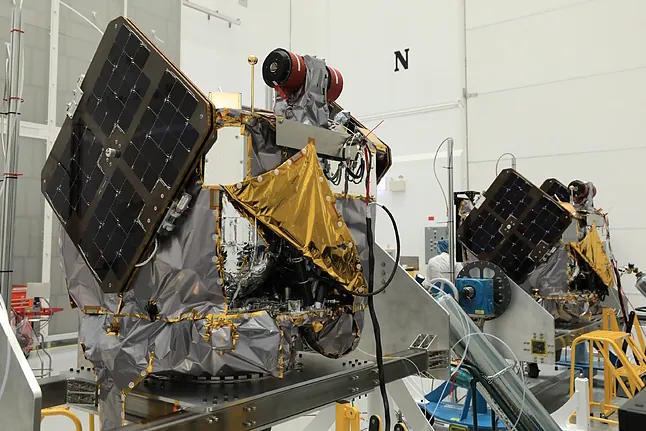
Bezos' company has been chosen by the U.S. space agency to send its ESCAPADE mission (Escape and Plasma Acceleration and Dynamics Explorers), consisting of two identical satellites -Blue and Gold- designed to investigate the interaction between the solar wind and the magnetic field of Mars.
With this mission, NASA aims to assess the feasibility of sending low-cost spacecraft into space. ESCAPADE is part of the SIMPLEx (Small Innovative Missions for Planetary Exploration) program, which funds small low-cost spacecraft for independent planetary exploration missions.
ESCAPADE has cost only 80 million dollars (69 million euros), compared to the hundreds of millions usually invested in Martian spacecraft. It is also the first scientific orbital mission with multiple spacecraft sent to Mars. Its two orbiters will make simultaneous observations from different locations around the red planet.
If all goes as planned, the satellites Blue and Gold will reach Mars in September 2027, due to the particular planning of their journey. The rocket will launch the probes towards the Earth-Sun system's Lagrange Point 2 (L2), a gravitationally stable zone located about 1.5 million kilometers from our planet. The twin probes will stay there for a year studying space weather. In November 2026, they will fly past Earth and receive a gravitational boost to head towards Mars, where they will arrive approximately 10 months later.
Both satellites have been built by Rocket Lab and will be operated for NASA by the University of California (UC Berkeley). In fact, the spacecraft have been named after the university's colors, Blue and Gold.
Both will study Mars' magnetosphere and how the solar wind contributed billions of years ago to the loss of most of its atmosphere, as there was a time when Mars closely resembled Earth. The goal is to observe how the solar wind affects the planet's upper atmosphere, a process that scientists consider crucial to understanding how it lost water and atmospheric gases, transitioning from a warm, water-rich world to the extremely dry and cold planet it is today.
This knowledge could also contribute to the preparation of future manned missions to Mars, as it will help understand the conditions that astronauts traveling there will have to endure.
It has been five years since NASA last sent a mission to Mars, as the last one took off in the summer of 2020 with the Perseverance rover and the Ingenuity helicopter on board.
Regarding the New Glenn rocket, which measures 98 meters in height and seven in diameter, it made its inaugural launch on January 16, 2025. Bezos' vehicle carried the Blue Ring space platform from Blue Origin, and although the launch was successful, the company did not achieve the secondary goal of recovering the rocket's first stage for reuse.
This Sunday, they will try again to recover a rocket component on a ship at sea, which would allow them to emulate the successful and complex maneuvers to recycle part of the rockets that their rival, Elon Musk, has achieved with his SpaceX rockets.