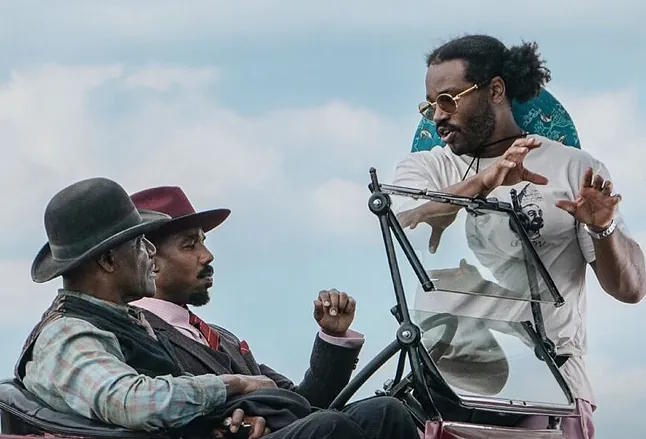
Few directors today can boast of a resume like Ryan Coogler (Oakland, 1986). Each of his five films in just 12 years of career has achieved what every human being seeks in times of unleashed vanity: recognition and money; glory and success. It sounds tremendous, but no one but him is capable of walking through life with an award from Cannes, Sundance, or his surroundings, as they say now, and a Marvel movie among the 20 (or 10 if limited to the United States) most viewed of all time. Chloe Zhao tried, but it didn't work out for her. From Fruitvale Station to Creed through his two installments of Black Panther, Coogler has managed to merge political consciousness and the most voracious entertainment without apparently any effort. His latest work, The Sinners, takes his creed to the extreme and manages to turn a vampire movie (that's what it is) into a vindication of the roots of a people (African Americans in the midst of the Jim Crow segregation laws era), a way of understanding life and music (the blues), the shores of a river (the Mississippi), and cinema (all of it) in its most genuine and unprejudiced version. The director recently visited Madrid on his promotional tour for the awards season and took the opportunity to reflect. The interview was conducted before Warner, the film's distributor, was acquired by Netflix.
"The blues is life. Sometimes sweet; sometimes funny; almost always sensual"
"My blackness is not something I can turn on or off... I am a black filmmaker and I make films about black characters"
What is The Sinners exactly: a vampire movie, a blues redemption, or a statement against racism?
For me, it all starts and ends with the blues, the Mississippi Delta blues. That was the seed of the project and the best way I have to define the movie. It's part of my life. It was my uncle James who introduced me to it. He was the oldest man in my family for a long time. He passed away in 2015. We used to listen to that music every time I spent time with him. And when he died, I found myself listening to it as a ritual every time I missed him or reflected on him. And I fell in love with the blues. I am fascinated by the story of how it changed popular culture worldwide. If we want to understand what music is today, regardless of the genre, we have to turn to the blues. More specifically, it was the song Wang Dang Doodle that was responsible for everything.
This is your first personal project since your first film, and it seems like you wanted to pour everything into it to the point of making it a musical, a horror film, a political reflection... Did you feel challenged coming from making blockbusters?
Life is a mix of genres or, as the blues musicians say, that's life. They say: "Blues is life." Sometimes it's sweet, sometimes funny, almost always sensual. And as such, I wanted it to be a concentrated dose of life. The 24-hour structure gives you a canvas to have many movies in one because that's more or less a day. If I were to make a movie about anyone's life, in the morning it would be a domestic drama with your partner and kids. Then you take the train or drive, and it turns into a workplace thriller. You have a deadline, and there are people in your office you don't like. Maybe, why not, something incredible happens to you on the way to the car. Maybe your wallet gets stolen, and you have to chase someone. Now you're in an action movie...
There might even be moments where you laugh...
Yes, there is comedy too. I learned that idea from some of the greats. If you watch Do the Right Thing, there are many movies within that movie. Spike Lee at home with Rosie Perez is a musical. And the comedy that happens during the day at the pizzeria, that's another genre. Then it all turns into a thriller in the end. So, I saw it as an opportunity to make a film like the ones I enjoyed watching when I started out, like Carpenter's or Robert Rodriguez's...
"Blues is life. Sometimes it's sweet, sometimes funny, almost always sensual."
And what about returning to an original project after the Marvel storm?
I want to think that it's the audience that has brought me here. I even felt a bit ashamed of hiding in other projects or scripts and not opening up to that global audience that has changed my life and made my dreams come true. Yes, I felt a bit like a coward for not having done something completely mine before. I had to take the risk, and that's what I did.
"Art is a path to liberation." This line is heard in the movie almost like a political statement, is it yours or your character's?
Mine, undoubtedly. Art and its enjoyment in community is what makes us different as human beings. The act of creating and the ritual of sharing it with others is what makes art and life worthwhile. There is nothing comparable to seeing an artist create something unique live. The flow of energy in both directions places us on another spiritual level of communication. When someone like Miles Davis, at 18, opens his mouth, inflates his lungs, and produces that sound, it seems to come from another planet. It's like evidence that we are more than just what we see and touch.
All your films, in one way or another, are profoundly anti-racist. In this case, there is a protest in the form of a metaphor against the white culture's attempt to appropriate the black...
The reason I love my work is because I consider myself deeply humanistic. No matter which history book you open, you soon discover that patterns repeat throughout history and that, in truth, no matter the era, we are always the same doing the same things. A lot of money is spent to justify the false idea that humans are different from each other. Every time I hear a song, see a painting, or read a poem from another part of the world created by someone who is being oppressed and dehumanized, something stirs in me, I recognize myself in their pain. And that makes us equal. What people suffered in the Mississippi Delta in 1932 is what people today suffer in any ongoing wars.
Horror movies resurge in times of terror. Do you agree? Do you feel panic for the times we live in?
There is a lot of literature and very intelligent people analyzing horror patterns, horror archetypes, and what happens in a world where horror becomes popular. The only thing I can add is that it's not enough to offer people what they desire or fear. You have to do it in a completely unexpected way to surprise them.
At one point, Spike Lee lamented the pressure he felt to turn each of his films and each of his interviews into a statement about blackness. Pressure that a white person obviously does not feel about their whiteness. How does being a director belonging to a minority condition your work?
That is the big question. My blackness is not something I can turn on or off. It is a constant. Wherever I go, it is always with me. It's me. Without playing on words, it colors every interaction I've had in my entire life. I don't expect an interaction with a journalist to be different from going to the store or getting on an elevator. For me, it's a great honor to be in the position I am, to be able to tell the stories I tell, and to work with the actors I have the opportunity to work with. At the same time, I am a black filmmaker, and I make films about black characters. That's how it is.
If we look back, your version of Black Panther was seen as a renewal of Marvel in general. What do you think of the crisis that seems to threaten the Marvel Cinematic Universe (MCU)?
First, we must acknowledge the immense success Marvel has had. But I know the people who work on it, and they are not machines. They are people who live, breathe, and have families. That is, the success that the MCU had and has had has been so immense that it simply is not sustainable continuously. It is logical that there are ups and downs. Often you see companies that fall victim to their own success, and it is a mistake typical of a capitalist mindset to think that if there is no growth, it is a failure. I don't believe that's the case. The market adjusts, and I don't think it's over at all.
Spielberg said some time ago that superheroes will disappear as the western did...
I don't think so. I would never make such a grand statement. I have seen westerns like Unforgiven or Hell or High Water that have come long after the classic western era and are great. Nothing completely disappears; it just renews and adapts to the new times.