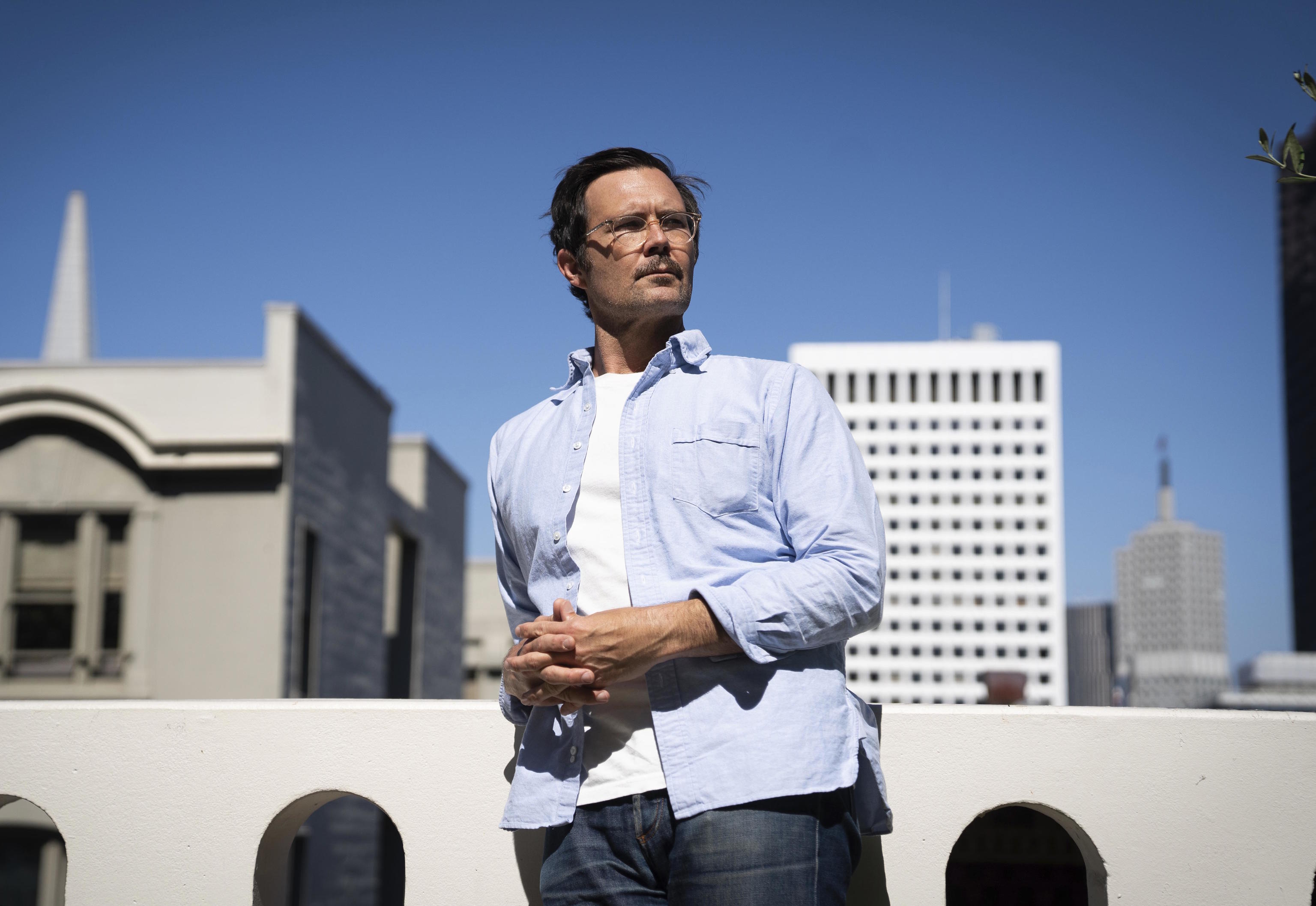
Osgood (or Oz) Perkins (New York, 1974) has managed to become a reference in the new horror cinema with just half a dozen films. His filmography wisely navigates between classic orthodoxy and measured innovation, without exaggerating the gesture, without intellectualizing beyond reason, and without falling into the abyss of what has been called "elevated horror." Keeper hits theaters months after the delirious and brilliant The Monkey, and just a year after Longlegs achieved cult status. All bearing his signature. The son of the legendary Anthony Perkins reflects on the surprising relevance of fear in times of panic, on the inherited legacy, and on the terrifying current state of machismo. Not in vain, the recently released film places patriarchy at the center of a horror tale that spans from the depths of the past to the most evident and everyday present. "The abuses against women from the past are those of today," he says.
"Every generation looks at the world around them and thinks, 'This is the worst it has ever been'"
This year we have seen how "Los pecadores, Weapons" or "Devuélvemela", beyond the box office success, placed the horror genre at the forefront. Is there an explanation for a phenomenon like this?
We believe we are special, but every generation looks at the world around and thinks, "This is the worst thing that has ever happened." And cinema quickly takes on that reflection. The classic example is "Night of the Living Dead" by George A. Romero. Probably no film of its time portrayed the anguish over the Vietnam War more accurately. An army of zombies invading a tiny American town was a beautiful metaphor for what the United States was doing in a small Asian country. On the other hand, "Rosemary's Baby," by Roman Polanski, perfectly depicted the social control of women's bodies.
What would be the movie that explains our world?
All of them. Now we live in a world where everything seems deeply out of control. The horror genre offers a kind of medicine that precisely relieves that feeling of chaos. You can choose to take it for two hours and then go home, light the fire, have dinner, and have a glass of wine having left the horror behind. It seems simple.
They should teach it in schools...
The good thing about the horror genre is that it allows for the complete human experience: what we can see and what we cannot, what we do not know, what we have lived, and what we fear living. It becomes a very useful vehicle for expressing all facets of the human being in its entirety.
We have talked about horror, but your latest film is essentially a jump scare movie. Jump scares are not usually highly appreciated by critics. How would you define a good jump scare?
I wish I knew. It would certainly be much richer. I prefer to think that I am learning the language. For me, a jump scare is about powerlessness. About the inability to change the outcome of an event. A jump scare occurs when you are surprised by something you cannot control. I imagine that what I am saying has to do with my personal experience. A couple of times in my life, I have been through situations that left me shocked. Seeing something unfold before your eyes and not being able to stop it is probably what generates the most fear or dread. That seems to be the recipe.
Some attribute the success of horror cinema to the search for new and surprising experiences in a world of entertainment dominated by formulas, algorithms, and clichés.
I don't know if that only applies to the horror genre. In general, I believe that all of us who dedicate ourselves to creating something are obsessed with avoiding or being able to overcome the current cultural noise. The feeling I have is that we live in an oversaturated world where everything is disposable. What is true is that horror by definition deals with something beyond our reach, it deals with the fantastic... And in that sense, it is easier to conceive something that arouses the curiosity of the viewer. But in the battle against the omnipresent algorithm, we are all, all of us who respect our work.
"Keeper" places an abuser at the center of the plot, perhaps the biggest and most persistent of them all, who fits a typology: man, white, and rich. Is that the idea of a monster for you?
Generally, we locate the enemy outside instead of looking inside ourselves. As a white, heterosexual, and privileged man, I have personally witnessed how until recently we were allowed to think, say, and do whatever we pleased. Without any kind of control. Only recently has there been a necessary correction. The consequent thing now is to reflect on our past, on our education, on the forms and customs that we assumed uncritically.
You speak of patriarchy...
Yes. It's very simple. We have all ended up being what our parents taught us, what we learned from television, cinema, literature... I, for example, consider myself a child of MTV. And I can't imagine a more toxic and patriarchal vehicle than MTV. I adored it, and it was a blatant way of sexualizing women. Perhaps it is time for white, heterosexual, and rich men to acknowledge how toxic, authoritarian, and colonial our behavior has been. So, essentially, "Keeper" is just a movie about a white, heterosexual, and rich man who has been misbehaving for a long time. That would be the summary.
It is clear. Would you say that sexism is the most terrifying thing we face as a society?
It is certainly one of the most concerning issues. And there are still those who do not want to acknowledge it. But there are many other fears to combat. The movie I am currently making is called "The Young People" and it is about young Americans and the indifference with which they are treated. The impression I have is that young people no longer matter. One thing is that the working class does not matter, another that women do not matter, and another that transgender people or anyone different from the established norm do not matter. But even more serious than all this, already unbearably serious, is that we do not care about our children. In the United States, now I speak of my country, they do not care about their children. I believe that is the most terrifying thing we face.
You talk about the United States, but I'm afraid it's widespread...
Yes, probably.
Not long ago, you spoke extensively about your father. I wonder if you are still bothered by the fact that your father's name comes up in every interview you give.
Not at all. I am proud of him. It would bother me if my relationship with him were presented as a competition with his work. I remember that when I was young, I felt insecure and thought, "I will never be enough, I will never be able to do what he did." But then you grow up and understand that it is not about surpassing anything or anyone, but about adding and, if necessary, completing and building on what is inherited. I have the true honor of coming from a family -- not only on my father's side, but also on my mother's side (my great-grandmother was the designer Elsa Schiaparelli) -- very connected to art and thought. Having the privilege of standing on the shoulders of that legacy is something you can either run away from and feel diminished, or you can see it as a step, as something you rise above to reach a little higher. What my father and great-grandmother achieved is always present for me. It's like having a saint, a guide, or supernatural assistance. I never see it as a burden.
How many times have you been asked about "Psycho"?
Many. And I am proud, even though it has nothing to do with it. There are movies that define an era and uplift people's spirits. This is one of them. Like "2001: A Space Odyssey" or, right now, "Barbie," why not? And not just movies. Let's think for a moment about paintings like "Guernica" or novels like "Lolita." They are all works that... how to say it... energize people. What I liked about "Longlegs," for example, was precisely that. It's not about whether you liked it more or less, it was something else. And undoubtedly, that energy I felt and personally received changed my life.