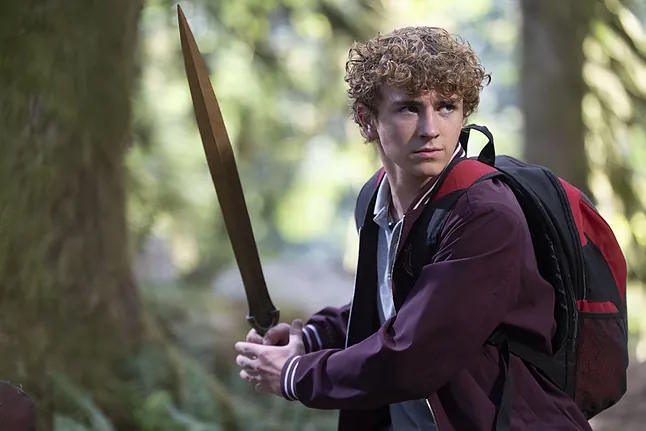
That growth permeates everything: from the tone of the story to the way the actors approach characters who can no longer hide behind humor or youthful slang. The protective boundary of Camp Half-Blood has been breached, and Percy Jackson embarks on a dangerous odyssey across the Sea of Monsters to rescue Grover and retrieve the Golden Fleece, the only hope to save his home.
"This second adventure pushes Percy to question how far he is willing to go for the people he loves," explains Walker Scobell, who brings to life the famous demigod son of Poseidon. "That's his tragic flaw, and we wanted to explore that." This tension runs through the relationship with Annabeth (Leah Sava Jeffries), daughter of Athena, and Grover (Aryan Simhadri), his satyr best friend who serves as the comic relief. A trio whose chemistry is one of the pillars of the series. Paradoxically, Simhadri acknowledges that their real closeness - evident in the interview - complicated the work: "Our relationship is very similar to Percy and Grover's, but there are things they don't do. We interrupt each other, finish each other's sentences. They have a different way of communicating. Finding that line was difficult."
The evolution from the first season was also tangible on set. Scobell recalls a key moment as the return to camp for the chariot races: "Seeing all the extras and fellow cast members from the first season and filming such a gigantic sequence was like saying: wow, this continues."
The series unabashedly embraces the structure of the Odyssey, the epic tale by Homer that the actors revisited through a graphic novel and excerpts from the original work. Jeffries recalls one of the toughest scenes, that of the sirens: "I was soaked, it was brutally cold, and we were walking on real gravel. It was exhausting." Even more demanding was the constant shift in emotional register, especially in episodes memorable for Percy Jackson fans: "I had to go from bravery to guilt, then to sadness and then to a happy memory in a matter of seconds. I ended up crying not from exhaustion, but from fear of not doing it right."
That vertigo also defines the secondary characters, who in this season gain narrative depth. Daniel Diemer builds Tyson, Percy's cyclops stepbrother, from innocence and tenderness. "He's excited about everything, but he's also very emotionally intelligent. He senses how others feel, and that conditions him," he says. Dior Goodjohn sees an unexpected arc in the defiant Clarisse: "She has to decide whether to follow exactly in the footsteps of her father, the god Ares, or allow herself to be something else. That choice changes everything." And Charlie Bushnell defends Luke, the young villain of the saga, as more than a flat antagonist: "He truly believes he is fighting for a better world. He doesn't want to destroy it, he wants to fix it."
That moral complexity was a priority for the producers. "Luke is very angry with his father, something many teenagers can identify with," explains Silverstein. "His plan is not absurd. That's where it becomes dangerous." Shotz also points to one of the key creative decisions of the season: advancing the Great Prophecy. "In the books, it's more in the background. Here we wanted the audience to understand that we are in the middle of something much bigger."
With more action, better special effects, and pop songs playing in the background, the show accompanies but does not replace the heart of the story. The chariot race sequences — filmed with real horses and without resorting to digital doubles — symbolize that commitment. "We wanted to do it for real," says Steinberg. "But always remembering that, the bigger the production, the easier it is to lose sight of the people. Emotion had to anchor each sequence."
Two decades after the publication of the first installment of Percy Jackson, its adaptation to the small screen continues to resonate with new generations of viewers. The recipe behind its success is quite simple: "It's a universal story about discovering who you are and where you fit in", summarizes Silverstein. "And at a time when everyone is looking at their own screen, the series is achieving something unusual: bringing families together to watch it. It's a wonderful achievement."