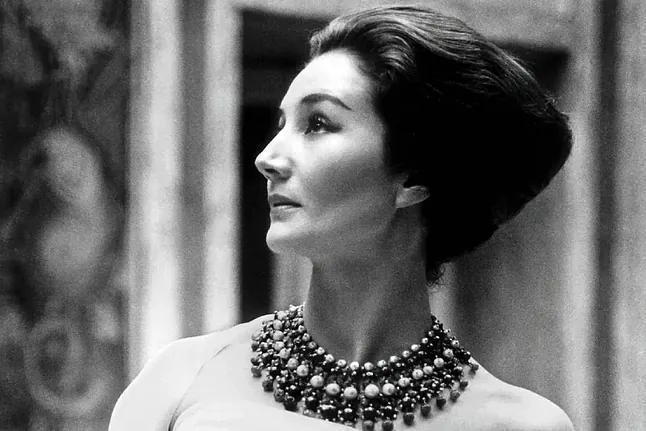
In the international 'jet set' of recent decades, a mere echo of what she represented when the most desired character was Wallis Simpson, still remained a name symbolizing the elegance, glamour, and mystery of an era that will not return. This is Jacqueline de Ribes, nicknamed 'the last queen of France', who passed away on the night of December 30 at the age of 96.
Her real name was grandiose, Jacqueline Bonnin de La Bonninière de Beaumont, and she was a descendant of French nobility. Her father was the banker and noble Jean de Beaumont, also known as one of the best hunters in France, and her mother, Paule de Rivaud, worked as a composer, translator, and painter.
Thanks to her uncle, Count Étienne de Beaumont, she met Christian Dior at the age of 16, sparking her passion for haute couture as she became a reference model for Yves St. Laurent and Valentino. At 18, she fell deeply in love with Édouard, Viscount de Ribes, whom she married in 1948 in Saint-Jean-de-Luz (France).
This led to a dream life that would be envied by high society ladies on all continents. Her first major social event was Le Bal Oriental, one of the most important parties of the 20th century organized by millionaire Carlos de Beistegui at the Palazzo Labia in Venice on September 3, 1951.
Jacqueline quickly became the muse of elegance. In fact, she said that elegance is "the art of being fascinating without creating fascination," and even The Washington Post described her as "simply the epitome of elegance."
In 1955, Diana Vreeland, the most powerful woman in fashion as the editor of Harper's Bazaar, convinced her friend Richard Avedon to photograph the noble Parisian. The result was historic. A black and white image with her hair up in a braid, in profile showing her long neck and a prominent nose that also earned her the nickname of 'modern Nefertiti'.
On one occasion, Jacqueline commented, "I did not grow up in a family that told me I was beautiful, quite the opposite. I thought I had a nose that was too big and very pointed. My mother, for years, also told me that I did not know how to walk."
After the birth of her children Élisabeth and Jean-Loup (who passed away in 2009), the aristocrat was heavily involved in the arts, overseeing the international production of the Marquis de Cuevas Grand Ballet, founded by the Chilean Jorge Cuevas, which redefined the art of dance in Monaco. The choreographer, despite being in love with Raimundo de Larraín, married one of John D. Rockefeller's granddaughters.
Throughout her life, Jacqueline de Ribes was one of France's most important patrons and became one of the most influential figures in Parisian and New York social life. From her impressive mansion in Paris - Hôtel de la Bienfaisance - from the mid-19th century, Jacqueline and her husband controlled the world. Inside, there was a room that only the chosen few had access to.
Among the most wonderful art objects were pieces from Louis XIV, Louis XV, and Marie Antoinette, paintings by renowned Old Masters, and original editions of books by Flaubert or Montaigne.
Among the highlights were works of great provenance, such as those of Louis XIV, Louis XV, Louis XVI, Marie Antoinette, and the Duke of Orleans. Along with distinguished paintings by Old Masters Élisabeth-Louise Vigée Le Brun and Marguerite Gérard, there were spectacular pieces of decorative arts, including an exceptional automaton clock, presented to Queen Marie Antoinette in January 1792. The library housed rare original editions of Montaigne, Flaubert, Apollinaire, and others from the 16th to the 21st century.
Aware that the era she lived in would not return, in 2019 she decided to auction the contents of her home at Sotheby's, where it reached a total of 22.8 million euros.
In the sixties, the aristocrat fell in love with Ibiza to the point of buying two houses, promoting Punta Galera, and even speaking with Manuel Fraga, who was then the Minister of Tourism, to protect the island of S'Espalmador. As her close friend, Catalan public relations Carlos Martorell, recounted to Vanity Fair, the politician replied, "And where is that island?"
In 1982, Jacqueline launched her eponymous fashion brand, which she kept open until the mid-nineties. Such was this woman's influence on fashion that the Costume Institute of the Metropolitan Museum of Art in New York dedicated an exhibition to the aristocratic muse of Richard Avedon and Yves St. Laurent called The Art of Style.
With the passing of Jacqueline de Ribes, an era comes to a close, but she must continue to be remembered, especially for how the fashion greats described her. Yves Saint Laurent called her the "ivory unicorn," and Emilio Pucci 'Giraffina' (Little Giraffe).