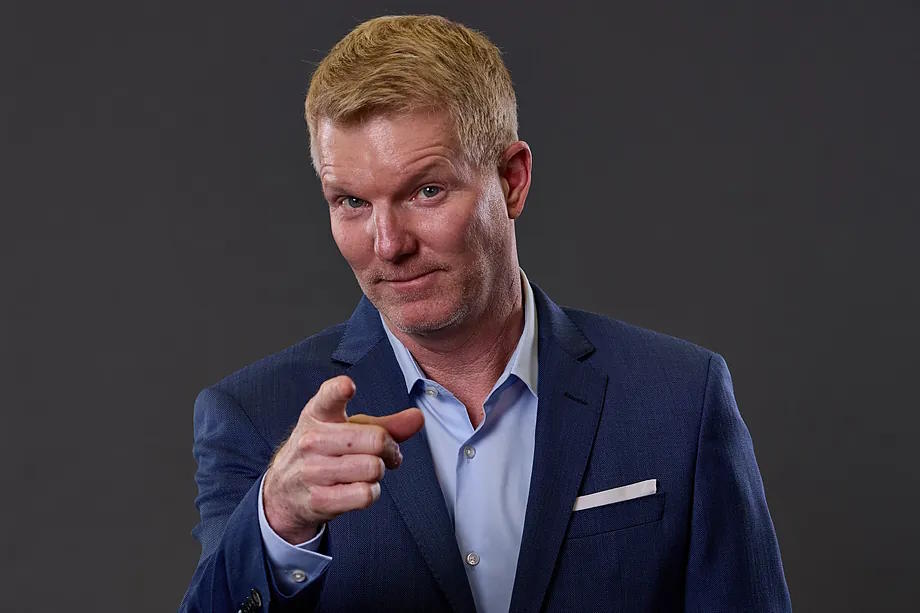
Jim Courier has always been an intense guy. Legend has it that after matches, he would go for a run instead of heading to the shower to show his opponents that he could have lasted longer. Between 1991 and 1993, he won four Grand Slam titles and was the world number one. In Melbourne, he is especially remembered for celebrating his two Australian Opens by bathing in the polluted Yarra River.
"I would do it again, but it wasn't my idea. It was my coach at the time, Brad Stine, who challenged me and joined me. We suffered through that," he recalls in a conversation with EL MUNDO from his new role. Today, Courier is part of the expert team at HBO Max and Eurosport, the channel that broadcasts the first Grand Slam of the year, and he handles the microphone like he handled the racket. Perhaps not the most elegant or aesthetic, but he returns all shots.
Question. He has been commentating on tennis on television for 20 years now. It seems like a sweet life.
Answer. It is. I really enjoy commentating on matches, but I also put a lot of dedication into it. I give it my all, it doesn't just come naturally. I remember the first interviews with players like Roger Federer, Andy Roddick, or Marat Safin... oh, a disaster. I was lucky because they helped me. The audience doesn't know the effort behind a TV broadcast. It's a job where you also feel pressure. When I was a tennis player, I had no clue.
Q. Did you never want to be a coach?
A. No. With television, I travel a few weeks a year, but coaching a tennis player requires total dedication, and I don't want that. It's a family sacrifice more than a personal one, and I have two young children, aged 11 and nine.
Q. In an interview, you explained that you don't want your children to see your trophies.
A. I have them stored in boxes. My children know who I am through their school friends, or rather, their friends' parents. But I haven't explained much to them. I don't want them to grow up under pressure, in anyone's shadow. Their mother and I are normal people, like the rest of the parents, and they can pursue whatever they want. Still, I am proud of those trophies.
Q. Which one stands out the most?
A. The first Grand Slam is the one that changes your life, so I suppose I should say Roland Garros 1991. But I have great memories of all of them.
The Alcaraz moment
Q. The Australian Open has already started. Were you surprised by the previous split between Carlos Alcaraz and Juan Carlos Ferrero?
A. Very much. When everything is going well, it doesn't seem logical to change. Tennis players change coaches for three reasons: results, power struggles, or money. It wasn't a results issue, that's for sure. So there must be a bit of the other two reasons. It will be interesting to see Carlos at this Australian Open, although I don't think his decision will have an immediate effect on his game.
Q. Why?
A. Before, in my time, teams were much smaller, and the impact of a coaching change was greater. You didn't just change the coach, you changed the psychologist, the travel companion, everything. Now players like Carlos have much more support, and with Samu López, he has continuity in his team.
Q. What role should a tennis coach have? Should they control or let the player do their thing?
A. It depends a lot on the player. Some tennis players need a boss, and others prefer to be their own boss. The level of control off the court depends a lot on the dynamics of each pair. In Carlos's case, we can all imagine that when he was a teenager, Juan Carlos told him what to do, and now, at 22 years old, with six Grand Slams, he prefers not to have to answer to anyone. The relationship between coach and player must change to last, just like a marriage or a friendship. I felt the same: when I was young, I wanted people to tell me what to do, and then I only sought technical help.
Last year, you said that Alcaraz could break one of your records: you are the youngest to reach the final of all four Grand Slams. By age, he can still do it.
And I think he will do it this year. In fact, he has a great opportunity to complete the Career Grand Slam, to be the youngest to win all four 'majors'. We will see in two weeks.
Sinner's improvement
Q. Do you see Sinner as a favourite here in Australia?
A. He must overcome Alcaraz, who is his biggest obstacle. I see them very evenly matched. But I believe that last year Sinner evolved a lot, more than is recognised. We know his game is based on dominance, but now he can adapt more to Alcaraz's game, to his drop shots, his slices, his changes of pace. Alcaraz is very complete, but so is Jannik. They don't have the weaknesses that other champions like Sampras and McEnroe at Roland Garros or Lendl at Wimbledon had. That also gives them a lot of confidence.
Q. In your time, there were great rivalries: Sampras, Agassi, Lendl, Becker... What do you think of the friendship between Alcaraz and Sinner?
A. I see it as a genuine friendship. And you can have friendship and rivalry at the same time; it's not a problem. Tennis is not a sport of separate locker rooms; it's a travelling circus where everyone constantly travels together. I understand that people want animosity, but it's not necessary. Evert and Navratilova or Federer and Nadal showed us that you can maintain a friendship and, at the same time, want to beat each other on the court.
Q. Do you think a third contender for the Grand Slams is missing?
A. It would be great, but what we have now is already incredible. Two great rivals fighting for everything, evolving with each other... If a third one comes, even better. But this era is already amazing. The important thing is not to have a single dominator in tennis, but constant rivalries.