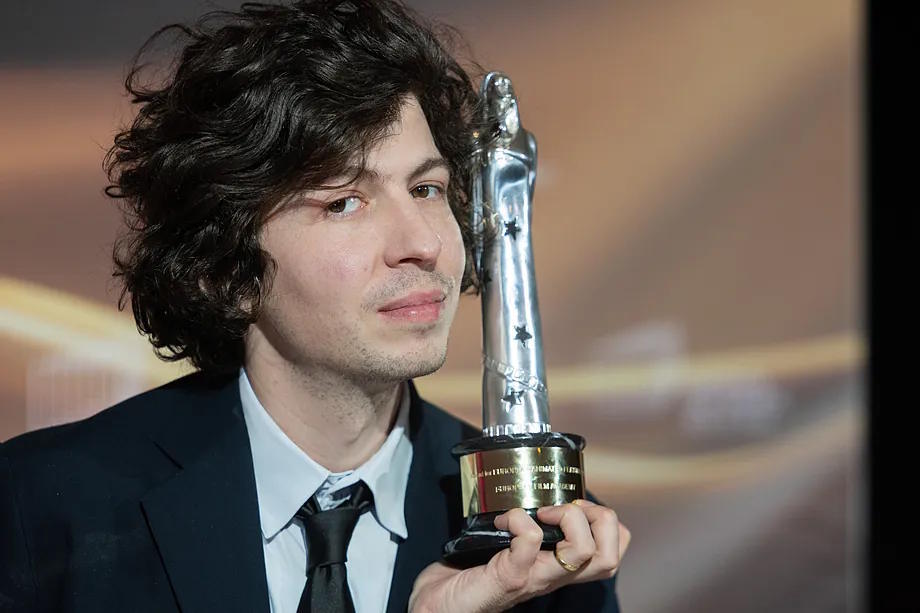
Face of sleepiness and childlike face (even though he's 38 years old). Ugo Bienvenu (literally Welcome) welcomes you, and in just a moment, all that seems like tiredness, or perhaps reluctance, transforms into energetic diligence. He says, and he says it very quickly, that he has just arrived from Berlin where he received the award for best animated film at the European Film Awards. He says that the day before he was in London. Or was it New York? And that two days before he landed in California just after spending some time, now yes, in New York. "Something very curious happened to me. As soon as my plane landed in New York, I had this idea stuck in my head that I was in Los Angeles. I didn't understand anything. Everything was very strange. I tried to understand what was happening because nothing was as I remembered," he says again. He says all this now in Paris. All this travel and all this tiredness is nothing more than the result of a colossal success. And surprising.
His film Arco has become the big revelation of the season, a direct rival to the major productions of Pixar and Disney.
With classic 2-D animation, the futuristic story of a kid traveling through time with a stroke, dynamism, and brilliance reminiscent of Studio Ghibli is both a charming fable of our time and a wake-up call for what lies ahead. It's a fairy tale, a warning, and even a hopeful and very contradictory dystopian utopia.
Was the Oscars part of the plan or just another walk through the wrong airport?
Everything happening to me right now is completely new to me. Not long ago, I was in my studio with my partner making ads and shorts, and now this. Undoubtedly, it's a privilege because it allows me to defend what I love, and it's very rewarding to see 2-D animation taking on this unprecedented prominence. But, if I'm honest, it's a real nightmare. In my personal life, it's horrible. If I'm honest, I have to admit it's the worst experience of my life.
The worst?
By far. I have two young children, and I haven't seen them in I don't know how many months. I'm struggling with it.
Why not quit? You always have the option to walk away...
On the other hand, for the film and the team that worked on it, it's great. Often, when I feel bad and want to stop, my wife reminds me: "So many people trusted you and worked for you on this film, you have to do it for them." And that's true. I do it for them. Otherwise, after the first month of promotion, I would have stopped.
You have stated on more than one occasion that you made this film for your children. Is that true?
It is. My daughter was born a year after I started working on the film. My obsession has always been to give them something that comforts them when they feel bad, something that gives them hope for the future. I imagine and have always believed that this is the task of parenthood. It's the same with everything. When I read them books by Roald Dahl or J. M. Barrie, I felt that there were missing books of that caliber for children. So, I started writing a book for them. This is what motivates me: to give my children what I believe they need.
But it also doesn't seem clear that Arco is strictly a children's film.
That's precisely what's interesting and what I aim for. The film's greatest success is seeing a grandmother cry and laugh alongside her grandchild. For me, fiction is essentially emotion. I work with emotions, and they have no age. It's not about illustrating a thesis or inviting reflection, but essentially about moving people. I'm convinced that sadness and happiness share the same space; they are inseparable.
The story goes that Arco was a very artisanal, almost personal project until actress and producer Natalie Portman crossed paths with it. How did that encounter happen?
It all started in 2020. That's when I showed my partner, Félix de Givry, a small drawing I was working on. He got excited and proposed that we venture into making a feature film. We spent two and a half years writing, storyboarding, and showing the work to people we trusted. The unanimous response was that what we were doing was worthless. We got tired of hearing that everything was crap. So, with those words or even more vulgar ones. A producer we completely trusted was even clearer and explained that the film couldn't work, that it lacked an antagonist, that it was too complex... But we are stubborn, and we decided that instead of giving up, we had to step up. So, we insisted, spent all the money we had, and made what is called a 45-minute animatic, which is like a first draft of the film. It's a rough animation, but explicit. We showed all of that to our agent, and he saw the light. It turns out he's also Natalie Portman's agent and thought she might be interested in the project for her production company, MountainA.
And she was.
Indeed. Her response was clear: "I like it. What do you need?". Well, we needed her to provide 50% of the funding for a project that cost 9.5 million euros. And from there, it was a straight path to Cannes, where we arrived at the very limit of dates and our strength.
I imagine part of the misunderstanding they encountered comes from the fact that it's not a typical futuristic film. It's not a dystopia, but quite the opposite.
When we started the project, I felt like we were living in the reality of our day-to-day as if in a bad science fiction movie. It's as if all the ideas spread about the future in the 50s, during the Cold War, we are experiencing right now. In fact, the fundamental problem is that people, in general, are lazy and use science fiction to avoid thinking.
I don't understand.
We are hostages of old futuristic fantasies that inspire people like Elon Musk, which are from the 50s. He is using past science fiction to build his own myth. And that's why things are happening as they are in the world. And that's why I believe it's the responsibility of all of us to change that myth and those preconceived ideas. If we want the best to happen, we have to imagine better. Creating optimism is much more complicated than boasting about being pessimistic. From the start, our intention was to bring to the screen a story with light, to bring light. We all know that producing light is much more difficult and less intellectually respectable than producing darkness. It took us thousands of years to master fire and almost two millennia to control electricity. That's the proof. Also, as I mentioned earlier, my duty as a father is to hand over to my children a world with hope. For the first time in human history, we are facing the challenge of saving the planet from a global threat like climate change. Only if we do it together can we move forward. We have a moral obligation to focus our energy and not be deceived by doomsayers.
The film itself is a bet on the analogue, on the artisanal... To what extent was that the foundation of the project?
Arco is a film that speaks of trusting in imagination, in feelings, of being aware of emotions. We are creatures with a worldly experience that numbers can never provide us. Now things are replaced by their concepts. It's a truly strange time.
Without mentioning it, it seems like you're talking about Artificial Intelligence. How do you think AI will change the world and your profession?
Certainly, the issue is not our profession. It's not just about whether we will lose our jobs or not. That's not the issue. It's much more serious and profound. AI threatens us as a society. Because the problem is that AI threatens the most interesting thing and what defines us as human beings, which is imagination. Imagination is part of every corner of our lives. We imagine when we write, when we cook, when we have sex... What is sex without imagination? Nothing, just pure gymnastics. Imagination fills every void in our lives. What AI does is simply take its place. It leaves us without arguments, completely empty. It took us thousands of years to have space and time for our thoughts, to be able to get bored, to think, to dream about the world... Only when we get bored are we capable of creating. Imagination is the child of boredom, and that's what a device like a mobile phone robs us of, constantly demanding our attention. Consider that thanks to technology, we gained time to dedicate to ourselves, to our inner space. But with technology, which is very recent, that process was reversed. Technology has taken away time from our thoughts, and the final step of this progressive deterioration has come with AI. AI has come to tell you clearly: "Stop imagining. I'll do it for you."
Isn't your vision too catastrophic? After all, AI is also a tool to precisely save time.
I don't think so. In fact, I believe it is a tool for social exclusion and segregation. Soon, there will be those who read books, watch movies, and educate their emotions, and those who don't. AI is not a creator of experiences, and living is about sharing experiences, strengthening and growing through one's own experiences and those of others. There used to be a financial divide between the poor and the rich. But now, it will be a much deeper abyss. There will be people who experience the world and those who live completely isolated in their bubbles, oblivious to the world.