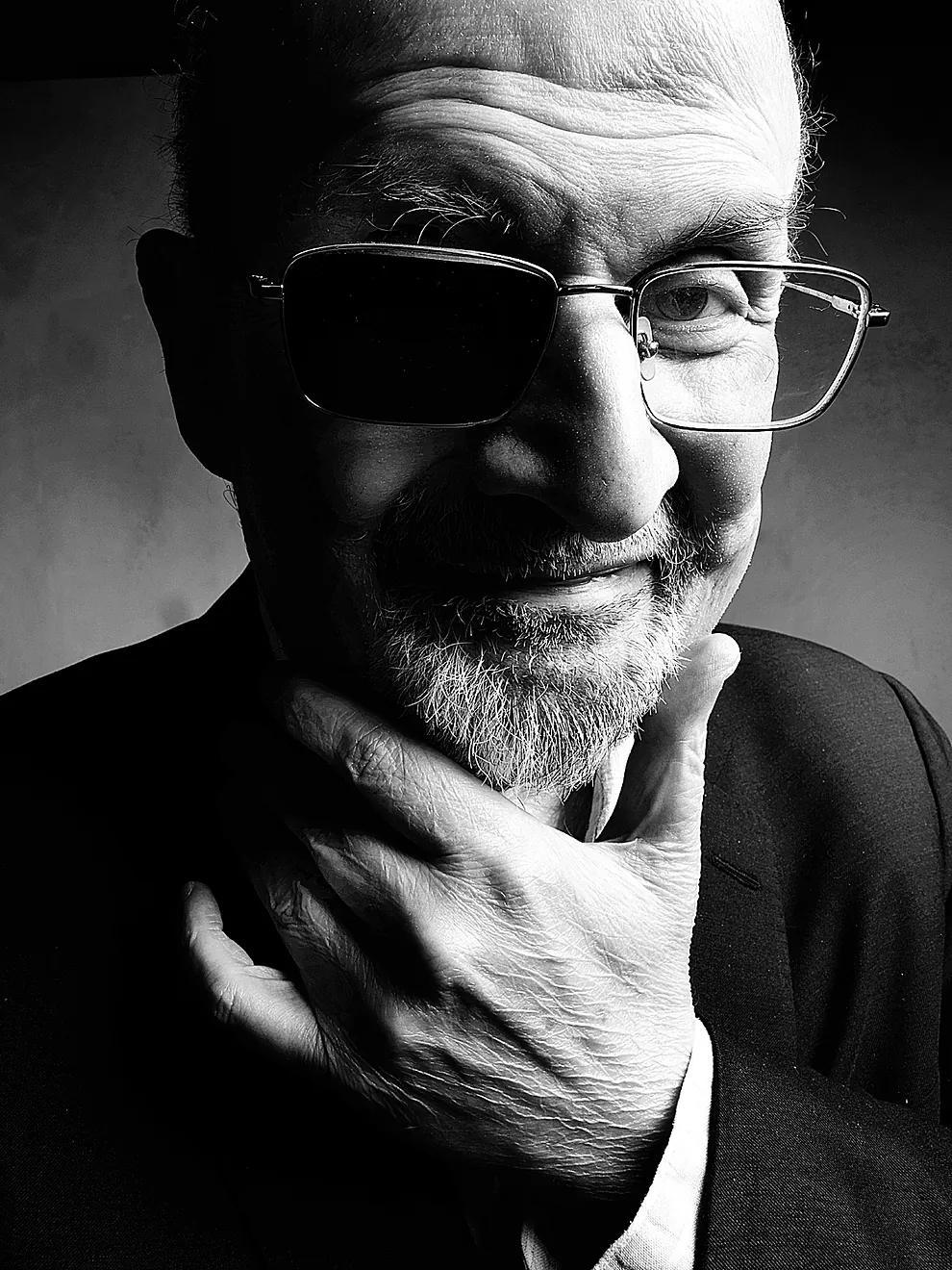
"It's a bit cheeky to say, but I am very happy with this book. The locations, eras, and literary backgrounds of the stories are very different and that makes me happy," shares Salman Rushdie (Bombay, 1947) on the other side of the screen. He refers to The Penultimate Hour (Random House), a collection of five stories that serves as a culmination -not a final point- to the major themes and settings of his life and work, marking his return to fiction after Knife, his intense memoir about the assassination attempt that almost cost him his life in 2022.
"When I returned to writing fiction after finishing the memoirs, the first thing that came to mind was my university days, those 60s years, but I couldn't find a good story. I didn't want to write about the cliché of sex, drugs, and rock and roll, and besides, I never got too involved with drugs -he jokes-, so I kept looking until I came across two interesting things," he explains. "The arrival of women at the institution after 600 years and the mistreatment suffered by two great figures of King's College due to their homosexuality, E. M. Forster, who went years without publishing, and Alan Turing, who was subjected to chemical castration." From this mix, without revealing more to the reader, "Finado" is born, Rushdie's first and only ghost story.
The story "Oklahoma," a Kafkaesque delirium about the limits of fiction, was born from two visits to the museum and exploring the idea of disappearance. "Part of it came to me here, in New York at a wonderful exhibition at the Morgan Library on Kafka's manuscripts. When I saw his unfinished novel 'America' and saw that he had wanted to title it 'The Man Who Disappeared,' I thought there was something there," he recounts. The other part of the eerie tale rests on Goya. "I was able to enter the Prado before it opened last year and I only needed to see three rooms: the one with Las Meninas, the one with El Bosco, and the one with Goya's Black Paintings. I was impressed by how at that time he had to flee the Court because of Fernando VII and I thought that the arrogance, authoritarianism, and persecution of liberals by this king, who has many imitators today, gave everything a very contemporary touch," reflects the writer.
And so Rushdie continues, whose calling as a storyteller is inexhaustible, threading anecdotes more or less hidden in the book for over an hour: when arriving in New York in his youth he met Kurt Vonnegut, Philip Roth, or James Salter "in that Long Island that seemed like a small town of artists and not the cradle of snobbery it is today," his visit to Borges' library in Buenos Aires "which was full of British writers like Kipling, Chesterton, or Stevenson." Although what impressed him the most, he says, was "a small room that contained only encyclopedias of everything imaginable, from football, to cooking, to mythology...", he lists.
"Literature always has some relationship with truth, that's why dictators don't like writers," he says.
"Once, visiting Spain as a young man," Rushdie continues tirelessly, "I met a German expatriate who was a photographer and lived in Mijas. He told me that he once met Borges in a bookstore and asked him to write a prologue for his book of photographs of Buenos Aires. And not only did he do it, but in the introduction he wrote something beautiful and fitting for the current world: that there are things that cannot be photographed," he points out with emotion. "And he gives the example of the Pampa. He says that it cannot be photographed because it is infinite, so the only way to experience it is by traversing it, so it can only be represented through time. And a photograph, unlike literature, has no time. That's why the Pampa cannot be photographed, because the infinity cannot be photographed. Isn't it great?
- Of course, but we should start with the questions...
Q. The book praises, like all your work, the power of fiction to shape reality, but also warns of the dangers it entails. In this era of fanaticism, lies, and fake news, can words be an enemy?
A. One of the things that is clearly happening, especially in this country, is the use of falsehood, of lies repeated over and over again. Already in 1984 Orwell wrote that Big Brother asked people not to believe what their own eyes saw, but the lie told by power. And that happens daily in the United States. About the danger of words, some time ago a journalist, I don't remember who, asked me how I could write fiction in this era of lies, if it wasn't contributing to them. Do you know what I told him?
A. I tried to explain to him that literature, whether realistic or not, aims to approach the truth. The truth about human nature: Why are we like this? Why do we treat people as we do? Who are we at our best or worst moments? So literature always tends towards some relationship with the truth, while lies are a way to disguise the truth, a distancing. Although these two things seem similar, they are actually opposite. That's why dictators don't like artists or writers.
Q. In a world where uncertainty and dogmatism are the norm, your stories always stand out for their nuances and depth. Can art and literature be an antidote to today's speed and confrontation, or is it attributing them too much responsibility?
A. I always distrust the much-vaunted power of literature to change society, as there are indeed much greater powers. But what it does, at a time when, as we discussed, power has understood that its strength comes from shaping the narrative, appropriating discourse, and excluding those who do not share it, is to challenge that dogma. Because literature is a way to revise the narrative, to reconfigure it. It is very heterodox and does not accept the orthodoxy of the official narrative. So, if your purpose in life is to control the narrative, literature is your enemy. That's why writers are often imprisoned and killed.
"I no longer recognize India. The ideas of tolerance and socialism have given way to a uniform nationalism," he says.
A reflection that, of course, leads to another anecdote. "A few months ago, I visited Granada to attend a festival at the beautiful Alhambra and there I met the director of the Federico García Lorca Foundation. My wife, also writer Rachel Eliza Griffiths, is an absolute fan, and we were able to see his manuscripts, his desk, his piano... It was very impactful and moving," recalls Rushdie. "This made me think. As you know, Lorca was assassinated at the beginning of the Civil War. Why? Partly for being homosexual and partly for being left-wing. But how dangerous was a poet? Very, and his killers knew it. What they didn't realize is that he is much more dangerous dead. Today Francoism no longer exists, but Lorca is immortal and known worldwide," he concludes. "Writers, when we are alive, have no power. But our work outlives those who oppressed us. I love the idea that art and literature outlive power and tyranny."
Q. The story "The Interpreter of Kahani" portrays the best and worst of India, do you recognize your country in it today?
A. The truth is that in many aspects, not anymore. In this portrayal, I satirize the world of Indian billionaires, the extravagance, the false spirituality... In my youth, Gandhi's ideas of humility, restraint, simplicity still prevailed, but all of that has disappeared. In Bombay, people used to be proud of their tolerance. Now the religious issue is an open wound, and the ideas of secularism and socialism on which India was founded no longer exist, they are things banned by a Government trying to make a monochrome country where everyone is uniform.
Q. Well, the rise of nationalism is global...
A. True, but that's not an excuse. In fact, my three countries suffer from this epidemic. It's sad to see this hostility towards immigrants, not to mention the drama in the United States, but also in the United Kingdom. Let's not be naive, in the 70s and 80s there were prejudices against people from the Caribbean or South Asia, but now it's against foreigners in general. You know, if you don't speak English or have a foreign accent, suddenly you're under scrutiny. And this causes the country to destroy itself because, of course, these same foreigners are the ones who make the hospitals work or take the worst jobs that the whites don't want. So the fruit rots on the trees, and suddenly the system doesn't work because you're expelling these people whom you thought were the problem when in reality, they were the solution.
"It's sad to see this hostility towards immigrants, not to mention the drama in the US, but also in the UK"
Q. In "Oklahoma," the narrator is a writer who borrows characters from the real world. Do you think we are currently experiencing a crisis of imagination, both socially and politically, as well as in literature, with the boom of autofiction and all this "based on true events" trend?
A. When writers of my generation were younger, there was a hunger among readers for new things, not the same old stories. And we all benefited from that. Martin Amis, Ian McEwan, Julian Barnes, Kazuo Ishiguro, Angela Carter, or myself were doing something very different from the classic English novel. And at that time, people wanted that, new ways of telling stories. Now I think it's a more conservative moment in many ways. It's more conservative politically, more conservative socially, and more conservative in terms of what people want to read. As we know, non-fiction sells better than fiction. And fiction, in a way, is only read if it can claim to be telling a real story, as you said, based on a true story. Imagine putting that on the cover of a Borges or Kafka story...
Q. And do you think that kind of literature is easier to write?
A. Honestly, I think so. In today's world, there is an idea of truth that is very simple realism, and that has led to the successful books of our time fitting into that pattern. Many of them are very focused on social issues, and in my opinion, that is a very simple way of writing. Not to mention the simplification of language itself, based on short sentences and simple prose. If you try to do something more playful with language... Well, a general impoverishment resulting from that conservatism.
Q. In one of your stories, Goya appears as an old man who gets angry at the inevitable and eternal human stupidity. Is it truly inevitable, and only the lucidity of age allows one to understand this?
A. Human stupidity is indeed inevitable, I suppose it's something you become more convinced of with age. Also, I was interested in Goya in his old age because he feels like a defeated man, and because it's when he leaves, after almost a lifetime, the Bourbon Court and goes first to the Quinta del Sordo and then to Bordeaux. One of the things I wanted to convey to the reader is how odious Fernando VII was, who, as I said, has many imitators today. That is, the key is that one of the characteristics of tyranny is hatred of culture. Culture understood in a very broad sense: journalism, museums, universities, music, painting, literature, poetry... Culture is the enemy because it doesn't align, it has its own vision that does not allow the tyrant's vision. And I think Goya's last years are a perfect example of this.
"I always tell my students that there are enough books in the world, make sure your story must be told"
Q. Old age and how to live it is one of the themes of the book, do you think the current cult of youth, ignoring our elders, is one of society's major problems?
A. Perhaps this is one of the biggest changes from my youth to today, the disappearance of respect for the elderly or matriarchs. And it's a waste of experience, yes. In a sense, I think it comes from often living in two parallel worlds, lacking understanding, communication, mainly due to technology and the values of speed and immediacy being absolute today. Although, on the other hand, that has always happened. In literature, there has always been this idea of: "We've heard enough from that writer, we don't need another story." I've been lucky, I still have enough readers to pay the rent, but I remember meeting the British writer Angus Wilson when I was young, who was 70 at the time, and at one point he used a phrase I haven't forgotten: "In the days when I was an interesting writer," he said. And I thought it was very sad to have that opinion about your own work. But now I understand it, it's a fear that comes with age, I suppose. So, in summary, it's human nature to want the next thing, the new thing, especially in the times we live in, the new thing must also be immediate.
Q. In this regard, your colleague Julian Barnes has said that his new novel will be the last, do you consider making a final book or wouldn't know how to face life without being a writer?
A. It saddened me a lot, and I hope he reconsiders. Being a writer is about having something to write. I always tell my students that there are enough books in the world, so if they are not 200% sure that a story must be told, don't write it. I literally wouldn't know what to do with my life without writing, and I haven't lost the impulse to construct plots, stories, and characters, born in my mind but taking shape by looking out into the world. So for now, I don't see myself retiring, I still feel that drive and hope to never lose it.