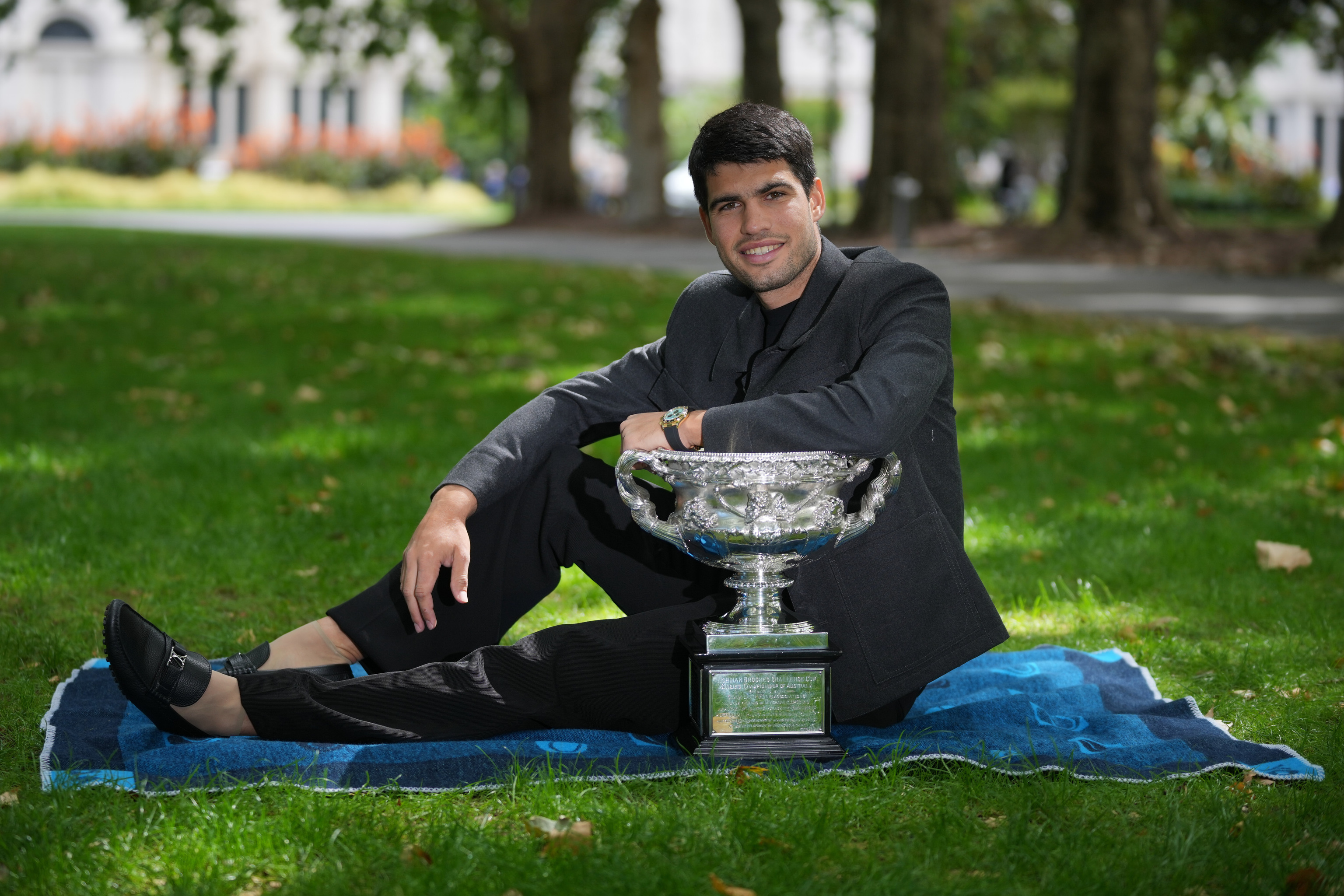
One hour before Carlos Alcaraz arrives, photographers are already testing in the gardens of the Royal Exhibition Building in Melbourne. "Stand here," they ask the earliest journalist, and he does. Later, when the Australian Open champion appears looking sleepy, everything happens at a dizzying speed. Used to these arts, Alcaraz poses, poses, poses again with his Louis Vuitton suit, greets the fans waiting for him, and fulfills his last commitments before flying back home, finally.
"I wish I had the strength to go party. After the final, I got to my room at two in the morning and couldn't do anything. I was dead tired. I played some games with my brother, and that was my whole celebration. It was all I could manage," he confesses to EL MUNDO in an interview conducted in the car rushing him from the official photo shoot to his hotel to pick up his luggage before heading to the airport. "I can't wait to get to Murcia to rest," he adds, with the kindness with which he always speaks to others and with which he has also been addressing himself in recent months.
Question. In this Australian Open, as in the past US Open, the crowd has not stopped cheering during the matches. "Come on, Charly," they said. It all starts with oneself.
Answer. Absolutely. It is very important to me. I have realized the importance of speaking positively to oneself. When things get tough is when you have to draw on that encouragement. It can change everything, it changes your mindset. It is not uncommon that my two best Grand Slam victories -referring to the US Open and this Australian Open- have come when I have spoken to myself kindly and treated myself excessively well, with the intention of doing so from the beginning.
Q. Who do you talk to if that positivity doesn't come out, if something worries you?
A. Off the court, I have my family. My father, my uncle, my brother... they all travel with me and I consider myself very lucky. But on the court, during tournaments, I have Samu [López]. Samu is a person who not only helps me professionally, improving my backhand or forehand, pointing out tactical changes; he also reassures me when something bothers me. That is very important to give my best on the court.
Q. When you were a child dreaming of having this life, did you imagine it like this?
A. As a child, I dreamed of winning the best titles, of having several Grand Slams, but I didn't know how I would feel or what would happen in my life. The sensations are a bit different from the idea I had as a child.
Q. In what way?
A. When I was 12, maybe I thought everything came out of nowhere. Like a gift, something that appears. But as you progress, you realize that it's not like that. That you have to prepare a lot for that moment you dreamed of, that you have to work hard for it, starting in the first ATP 250 tournaments, then the 500s, the Masters 1000s, and you keep advancing. Now, obviously, I feel incredible, I feel special, but it doesn't come out of nowhere. There is a lot behind it.
Q. In your champion's speech, you mentioned the criticism you received for parting ways with your coach, Juan Carlos Ferrero. Did it affect you?
A. As time goes by, I have become more aware of the power of words. Both a good word and a bad word can change a person's mood. That's why I always try to be very careful with what I say and how I say it. Some of the negative things I read or heard affected me, even made me doubt a little. But I also want to say that the positive things filled me with pride and made me happy. Thankfully, there were more good things than bad.
Q. What were the reasons for that change in your team?
A. A tennis player's season is from January to November, and when it ends, decisions have to be made. Life is based on that: on taking paths. Sometimes those paths are correct, sometimes they are wrong, and you have to keep learning. We saw that we needed a change, we decided that way, and it happened that way.
Q. With seven Grand Slam titles at 22, a clean sweep in all the 'majors'. Are you worried about getting carried away?
Truthfully, no. I am clear about my foundation, where I come from, who my people are, and that's something no one can change. If at any time, for whatever reason, I might make a mistake, I have my family and my people there. If they have to bring me back down to earth, they will. They are the ones who have always been with me since I was a child and who truly know me.
Q. When you talk to your friends, do you see a very different life from yours?
A. Obviously, yes. That is undeniable. But when I am with them, I forget all that. I forget about my life, about everything being a tennis player entails. When we get together, we are all equal, and I go back to childhood, when I was 12, 13, or 14 years old and could spend more time with them. I appreciate how they treat me, I love it, but obviously, we live different situations in our daily lives.
Q. Your record shows that you have achieved almost everything.
A. I used to see that next year here in Australia, I could complete the four Grand Slams twice and also be the youngest to do so. There is always something. There are always things that keep you ambitious. The big tournaments always motivate me, and there are several Masters 1000s that I would like to win at least once. There are also the ATP Finals and, above all, the Davis Cup. The Davis Cup is a tournament that I love, I really enjoy playing with Spain, and I would love to have it in my record.