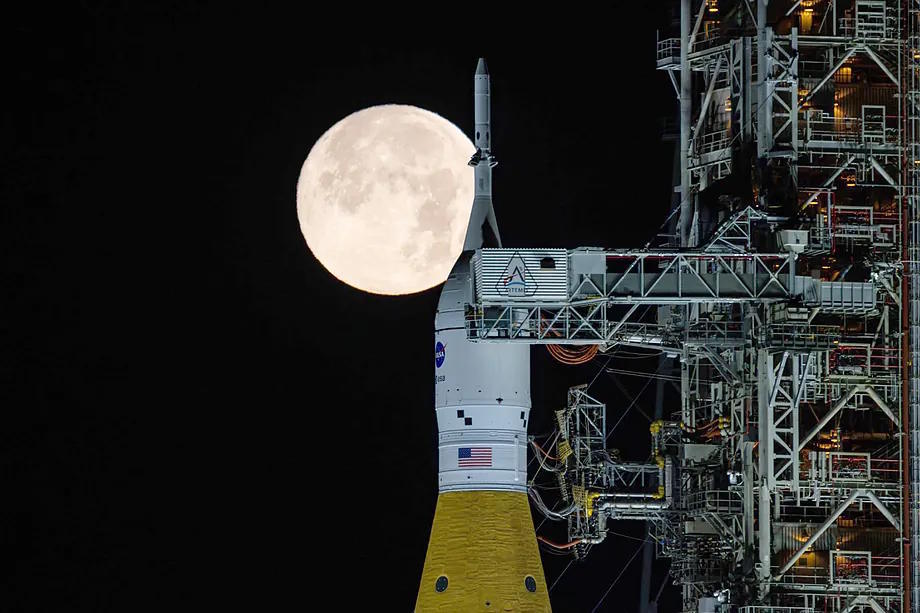
It will not be in February after all. The highly anticipated crewed NASA mission Artemis II, the first to return to the Moon since 1972, was set to launch from Sunday, February 8, but following the general rehearsal (Wet dress rehearsal) conducted in the last hours, it has been postponed until at least March due to a fuel leak during the delicate process of filling and draining 2,650,000 liters of propellant in the Space Launch System (SLS) rocket.
"As always, safety remains our top priority: that of our astronauts, our staff, our systems, and the public. We will only launch when we believe we are ready to undertake this historic mission," stated Jared Isaacman, NASA director, on the social network X after announcing the decision.
The mission crew - Americans Reid Wiseman, Christina Koch, Victor Glover, and Canadian Jeremy Hansen - who have been in quarantine in Houston since January 21 to avoid getting sick, will have to wait at least another month to start their 10-day space journey, during which they will orbit the Moon without landing - an objective that will be achieved during Artemis 3, scheduled for as early as 2028.
Once February is ruled out, the available launch dates in March for Artemis 2 are the 6th, 7th, 8th, 9th, and 11th. If March is not feasible and it has to be postponed to April, the dates indicated by NASA are the 1st, 2nd, 4th, 5th, and 6th.
The test conducted in the last hours on launch pad 39B at Kennedy Space Center in Florida is called Wet dress rehearsal and is a crucial test, as all procedures prior to launch are rehearsed for almost two days, the Space Launch System (SLS) rocket is filled with cryogenic fuel (liquid hydrogen and liquid oxygen at extremely low temperatures), and the countdown is performed. Astronauts do not participate in this test, designed to identify any issues and resolve them before attempting the launch with the highest chances of success.
NASA concluded this general rehearsal early Tuesday. Cryogenic propellant was successfully loaded into the SLS tanks, a team was sent to the launch pad to close the Orion spacecraft, and the rocket was safely emptied. Leaks were expected as the fueling process is very delicate and complex, which during the unmanned Artemis 1 mission - conducted in late 2022 - caused numerous headaches for engineers and delayed the launch by several months. However, NASA technicians believed they had learned how to perform it and expected to do the procedure smoothly. This was not the case, and the detected problems have led the team to postpone the launch until March to have more time to repeat this test and ensure the rocket is ready.
As explained by NASA in a statement, "engineers conducted an initial countdown test, which was stopped five minutes before the end due to a peak in the liquid hydrogen leak rate." In addition, as detailed by Jared Isaacman, there were intermittent audio interruptions on the ground and impacts from cold weather on some cameras.
"The team will thoroughly review the data, address each issue detected during the Wet dress rehearsal, make necessary repairs, and resume testing. We plan to conduct an additional general rehearsal and then focus on the March window," Isaacman noted.
On January 17, NASA moved the assembled spacecraft on the rocket from the Vehicle Assembly Building to Launch Pad 39B at Kennedy Space Center, where the general rehearsal took place. A 6.5-kilometer journey that took almost 12 hours to complete, and which they will likely have to repeat back to the Building to prepare the vehicle for the March launch.
The cold and intense winds that hit Florida last week as a result of the Arctic cold wave affecting the US caused a couple of days' delay in the launch general rehearsal, which in turn pushed back the initial possible launch date, originally set for February 6.
Meanwhile, the four astronauts are in Houston, in quarantine since January 21 to avoid getting sick. It is not a strict quarantine, as they can still have contact with family members who take the same precautions.
If NASA officials had approved the launch, the astronauts would have flown to Florida, as the plan was for them to arrive at Kennedy Space Center six days before the launch to finalize preparations. Now, they will return to their activities awaiting the next launch date.