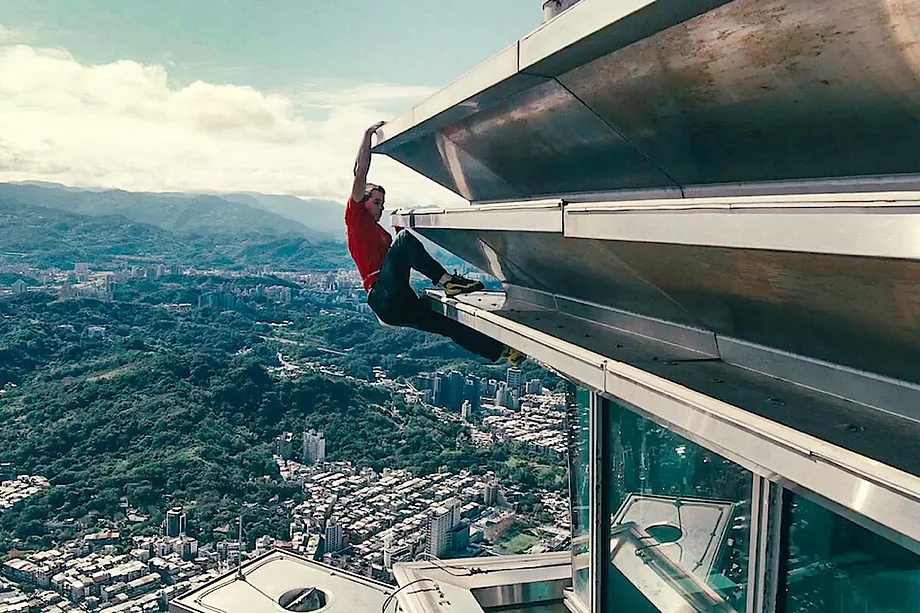
John Bachar, Sean Leary, Derek Hersey, Dan Osman... They were the best in the world at free solo climbing and all died doing what they loved most. However, none of them reached the level of Alex Honnold, the man who has taken the risks of this discipline to another level. On January 25, Honnold was the protagonist of the ascent of the 508-meter-high Taipei 101 skyscraper, broadcast live by Netflix. Without ropes or any other safety measures, as is his custom. A technically simple achievement for him, determined for years to defy death.
"It was a TV show," explains Iker Pou to EL MUNDO, one of the best climbers on the current scene, climbing with his brother Eneko. "In Taiwan, he tried to bring climbing to the general public in a reality show style, but very calmly, very safely," adds Iker, while Eneko delves into the analysis. "Climbing that skyscraper was impressive, but his rock achievements are on another level." And none like his ascent of El Capitan, the legendary 914-meter wall in Yosemite National Park (California). It was on June 3, 2017, a date for climbing history.
That day, Honnold opened the Freerider route in free solo and his feat was captured in the documentary Free Solo, which won an Oscar in 2019. More than a challenge, El Capitan had become an obsession. Honnold confessed this to the Pou brothers in 2013. "We met him in a supermarket around there and had coffee with him. We advised him against it because we thought it was too tough and dangerous," Eneko recounts. That was the masterpiece of the genius with a hippie soul, who had spent nine years living in a van; of the young man who lost his father at 19; of the teenager who climbed alone because he didn't want to talk to anyone; of the boy who wasn't cool and felt fine being the "lonely fool."
"That will take 20 years to repeat. It was impressive," emphasizes 48-year-old Iker, very precise in evaluating Honnold's distinctive aspects. "There are other climbers with better physical performance, but his mindset makes him unique in assuming those risks," he points out, referring to the neurological tests where Alex's amygdalas seem inactive in the face of fear. The Pou brothers, of course, have also climbed the Freerider on El Capitan with ropes. And that experience allows them to better understand their colleague's milestone. "When you're there and imagine Alex in free solo making those moves with a 900-meter drop, you just marvel. It's surreal. The rest can't afford something similar. He has been doing it since he was very young, he has those qualities, and it doesn't affect him like others," concludes Iker.
Honnold started free solo climbing in 2008, with Moonlight Buttress (Utah), a 290-meter ascent "quite easy and very safe." A couple of years later, he took 11 hours to climb Half Dome, also in Yosemite. At that time, he still idolized Tommy Caldwell, seven years his senior, the closest thing to a friend. "Climbing without ropes is a bit of a strange personal activity because you never tell anyone what you're going to do," Honnold confesses in Free Solo, directed by Jimmy Chin and Elizabeth Chai Vasarhelyi.
"We consider him a very nice guy, a cool guy. But maintaining that in the United States, once you become famous, is very difficult because money and fame come. I remember a friend, right after watching Free Solo, said to us: 'What a shame because this guy will never be the same again,'" Eneko recounts, for whom American money can "change everything." However, he remains optimistic about Honnold. "Alex has spent years between his passion, his escape mode, and what has become a business. I think, in a way, he has achieved a balance."
There has also been much talk about Honnold's charitable side, who claimed to donate a third of his income to NGOs. In 2014, he started a foundation to support those without access to electricity. "The United States is a tough place. We have been working for many years for an American company, like The North Face, and we know how the most competitive country in the world works. Behind someone who seems like a hippie, there is a lot of business. They put on a show because they have the money to do it," the elder Pou comments on the perks of their sport. In fact, some still do not understand how Honnold obtained permission to climb Taipei 101 while Alain Robert, the great reference in the specialty, has faced countless difficulties over the years.
"Basically, Americans do what they want thanks to money. If I may speak a bit about us, in recent years we have been one of the most recognized climbing teams worldwide, but we will never achieve the impact of an average American climber. That's the reality, and we have to accept it," Eneko specifies.
The Pou brothers, on the other hand, never ventured into free solo climbing because, as Eneko admits, "we want to continue enjoying our passion and if possible, grow old doing it." "We can challenge ourselves with very difficult things, but not by going all-in," he adds, remembering those who can no longer tell their stories, like Darío Barrio or Carlos Suárez, and those who saw "death too close," like Armando del Rey, who knew he had to "put an end to this if he wanted to survive." The extreme experiences of this group of friends in BASE jumping can be enjoyed in La fiera, a film by Salvador Calvo premiering next Friday.
So, where should we place the thin line that separates risk from the almost obscene disregard for life that seems to guide Honnold? "Our sport has always been based a lot on freedom," points out 51-year-old Eneko. "You can't say they are suicidal, but quite the opposite. We all know we have this life, only one. And we have to enjoy it, live it intensely. Until the game over comes, the end of the game. Knowing it will end, but not seeking its end. None of us conceives a relaxed life, lying on the couch. That is losing your life or dying in life, in a way. But there are people who take it a step further in assuming risks. We cannot criticize them for the decisions they made. They knew what they were playing for and had the bad luck of not getting it right."