The risks of Trump's policy for the World Cup: Could Spain and European powers consider a boycott?
ORFEO SUÁREZ
Updated
Members of the German CDU open the debate on a boycott of the tournament while several human rights associations demand it due to the persecution of immigrants and deaths in Minnesota
Donald Trump does not share the same opinion as Carl von Clausewitz. He does not believe, like the Prussian military leader, that politics is the continuation of war by other means. On the contrary, long before exhausting the political route, he sends an aircraft carrier or the militarized agents of ICE, the U.S. Immigration and Customs Enforcement. Minneapolis and Iran are currently Trump's hot spots, not to mention the standoff with the European Union over Greenland, the situation in Venezuela, threats to Mexico and Colombia over drug trafficking, or the multiple trade wars. Tomorrow, no one knows.
This context has turned Trump into an enemy of various countries and regimes, democracies or dictatorships, months before welcoming them with a smile at the World Cup festivities. The problem may be that others understand that football can also be the continuation of war or politics by other means.
International tensions always cause concern for major sports organizations, mainly the IOC and FIFA, who fear a return to the era of boycotts. The threat has affected the Olympic movement more significantly because football is the food of the masses, and the masses are feared. However, there are precedents.
FIFA tries to pamper Trump as much as possible, as evidenced by the Peace Award, a chocolate Nobel Prize, given to him by Gianni Infantino as if it were an Easter egg. Nevertheless, concerns persist, both regarding the World Cup and the 2028 Los Angeles Olympics, as he is a character outside of the norm and control, even for his own hawks.
Infantino takes a selfie with Trump.AP
Calls for a boycott of the World Cup have already emerged worldwide, especially among human rights organizations, due to the persecution and expulsion of immigrants, but not from any government. Not even from those with the most tensions with the U.S. president's policies, such as Colombia, or those who have been targeted, like Iran. Both countries are qualified for the World Cup.
Germany is one of the powers where voices against the tournament have been loudest, even forcing the State Minister at the Federal Chancellery, Christiane Schelderlein, to state that decisions on participating in sporting events "fall exclusively to the corresponding federations." Sports law competencies are a convenient refuge for what suits, although the decisions for Spain not to attend the 1960 Euro Cup final in the USSR or for the U.S. to boycott the 1980 Moscow Olympics were not made by their federations or Olympic committees. They were made by Franco and Jimmy Carter, a dictator and a legitimately elected president.
"If Trump fulfills his threats and launches a trade war against the European Union, I can hardly imagine that European countries will participate in the World Cup," warned Roderich Kiesewetter, a key figure in foreign policy for the Christian Democratic Union (CDU), the leading party in the coalition government. Boris Mijatovic, also a member of the Bundestag for the Greens, was even more emphatic: "It is not safe for fans to travel to this World Cup."
Mijatovic cited the recent lethal shootings by ICE agents in Minnesota, even before Alex Pretti was killed, and warned: "I can only advise every fan to boycott the matches in the United States." The silence of the government of Pedro Sánchez is striking, one of the most vocal critics of Trump, despite having the tournament's favorite team. The World Cup is not Eurovision.
While a global or bloc-wide boycott may seem complex, fans boycotting a tournament shared by three countries - the United States, Mexico, and Canada - with ongoing tensions over immigration, drug trafficking, and tariffs, is less so. The borders that should be porous in a three-country World Cup are more sensitive than ever.
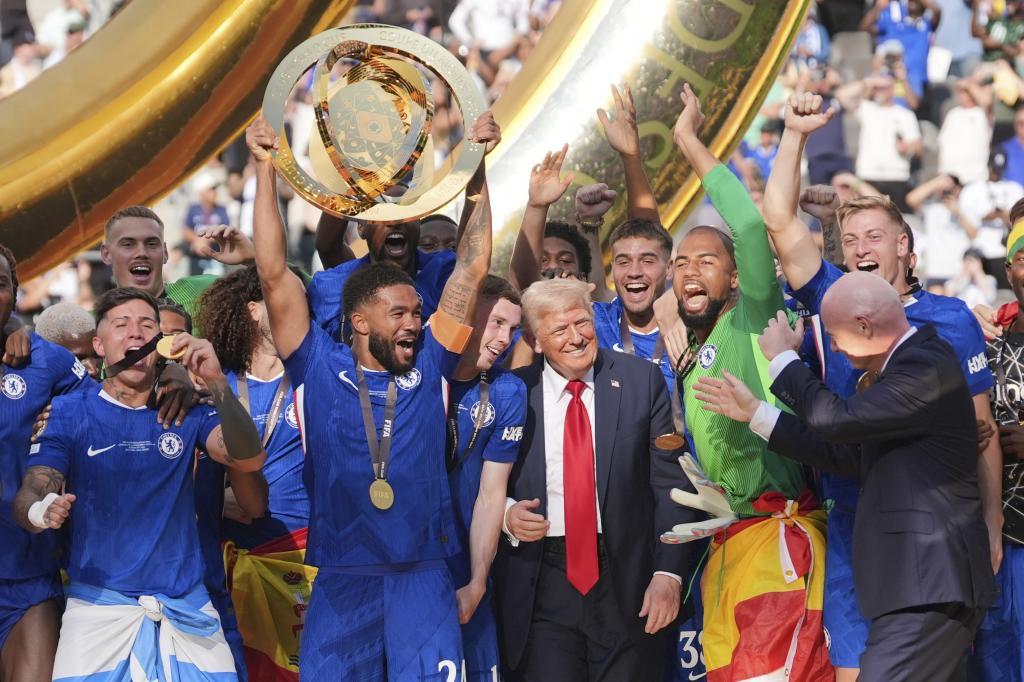
Trump at Chelsea's celebration in the Club World Cup.AP
The NATO pact over Greenland has put on hold the issue that had generated the most unity among European leaders against Trump's policies. If he continues with the intention of annexing Danish territory, voices calling for a boycott in Europe would increase. With Trump, nothing can be considered entirely settled, and it does not seem that soccer, something between unknown and grotesque for the White House tenant, will stop him.
The Soviet invasion of Afghanistan led to the U.S. and most Western countries boycotting the 1980 Moscow Olympics, and a racial issue - the violation of the apartheid embargo in South Africa by the New Zealand All Blacks - prompted most African countries to boycott the 1976 Montreal Olympics. While the U.S. has not invaded Venezuela, it effectively intervenes there, while threatening Iran or Cuba, and it is undeniable that racial issues underlie the strict immigration laws.
The 'yes' to Argentina under the colonels
Football boycotts have never had such a global impact. Not even when the torture allegations under the Argentine colonels' regime were evident, even before 1978. Many of these abuses occurred at the Navy Mechanics School, a short distance from River Plate's Monumental Stadium, where the national team became champions. Two months after General Pinochet's coup in Chile in 1973, the USSR refused to play a match at the National Stadium, which had become a center of detention, torture, and death in the days following the September 11 coup. The Chilean team took the field without an opponent, and their players scored on an empty goal.
Matt Freese will be in goal for the host team next summer in the United States, but for many participants and fans, Trump will be looming large over the World Cup. It will be like playing against the enemy.AP
Donald Trump does not share the same opinion as Carl von Clausewitz. He does not believe, like the Prussian military leader, that politics is the continuation of war by other means. On the contrary, long before exhausting the political route, he sends an aircraft carrier or the militarized agents of ICE, the U.S. Immigration and Customs Enforcement. Minneapolis and Iran are currently Trump's hot spots, not to mention the standoff with the European Union over Greenland, the situation in Venezuela, threats to Mexico and Colombia over drug trafficking, or the multiple trade wars. Tomorrow, no one knows.
This context has turned Trump into an enemy of various countries and regimes, democracies or dictatorships, months before welcoming them with a smile at the World Cup festivities. The problem may be that others understand that football can also be the continuation of war or politics by other means.
International tensions always cause concern for major sports organizations, mainly the IOC and FIFA, who fear a return to the era of boycotts. The threat has affected the Olympic movement more significantly because football is the food of the masses, and the masses are feared. However, there are precedents.
FIFA tries to pamper Trump as much as possible, as evidenced by the Peace Award, a chocolate Nobel Prize, given to him by Gianni Infantino as if it were an Easter egg. Nevertheless, concerns persist, both regarding the World Cup and the 2028 Los Angeles Olympics, as he is a character outside of the norm and control, even for his own hawks.
Calls for a boycott of the World Cup have already emerged worldwide, especially among human rights organizations, due to the persecution and expulsion of immigrants, but not from any government. Not even from those with the most tensions with the U.S. president's policies, such as Colombia, or those who have been targeted, like Iran. Both countries are qualified for the World Cup.
Germany is one of the powers where voices against the tournament have been loudest, even forcing the State Minister at the Federal Chancellery, Christiane Schelderlein, to state that decisions on participating in sporting events "fall exclusively to the corresponding federations." Sports law competencies are a convenient refuge for what suits, although the decisions for Spain not to attend the 1960 Euro Cup final in the USSR or for the U.S. to boycott the 1980 Moscow Olympics were not made by their federations or Olympic committees. They were made by Franco and Jimmy Carter, a dictator and a legitimately elected president.
"If Trump fulfills his threats and launches a trade war against the European Union, I can hardly imagine that European countries will participate in the World Cup," warned Roderich Kiesewetter, a key figure in foreign policy for the Christian Democratic Union (CDU), the leading party in the coalition government. Boris Mijatovic, also a member of the Bundestag for the Greens, was even more emphatic: "It is not safe for fans to travel to this World Cup."
Mijatovic cited the recent lethal shootings by ICE agents in Minnesota, even before Alex Pretti was killed, and warned: "I can only advise every fan to boycott the matches in the United States." The silence of the government of Pedro Sánchez is striking, one of the most vocal critics of Trump, despite having the tournament's favorite team. The World Cup is not Eurovision.
While a global or bloc-wide boycott may seem complex, fans boycotting a tournament shared by three countries - the United States, Mexico, and Canada - with ongoing tensions over immigration, drug trafficking, and tariffs, is less so. The borders that should be porous in a three-country World Cup are more sensitive than ever.
Trump at Chelsea's celebration in the Club World Cup.AP
The NATO pact over Greenland has put on hold the issue that had generated the most unity among European leaders against Trump's policies. If he continues with the intention of annexing Danish territory, voices calling for a boycott in Europe would increase. With Trump, nothing can be considered entirely settled, and it does not seem that soccer, something between unknown and grotesque for the White House tenant, will stop him.
The Soviet invasion of Afghanistan led to the U.S. and most Western countries boycotting the 1980 Moscow Olympics, and a racial issue - the violation of the apartheid embargo in South Africa by the New Zealand All Blacks - prompted most African countries to boycott the 1976 Montreal Olympics. While the U.S. has not invaded Venezuela, it effectively intervenes there, while threatening Iran or Cuba, and it is undeniable that racial issues underlie the strict immigration laws.
The 'yes' to Argentina under the colonels
Football boycotts have never had such a global impact. Not even when the torture allegations under the Argentine colonels' regime were evident, even before 1978. Many of these abuses occurred at the Navy Mechanics School, a short distance from River Plate's Monumental Stadium, where the national team became champions. Two months after General Pinochet's coup in Chile in 1973, the USSR refused to play a match at the National Stadium, which had become a center of detention, torture, and death in the days following the September 11 coup. The Chilean team took the field without an opponent, and their players scored on an empty goal.
Matt Freese will be in goal for the host team next summer in the United States, but for many participants and fans, Trump will be looming large over the World Cup. It will be like playing against the enemy.