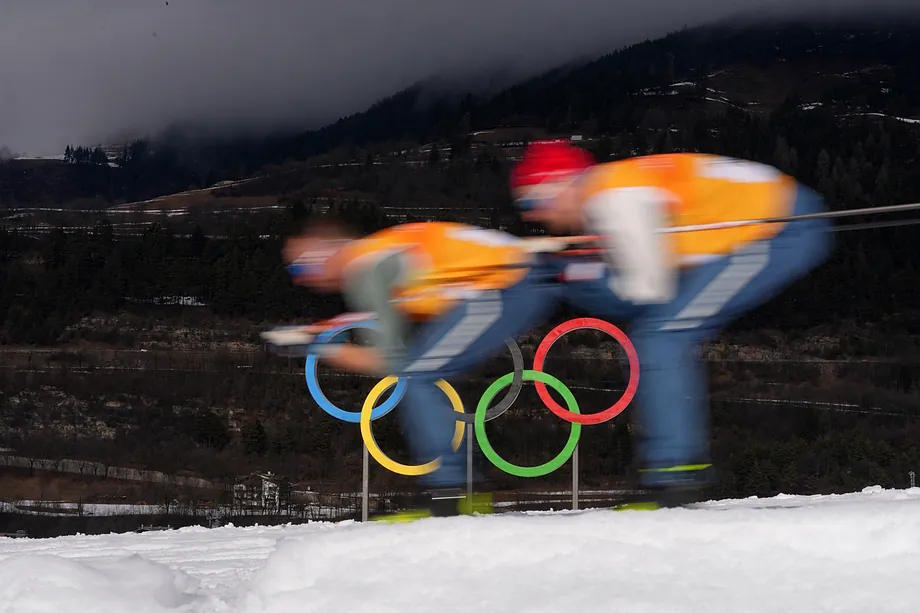
Friday of warm passion in the cold northern Italy. The white curtain rises on the 2026 Winter Olympics in Milan-Cortina d'Ampezzo and other venues in the Dolomites. The first for the new president of the International Olympic Committee, Kirsty Coventry. The second of the 21st century held in Italy, after Turin 2006. They would be the third in Cortina if the 1944 Games had not been canceled due to World War II.
The city recovered them in 1956 in one of the hottest moments of the Cold War. Sport, also recruited to fight it, was at the same time required to promote international harmony. That year the European Cup of football was created. The Games will close on the 22nd in Verona. Two cauldrons have been set up. One at the Arco della Pace in Milan and another at Piazza Dibona in Cortina, inspired by "The six knots of Da Vinci," a series of intricate and intertwined geometric engravings symbolizing the order underlying chaos. A metaphor for the functioning of the world, where, however, chaos often lies beneath order.
The opening ceremony, at the San Siro stadium, viewed "in situ" or on television by an audience estimated at around 2.2 billion people, will kick off 19 days of competition with 2,800 participants (47% women) from 90 countries vying for 116 medals in 16 sports. Eight of them are new. Some of questionable justification. Many days of continuous activity need to be filled, and everything related to snow and ice is used, even if it needs to be stretched and squeezed. And that's not all. There is even talk that in the future, cross-country and cyclocross could be included in the program.
In the realm of political order and chaos, which sports try to enjoy by either participating in one or avoiding the other as much as possible, Cortina rescues the Games for the cause of democracy after the ones held in Beijing 2022. The previous cycle, in fact, repeated this alternation: after Russia (Sochi 2014), South Korea followed (Pyeongchang 2018). New demonstrations that Sport, let's capitalize it, is not very scrupulous when it comes to whitewashing dictatorial regimes.
Russia, a major power that devalues many current medals in any event, had to be expelled from Paradise after State doping was an unsustainable and unforgivable shame and scandal. And to top it off, its exclusion was finalized after the attack on Ukraine. On the 24th of this month, when the Games are just an echo, four years will have passed since then, a pain that does not fade and a wound that bleeds every day.
Nevertheless, the International Olympic Committee (IOC) recently recommended to International Federations to allow Russian teams to participate in non-professional competitions. And Gianni Infantino advocates for Russia's reintegration into the common house, starting with football and its youth categories, because "the ban has served no purpose." What serves less and less is ethics, subordinated to power and money. Or to the power of money. Or money in power. There is no room for half measures in this matter. Either all Russians or none. "That is the question." Many vote for none.
Infantino, a cunning merchant, dines at the table of Donald Trump, a visceral businessman, both united by this summer's World Cup. Whether one likes it or not, Sport (we maintain the capitalization) is "the continuation of politics by other means." Another conflict, albeit bloodless. Virtual. Giorgia Meloni knows this and will meet with J.D. Vance, Vice President of the United States, who is in Milan. In a place where only hawks nest, Vance is part of Trump's closest and toughest circle, along with Secretary of State Marco Rubio and Defense Secretary Pete Hegseth. In the Trumpian horizon, the Summer Olympics in Los Angeles in 2028 loom. The Winter Olympics in 2034, awarded to the state of Utah (Salt Lake City), are for now too far off.
Amid the controversy, Trump has sent a contingent of the infamous ICE (Immigration and Customs Enforcement) as additional protection for the U.S. delegation. In other words, the Immigration and Customs Enforcement Service. The acronym of the unit being ICE, "ice" in English, offers a certain ironic coherence in a Winter Games.
Milan-Cortina will showcase some of the greatest athletes of all time in some specialties. In alpine skiing, the Games' king, Mikaela Shiffrin (USA, 30 years old) and Marco Odermatt (Switzerland, 28). Shiffrin has 108 victories in the World Cup, a number that, if surpassed someday, has not been born yet. Odermatt has 52. He is only surpassed by "monsters" like Ingemar Stenmark (86), Marcel Hirscher (67), and Hermann Maier (54). But behind him are Alberto Tomba (50) and Marc Girardelli (46). Among the Swiss, only Vreni Schneider (55) surpasses him by a short time. But no male compatriot comes close. Pirmin Zurbriggen, the national idol, stopped at 40.
Cortina awaited with supreme anticipation and maximum applause for Lindsey Vonn (USA), the blonde goddess of speed, adorned with 84 victories between downhill and super-G. And distinguished this season with two victories, two second places, and two thirds at the "impossible" age of 41 years and with a titanium prosthesis in her right knee, as well as other "patches and darns." Just a few days before the Games, she tore her left cruciate ligament in Crans Montana. Even so, to the world's surprise and admiration, she has decided to compete (pending Friday's training) in a daring gesture, bordering on heroism and leaning towards sacrifice.
Figure skating, one of the greatest historical attractions of the Games, has revealed, amazed, Ilia Malinin, American, 24 years old, already a double world champion, son of two Uzbek skaters who represented their country in the 1998 and 2002 Games, who emigrated as teachers to Virginia. He has achieved the highest scores ever recorded in the free program and can execute seven quadruples per session. Perhaps he will dare to attempt the first quintuple in history.
In other traditionally important disciplines, snowboarding and cross-country skiing, shine, respectively, Domen Prevc (Slovenia) and Johannes Hosflot Klaebo (Norway). The 26-year-old Slovenian is a member of a family of five brothers, four of whom compete or have competed, led by the eldest brother, now retired, Peter. Followed by a younger sister, Nika. All, top stars of the ski jump. The Norwegian, with five Olympic golds, one silver, and one bronze, has accumulated over 100 victories in the World Cup.
He is one of the most illustrious representatives of a country of five and a half million inhabitants where winter sports are a religion and leads the historical medal table of the Games with 148 golds, 134 silvers, and 124 bronzes.