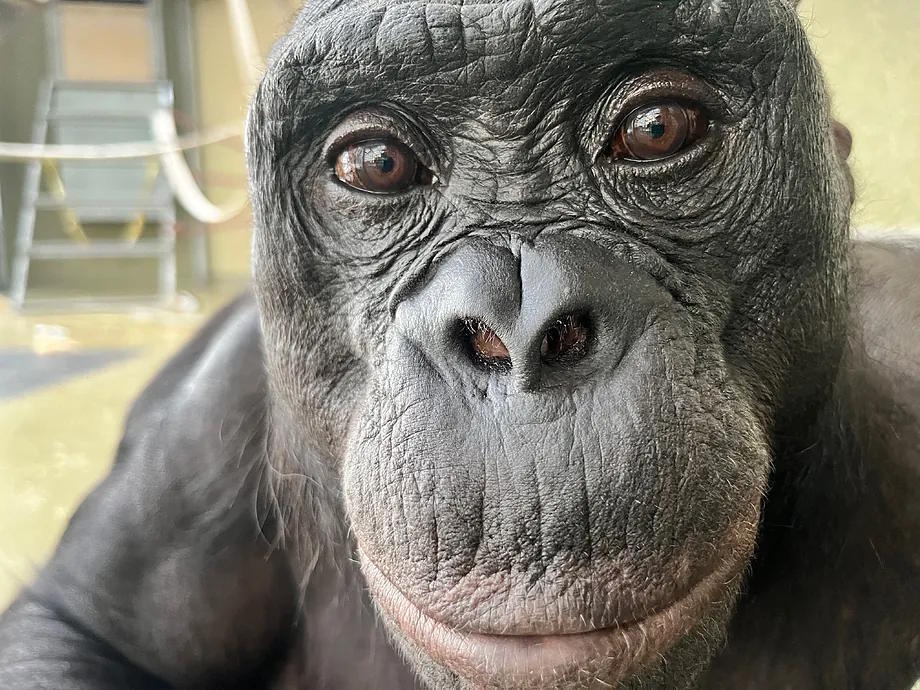
Sometimes, science doesn't advance with giant machines or space probes, but with an almost domestic scene: a table, a couple of transparent cups, and a primate seemingly tracking the movement of a non-existent juice. This is the starting point of a study conducted by researchers at Johns Hopkins University in the US, which poses an uncomfortable idea for our species' pride: the ability to manipulate imaginary objects, as in play kitchens - the basis of symbolic play and a significant part of imagination - seems to not be exclusively human.
The study, published in the journal Science, focused on Kanzi, a bonobo raised in a human environment and accustomed to interacting with researchers through signals and responses to verbal cues. The choice of the animal was not random, as in comparative cognition there is a clear boundary: distinguishing whether a behavior similar to ours reflects the same type of mental representation or can be explained by associative learning, trained routines, or unnoticed cues from the experimenter.
Therefore, the authors designed three controlled tests with a very specific goal: to verify if this bonobo - who passed away last year at the age of 45 - followed the continuity of an imaginary object when it moved, was 'poured,' or 'emptied' (always within the fiction of the game).
The tasks resemble a children's snack time with jars, bowls, and empty glasses. In the first condition, the experimenter simulates pouring juice into two transparent glasses and then pretends to empty one (with an explicit gesture of leaving it empty). The question is straightforward: "Where is the juice?" If the animal responded randomly or simply followed the most striking movement, it would fail when positions are switched or the procedure is repeated. However, what the study emphasizes is that, consistently, the bonobo indicated the correct glass: the one that, within the invented world of the experiment, still contained liquid.
An interesting nuance comes into play here. Juan Carlos Gómez, a psychologist and researcher at the Department of Psychology and Neuroscience at the University of St. Andrews, Scotland, considers it to be "an excellent experiment," with a "simple but very original" task to experimentally explore a topic that has received little attention in great apes, as he explained to the Science Media Centre (SMC). However, he also points out the typical "but": even with controls, there is always room for other explanations. In his view, Kanzi could have learned a practical rule of the type "point to the glass that, by process of elimination, is the only one that could contain something," rather than understanding the human's intention. Nevertheless, he adds, the study's interest lies in opening a paradigm to replicate it with more individuals and species, refining controls.
The second test aims to reinforce the interpretation of human similarity. Scientists introduce a glass with real juice alongside another with imaginary juice. When asked what he wants, Kanzi almost always points to the real liquid. In other words: he distinguishes between what is physically usable and what only functions within the framework of the game. This is important because, in humans, much of pretending relies on maintaining two levels simultaneously: "this is an empty container" and, at the same time, "in the game, there is liquid here."
The third condition repeats the logic, but with imaginary grapes: the experimenter pretends to take one from an empty container, places it imaginarily in one of two jars, and then empties one of the containers. Again, the question is "where is the grape?" and, again, the bonobo tends to locate the jar that 'holds' it in the experiment's narrative, beyond what would be expected by chance.
From an external perspective, Antonio J. Osuna Mascaró, an animal cognition specialist at the Messerli Research Institute at the University of Veterinary Medicine in Vienna, highlights to the SMC that the study provides "one of the clearest experimental evidences to date of secondary representations" in another species: not only does it respond to present stimuli, but it maintains an invented second reality and updates it as the human's actions change. Osuna also mentions figures: performing below 70% in such tasks does not necessarily indicate weakness; it is compatible with distractions, attentional variability, and the noise that creeps into social situations.
The key, he concludes, is that comparative imagination is difficult to study without tailored tests. Here, an exceptional subject is worked with, trained to communicate with humans, and in a scenario far removed from the natural challenges of a great ape. If one wants to know if these abilities are general, it will be necessary to invent tasks less anthropocentric and more adapted to each species.