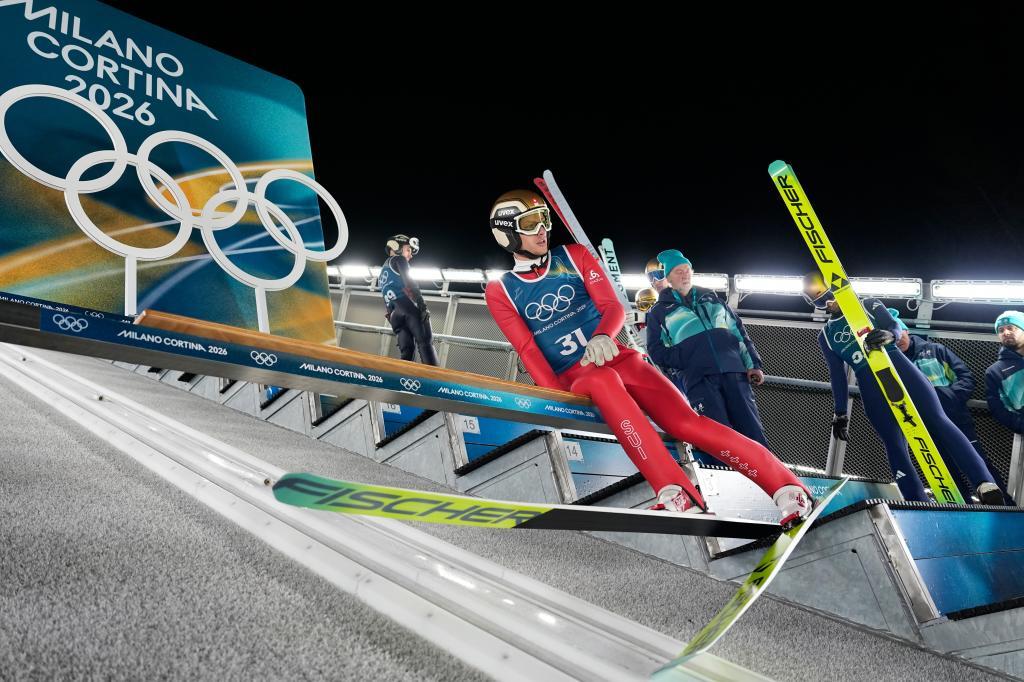
During the latest Ski Jumping World Cup tests, some specialists noticed a detail in Domen Prevec's suit, the recent winner of the Four Hills Tournament. The Slovenian's suit had a noticeable looseness in the crotch area, which inflated when he opened his skis during flight. To these suspicions, another rumor has now been added, which has clouded the beginning of the Olympic Games. In Milan-Cortina d'Ampezzo, the world's best jumpers may have resorted to a hyaluronic acid injection to increase the size of their penis, thus improving their results.
A larger male member represents a significant advantage during checks by the International Ski Federation (FIS), which scans the jumpers' suits and bodies using 3D techniques. The larger the penis measurement, the jumper would receive a larger suit. And that looseness will be crucial in full flight, when the suit acts as a sail in the wind. According to a recent study in the Frontiers journal, a two-centimeter looseness would represent an improvement of 5.8 meters in jump length.
The controversy over hyaluronic acid escalated on Thursday, following a report in the German newspaper Bild. "Ski jumping is very popular in my country, so I promise to investigate this," stated Witold Banka, President of the World Anti-Doping Agency (WADA), hours later. Among the 50 entrants for the Milan-Cortina d'Ampezzo event are three Polish jumpers. One of them, Kamil Stoch, 38, has three Olympic gold medals, obtained in Sochi 2014 and Pyeongchang 2018.
"Our specialty has become very professional, and there are people who do crazy things, but I don't give too much credibility to the injections," comments Bernat Solà to EL MUNDO, a two-time Olympic ski jumper (Sarajevo 1984, Calgary 1988). "Just as some point to the crotch, it could also be done in the armpit area, where more width would be released in the suit. However, no one talks about that," explains the Barcelona jumper.
On January 15, two technicians and the head of equipment for the Norwegian team were suspended for 18 months after it was discovered that they had manipulated suits during the Trondheim World Championships. This scandal involved two Olympic medalists, Johann Andre Forfang and Marius Lindvik, now registered by their federation for the Milan-Cortina d'Ampezzo event.
"Once the suit was approved, the Norwegians would unstitch it and insert rods to stiffen it, so that it would maintain its shape better, with the air and all. This way, it didn't oscillate as much, it seemed more rigid," Solà analyzes. According to the Competition Equipment Specifications, approved by the FIS a few months ago, the suit's thickness "must not exceed six millimeters or be less than four millimeters." It also specifies that the fabric will consist of five layers: outer fabric, foam, elastic membrane, foam, and lining. The warp of the outer fabric consists of two threads: 81% polyamide and 19% elastane, the material commonly known as lycra.
Romanian Cacina prepares to jump on Thursday in Predazzo.AFP
The FIS text states that the suit components will be laminated together "through a thermofusion process." All to ensure a constant value in air permeability, set at 40 l/m²/s. A convoluted jargon that Solà sheds some light on: "No more liters of air can pass in front than behind the suit. If it were the other way around, the suit would inflate, with the consequent balloon effect that would provide a longer jump."
Despite appearing cutting-edge, controversies surrounding equipment in ski jumping date back decades. Ángel Joaniquet, an Olympic jumper with Spain at the Sarajevo Games, can attest to this. "During my early days in the World Cup, FIS already conducted tests in St. Moritz, where the season began. They would put a lead seal on the back of the suit, and without that rivet, you couldn't jump," he recalls for this newspaper.
"On one occasion, Colmar provided me with suits with a rubbery membrane, about a millimeter thick. It was sewn all along the side and back areas, not the arms. It made me jump 10 meters more than I should have," remembers Joaniquet, 63. During a competition in Slovenia, his progress was abruptly halted when the Italian brand demanded his garment back. "They returned the suit to me at night, and the membrane had completely disappeared," he reveals.
According to the current Measurement and Control Procedure Guidelines, approved last autumn by the FIS, jumpers' suits are measured by the outer surface. "It must be stretched and flat, without folds. The suit will be marked and measured at the selected point, and then the athlete will be marked and measured in the corresponding body position," the text clarifies. During crotch measurement, the feet should be 30 centimeters apart and the legs fully extended. "The measured crotch height must match the crotch height measured on women's bodies and +3 centimeters in the case of men," details the FIS.
To determine the most aerodynamic position, every detail must be taken care of, including the use of wind tunnels. Cameras are also used to carefully film the trajectory of each ski and accurately calculate the flight path or the jumper's body position. "Not all morphologies are the same, as there are taller and thinner jumpers. In any case, I would seriously doubt that they have gone to the extremes of penis injections," Solà points out.
Joaniquet extends these doubts to whether the increased surface area in the suit serves to gain an advantage in the jump. In his opinion, sometimes it can be "counterproductive." To support his argument, he uses a very basic example. "If I leave the trampoline table a bit late, my feet will drop down, so my perpendicular to the air intake will be a bit more vertical, meaning a larger suit will slow me down more. However, if I manage to leave very well and I am already flying above the first third of the flight, from that moment on, I start to descend and with more speed. That's where it can help," he concludes.