As I could see yesterday with a random glance through several social networks, I know you are all experts in the music and trajectory of Bad Bunny, so I hope not to waste your time or patience by briefly reminding you that it was not the first time the Puerto Rican singer performed at the Super Bowl halftime show. I wouldn't insist on it if I didn't believe it is really important to understand the main lesson his performance yesterday left us.
Surely you remember, as it has only been five years. Bad Bunny's first Super Bowl was in Miami on 2/2/2020, a unique date: it was a month before the lockdown, at the end of Donald Trump's first term. Shakira and Jennifer Lopez, Lopez without an accent, starred in the concert with the most viewers in the world in a super Latina alliance. That performance was presented as a summit for Hispanic culture, the certification of a Latin boom, with a "u." In addition to the two female stars, J. Balvin and Bad Bunny joined as guests, with a minute and a half each on screen.
Well, it turns out that on that day of great celebration of Latin music, hardly any Spanish words were heard. Shakira greeted with a "Hello, Miami" and then only sang a chorus in Spanish, something that Lopez without an accent didn't even do. Their performances were entirely in English. Oh.
Even Bad Bunny sang some verses in English, those from his collaboration in I Like It by Cardi B, the only time he has not sung in Spanish in his entire career. Perhaps it was then, five years ago, when Bad Bunny decided he would never betray his identity again.
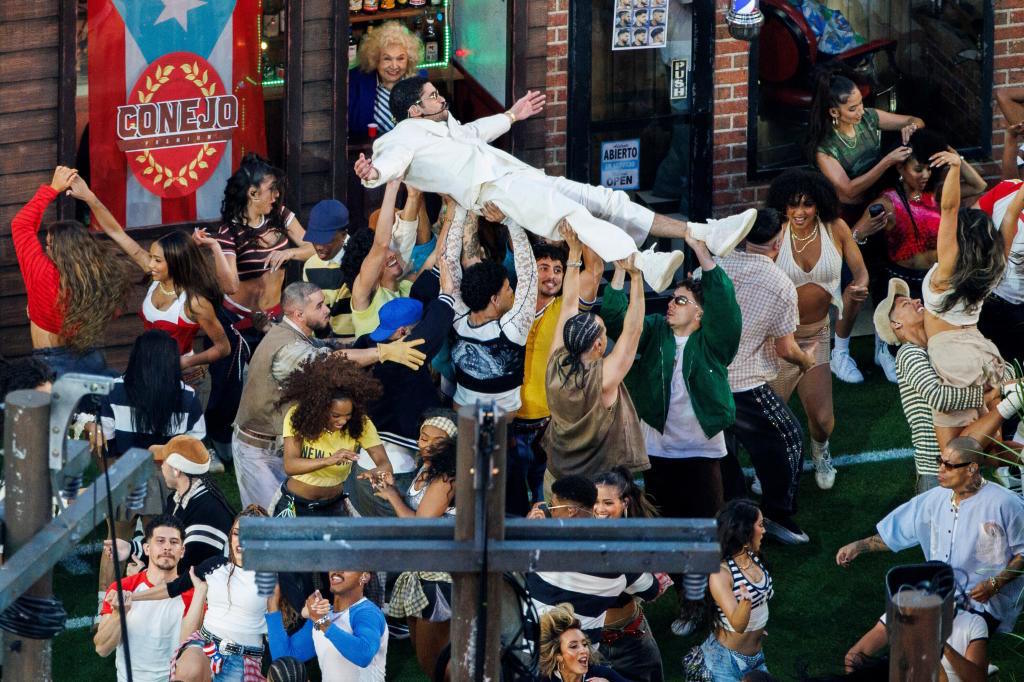
His performance yesterday at the Super Bowl left numerous anecdotes and great moments: the wedding, the child with the Grammy, the guests in the little house, the Zara clothing... And it had a purpose: to make a festive vindication of Latin culture. But the most important lesson of the show, which is the most important lesson of his entire career, something that transcends his condition as a Puerto Rican or Latino, was the importance of being true to oneself.
Bad Bunny strategically delivered several messages during the 13 minutes of his dizzying succession of songs, but at one point, he paused the frenzy and, alongside a beautiful ensemble of violins, looked directly at the camera and said his full name, Benito Antonio Martínez Ocasio, and stated with deep feeling: "If I'm here now, it's because I never, never stopped believing in myself. You should also believe in yourself, you are worth more than you think".
If there's something we can learn from Bad Bunny, it's to believe in ourselves. Not as a fairy tale American dream, but as a secure way to achieve dignity.
Bad Bunny does not betray himself, does not yield to what others expect or want from him. He has become one of the most listened to, influential, and creative stars in popular music and has not stopped reinforcing his identity not only as an artist but as a person at every step. This sensitive and intelligent man has never diluted or softened his music, he has not watered it down to please anyone, but has chipped away like a miner at his individuality and his roots, and that's why yesterday he could show himself to the world as a free and proud man, as a genuine and distinctive creator who represents a large community without offending anyone. Representation is a big word, it is important, that's why when it is intended to be done, it must be done with honesty and a certain purity.
Bad Bunny did not engage in the clash that Trump presented him with, but rather made a vindication without conflict. Unlike a protesting singer, his revolution is danced. "Welcome to the biggest party in the whole world," he announced at the beginning, and that was his political response: to be happy and want to love and celebrate, to show strength and resistance. "Dance, dance without fear. Love without fear," he said later, a brief phrase that may have gone unnoticed but is loaded with content for what it implies in terms of inclusivity and integration.
One of the most magnificent moments of his performance was therefore the exaltation of reggaeton and perreo, and even that was a vindication of Puerto Rico, where this music and dance originated and are now celebrated worldwide and will one day be protected as part of humanity's heritage. Dale, don, dale and Gasolina briefly played, and then a reggaeton disco erupted, adulterous, but unadulterated. "Women all over the world perreando without fear," Bad Bunny said then. Was he offering an adapted version for the Anglo-Saxon audience? Was it reggaeton lite for that potential audience of hundreds, thousands of millions of people? No. Bad Bunny with a heavy flow was representing himself and his truth. It was his clearest way of saying: this is me, I hope you like it, but if you don't, this is me.
Yes, gentlemen, it was a great lesson in dignity.
One important detail: Bad Bunny did not have to censor a single word of his lyrics. Why? Because, while explicit, there is nothing vulgar in them. When he sings about sex, and as you know as experts, Bad Bunny sings mostly about sex and love, he does so using his wit and the richness of language. The richness of the Spanish language.