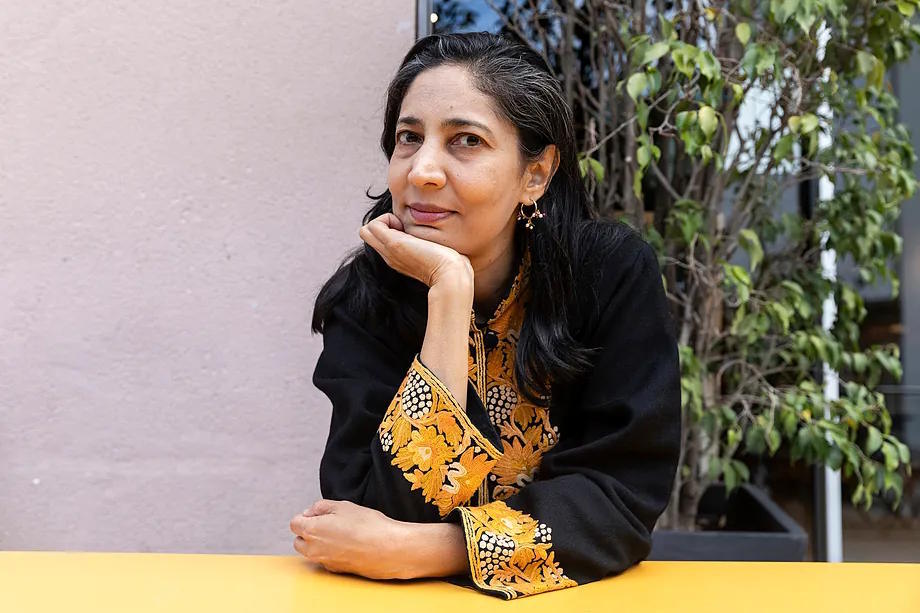
Just arrived in Barcelona, writer Kiran Desai (New Delhi, 1971) was strolling through Montjuïc mountain to visit some of the city's museums. She seemed like just another tourist, except she is one of the best novelists in Anglo-Saxon literature and is in Spain to present her new and highly anticipated novel, which took almost 20 years to write since winning the prestigious Booker Prize in 2006: the monumental The Solitude of Sonia and Sunny (Salamandra), over 700 pages, chosen as one of the top 10 titles of 2025 by The New York Times.
During her walk in Montjuïc Park, on a sunny Saturday so different from the sub-zero temperatures of New York, the city where she has lived for decades, her wandering led her to the Mies van der Rohe Pavilion, the temple of modern architecture built for the 1929 International Exhibition. There, she experienced an unexpected shock when she saw the sculpture Dawn by Georg Kolbe, located at one end of the pond and reflecting in the water, marbles, and glass. It wasn't a Stendhal syndrome, despite the ideal beauty of that goddess-like woman embodying the dawn, rather an almost meta-literary scene that could pass as fiction in one of her novels.
"My grandfather came from a family of communist revolutionaries who in the 1920s fought for India's freedom against the British. That's why they sent him to study engineering in Germany, instead of the UK. One day, an artist stopped him on the street and asked if he could sculpt his face. He made a bust and a Torso of a Young Indian. And they became friends. That sculptor was Kolbe, who also created those Aryan figures that the Nazis would end up praising...," explains Desai while sipping a cappuccino in the early morning. "It was amazing to see the connections. Because, oh, that Aryan woman actually seemed to have my grandfather's face... By the way, it was Kolbe who introduced him to my grandmother," she recounts about her family genealogy. After marriage, her grandparents sailed to India with a trunk full of books by Goethe, Schiller, and other German classics. "My mother grew up with a German, Bengali, English, and Hindi library, with translations and originals. She always says she had a European eye from my mother's side [who was German] and an Indian one from her father. I grew up with that and that magnificent library," she confesses about her mother, writer Anita Desai, who is now 88 years old and with whom she speaks daily.
"No matter what Donald Trump says, the world has no center"
"My mother is an extraordinary woman. She had the ambition to be a writer but there was nothing in her environment to support that dream. She wrote about India from a very honest perspective, that of the middle class. There is nothing orientalizing or fantastical in her work, something that not many people did at that time. Not even now...," Desai opines at the CCCB, where she leads a talk titled A World Without a Center. "No matter what Donald Trump says, the world has no center," she asserts. It's not irony. Especially coming from someone who grew up in Delhi, emigrated to the UK as a teenager with her family, and then studied Literature at the University of Vermont in the United States, where she forged her literary career.
Her protagonist, Sonia, also follows that trajectory: a young Indian aspiring writer who supposedly lives the American dream, in a Vermont with freezing winters and where she feels terribly lonely, like in an Edward Hopper painting. "In India, you are never physically alone, you are always surrounded by people. It's a huge cultural shock when you arrive in the US. Today, we are experiencing a real crisis of loneliness in the Western world, we are increasingly isolated," Desai points out, who in The Solitude of Sonia and Sunny has crafted a contemporary fable of a fading India, a love story in a globalized world.
"India has changed drastically since my childhood days. I wrote this book, set somewhat in the past, to try to capture something that was disappearing and that the younger generation doesn't even know because they haven't experienced it. I'm referring to the generation born in British India, who fought for the country's independence, who had a kind of pride and idealism, a strong belief in a secular democracy that is now unraveling. And that is very dangerous," she explains in reference to the recent years of the authoritarian and nationalist regime of Narendra Modi, precisely those not covered in her book.
Far from taking a break after this magnum opus, a modern epic spanning different generations, Desai is already thinking about her next story. "I want to write about this rise of nationalism. What interests me is: when do people start speaking differently? Nodding and thinking differently? Because suddenly, the conversations in living rooms have changed," she hints.
Is this something that also happens in the United States? "People are scared. I live in an immigrant neighborhood and you can smell fear through the window. The rhetoric is so violent... We all know that no document saves you, even if you have your passport, your visa, or are a naturalized citizen. There is a dehumanization of immigrants and a growing anti-Indian racism from the MAGA Republicans, which, I believe, is due to the large expansion of the Indian community and their holding of skilled positions and white-collar jobs, owning good homes and salaries, which triggers strong resentment," she sighs. She finds her refuge in writing, as an act of resistance and connection between generations and borders. Like a sculpture by Kolbe.