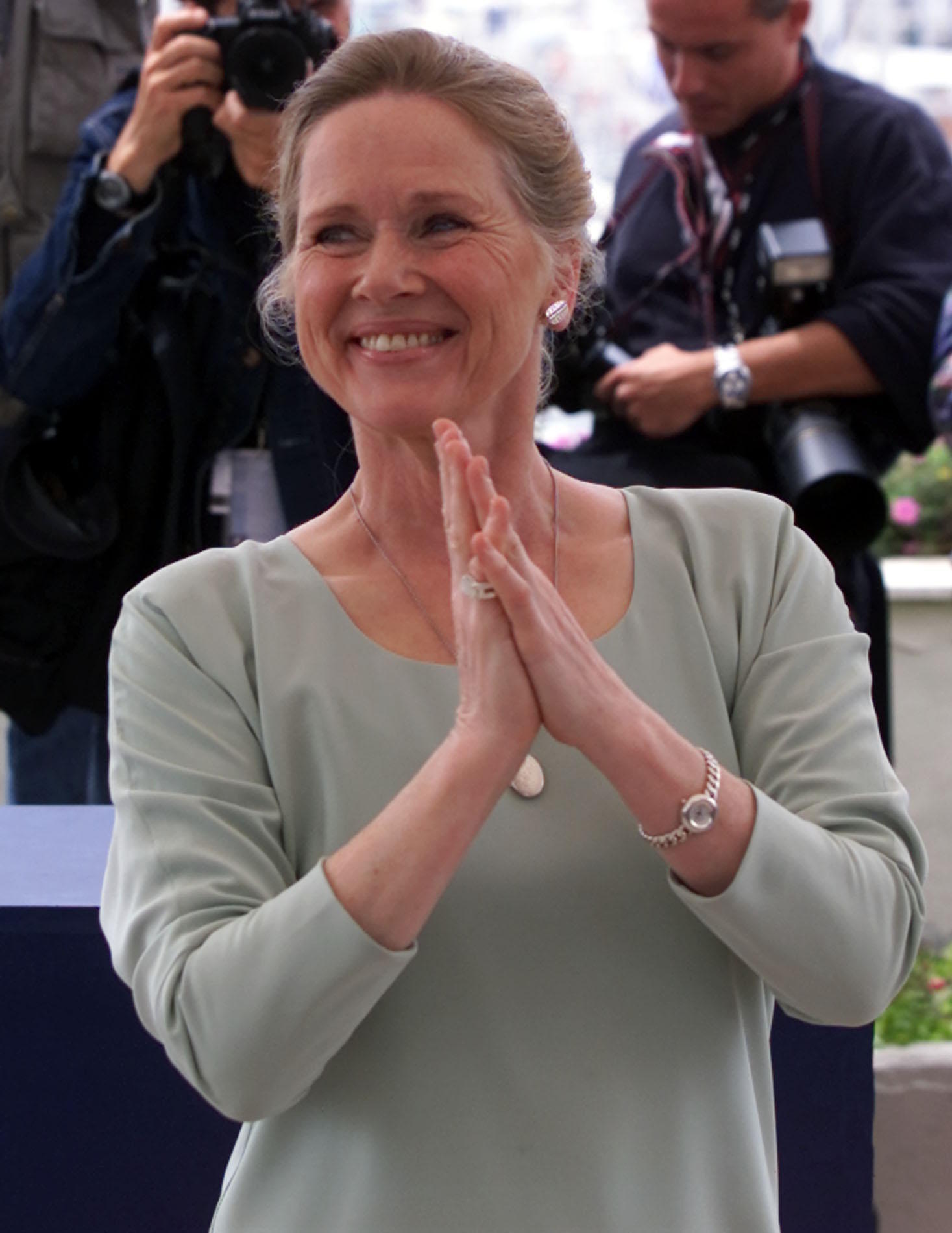
The door opens and on the other side appears a huge wooden table that dwarfs this hotel room. And in front of it, standing, a petite figure with bright blue eyes and deep wrinkles. "Nice to have you here, I'm Liv," she says, extending her hand. And indeed, there is no deception in that greeting. It is her, in the flesh, delicately shaking the hand of the person entering the room. And she is Liv Ullmann, one of the most undisputed myths of European cinema.
Just hours after the Norwegian actress, director, and writer landed in Berlin, she will be on stage to receive the Honorary Award of European Cinema at a gala that will crown the Danish Joachim Trier and Valor sentimental, his very Bergmanesque exploration of family relationships. As if a cosmic conjunction had caused the muse of Ingmar Bergman's most recognized films and one of the most renowned heirs that the present has given of the Swedish filmmaker to converge in the same space and time. As if their own universe had opened up and both had ended up there in the center without really knowing how.
For years, Liv Ullmann, born in Tokyo in 1938 due to her father's work, has been immersed in a kind of recognition tour at film festivals and award galas around the world. A well-deserved recognition for one of the greatest stars that Europe shared with Hollywood in the 1970s. In 2007, she received the Donostia Award at the San Sebastian Film Festival; in 2022, the Honorary Oscar after two nominations as an actress and no statuette, and now, the European Film Academy Award on the continent where she truly became a legend. But there is something about that term that doesn't quite fit with her. Or that she simply refuses to accept as definitive. "I have never believed it, and I know everyone hopes that one day I will believe it. I'm not being modest, it's just that I really don't think I'm a legend. I am very flattered when people are surprised, but I just don't think it's true," she responds without losing her smile or conviction.
But reality insists on contradicting Liv Ullmann no matter how determined she is. Just take a look at the actress's career, cut almost entirely since 2014 when she directed and adapted Strindberg's Miss Julie, to easily find a few masterpieces. Of course, a large part of the nine films she starred in with her partner, Ingmar Bergman: from Persona to Cries and Whispers, through Autumn Sonata and, of course, Scenes from a Marriage. Not to mention her two collaborations with Jan Troell -The Emigrants and The New Land- or Richard Attenborough -A Bridge Too Far-. "I couldn't do all that now, my time has come. But I look at it with excitement because we are all Europeans and we know how important it is to be together and fighting. Not fighting in a bad sense, but we are at a moment where we need to see movies that make us change our minds because the world is in a place we have never seen before. Even a Nobel Prize winner has gone to give it to Trump."
Liv Ullmann sprinkles this conversation with memories that shape a life, to which she herself arrives by jumping from question to question. At one point, in the middle of a dissertation on the importance of activism, she recalls a trip to Cambodia with a humanitarian organization where she coincided with the Dalai Lama and recounts how they were caught in a shootout on the border with Vietnam. "We stayed there and sang We Shall Overcome; that's when I started to experience the real world for three days while we were walking and talking."
She also recalls filming We Hope That It's a Girl under the blue sky of Italy under the direction of Mario Monicelli. Or how she had to dance and sing, not knowing she could, for the musical Lost Horizon. "I think I don't regret anything in my life, maybe I could say about Lost Horizon, but not really. Because now I can look back, laugh, and besides, it was the gateway to something very important in my life. I can't regret anything, I'm proud of everything that has happened to me so far."
And, in that exercise of memory, Liv Ullmann reaches her current 87 years, where the intense blue of her gaze still persists. Sitting in this chair, talking about her artistic and personal life. Standing on a stage to receive an honorary award and deliver a speech against the wars that are happening in the world. Or simply comfortable in her home. "Now that I am 87 years old, what I like is to be alone in my apartment. I already liked it when I moved to the United States 50 years ago, I have always liked being alone," the actress explains. And she continues to delve deeper, after a brief pause, into that thought: "I can be alone because I still feel like a child, inside I am 14 years old, and I can approach to see the photographs and say 'Hello, Mom, I'm starting to understand it'. I just do what I could have done when I was younger. I have a familiarity with the people who have been part of my life, I remember many things, and I still have many friends from the United States and Norway. It's just that most of the people I was with are now part... how to say it? Of the universe. I don't believe we will be reborn or anything, but I do believe that those people are part of something. That's why when I talk to Mom, it's not childish. It's just me, and I can do it, it doesn't matter. Now I understand her much better. And then there are people I have forgotten. Maybe it's a good time to be older."
The night before this conversation, Ullmann was able to see herself younger precisely, not only in her imagination but in a screening of selected scenes from Scenes from a Marriage at a cinema in Berlin. "There I saw myself young, I was 35 years old, and I have already lived more than double that," the actress jokes, letting out a slight giggle just at the thought of it. "I could have suggested other movies, but I am very happy to see myself in that one. I can say that it's not my story with Ingmar Bergman, but it's very important that someone at that time wanted to make a film about unhappy relationships. And, although I think it's a very sad movie, it's wonderful because it gives a feminist view of how women feel free. But seen from now, it's also for men. I regret not being able to tell Erland Josephson [the actor who plays her husband in the movie]."
To say goodbye, Liv Ullmann stands in front of the huge table again. She offers her extended hand once more. And she repeats a phrase that will not be the last time she says it throughout the day. But she intones it as if it were. "I hope we see each other again soon."