Rome is enjoyed with every breath, whether it's the first, fifth, or tenth time visiting. There is no city in the world that guarantees the "wow!" effect like Rome does. Its boundless magic, hence why it's also known as the Eternal City, now somewhat saturated by the vast number of tourists visiting, is wonderfully appreciated from any of the viewpoints surrounding it. Starting from Castel Sant'Angelo, a circular building on the banks of the Tiber River designed to house the mausoleum of Emperor Hadrian. From here, one can witness one of the city's most special sunsets.
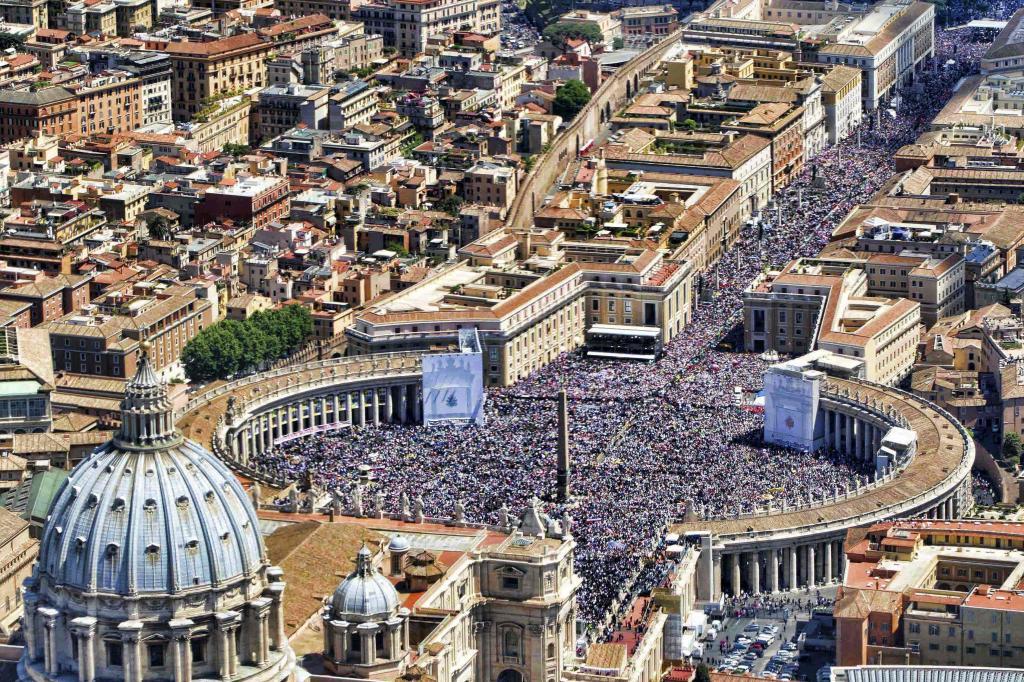
Remember that Rome is built on seven hills, providing various points to admire it in all its splendor. Throughout the centuries, this castle has served as a fortress, prison, papal refuge, and museum. Inside, it houses artworks, paintings, weapons, and Roman elements integrated into it, such as the ramp of Alexander VI leading to the interior. If it's time to sit down for a meal in the area, head to Alfredo e Ada, a small Italian restaurant with just five tables that retains all its charm and where you will undoubtedly enjoy one of the best meals of the trip. From here, we head to St. Peter's Square, with its elliptical shape and 284 Doric columns that Bernini intended to evoke an embrace; atop the colonnade, 140 statues of saints watch over pilgrims and visitors.
Facing it, the basilica, considered the most beautiful church in Christendom. The dome looms imposingly, but it's almost more impressive when viewed from the inside. Its over 136 meters from the ground to its apex give it the title of the tallest in the world. Designed by Michelangelo, who took on the project in 1547 at the age of 72, although other artists such as Bramante, Raphael, Giacomo della Porta, and Bernini, among others, also worked on its construction. It was completed in 1590. Michelangelo's Pieta, Bernini's Chair of St. Peter, and Pietro da Cortona's Trinity are three of the treasures it houses, although it's Bernini's baroque baldachin in the center of the church that captures the most attention.
We continue towards the Vatican Museums —buy the ticket in advance—, which house one of the largest art collections in the world and deserve at least a couple of hours, depending on what you want to see. Certainly, the Sistine Chapel must be part of the tour. The vault was painted by Michelangelo at the request of Pope Julius II between 1508 and 1512. The artist said, "Perfection is no small thing, but it is made up of small things"; by contemplating his frescoes, one understands the meaning of these words. The dimensions, the location, and the fact that he alone painted the nine panels, representing the creation of the world according to the Catholic Church, place it in the category of a feat. The Creation of Adam is the most famous image in the work.
Rome invites strolling, getting lost without a plan because there will always be a surprise along the way. Founded by Romulus and Remus in 753 BC according to legend, the city boasts no less than 13 sites named World Heritage in its historic center. And there are rituals that are part of the journey, such as tossing a coin into the Trevi Fountain, a work by Bernini that Anita Ekberg and Marcello Mastroianni made a worldwide icon in Federico Fellini's La Dolce Vita (1960).
What few tourists know is that over a million euros are collected annually, money that is allocated to charitable works and social projects. Legend has it that whoever tosses a coin will return to Rome; those who throw two will find love, and those who throw three will get divorced. Early in the morning is the best time to go, although it will always be crowded.
There are tempting ice cream parlors around it to make a stop along the way; it's a shame that you can no longer have a macchiato at Café Grecco, the oldest in Rome, as it closed a few months ago due to disagreements with the owners who wanted to significantly raise the rent. A short distance away is the Quirinal Palace (residence of the President of the Republic), although the more pleasant route leads to Via del Corso, one of the city's most famous streets. Upon reaching Piazza Colonna, take Largo Chigi towards Via del Tritone and then Via Due Macelli. Our destination, which is no more than a 15-minute walk, is the Spanish Steps and its famous Trinità dei Monti staircase. It's impossible not to remember Audrey Hepburn in Roman Holiday. From here, take Via Condotti, a commercial street of luxury brands, and continue walking before the sun sets.
Rome boasts over 900 churches (Santa Maria Maggiore, San Pietro in Vincoli, Santa Maria in Trastevere...) and 26 Caravaggio works spread across religious temples, museums, and private collections. In the church of San Luigi dei Francesi, we find The Calling of Saint Matthew, a summary of the apostle's life in three episodes: The Calling, Saint Matthew and the Angel, and The Martyrdom of Saint Matthew. A marvel. A short distance away is one of the liveliest baroque squares in the city, Piazza Navona, which was once a stadium where athletics and gymnastics competitions were held. Its oval shape is now filled with charming restaurants and cafes. In the center, Bernini and Borromini's three fountains, two masters who had their ups and downs in the project.
When it comes to choosing a table, the options are endless, although there are addresses that are always worth considering. Pizzeria Da Baffetto is one of the historic ones. It's one of the historic pizzerias, and its pizzas are top-notch. Its cozy and somewhat decadent establishment invites you to sit at its tables and admire the photos of the countless celebrities who have visited while they prepare a Fiori di Zucca pizza in front of you. Take advantage of being in the area to walk and explore charming streets and shops —Bialetti stores are a temptation for coffee lovers— until you reach the Pantheon, one of Rome's most important monuments, a temple built over 2,000 years ago. Its perfect dome still has a hypnotic effect on visitors. Make time to not miss seeing Campo dei Fiori (Field of Flowers), a lively square with its daytime stalls and terraces as the sun sets.
If there's one thing to consider when traveling to Rome, it's the location of the hotel. The NH Collection Fori Imperiali is a 42-room boutique five-star hotel located a few meters from the Roman Forum, another must-see on our trip. Just for the sunset it offers from its Rooftop Cocktail Bar, the stay is worthwhile; it also has a good gastronomic offer —Oro Bistrot by Natale Giunta is its restaurant—.
There are organized tours for the Colosseum and the Roman Forum, to which you can also add the Palatine Hill. The former, perhaps the city's most iconic monument, became the largest Roman amphitheater, with an elliptical structure of 188 meters in length, 156 meters in width, and 57 meters in height. Exploring it is like stepping back in time. There's much of Rome to discover and few lines left to do so. The fame of the Trastevere neighborhood always falls short. Getting lost aimlessly in its alleys, dining in some of its typical restaurants, buying an original souvenir, and savoring a maritozzo (a typical Roman bun filled with cream) are part of the walk, which always feels too short.
The city's parks deserve a spot on the itinerary. We mention two: Villa Borghese and Villa Ada, although there are many more. Opting for a bike to explore the former is a good choice. The next visit to Rome, however, will be done on two wheels. With the element of surprise intact. While the day arrives, we content ourselves by buying some Vespa keychains to remember our getaway among gelatos, Caravaggios, rich history, and thin, crispy pizzas.
Practical Guide
How to get there. There are direct flights to various cities with Iberia, Air Europa, Ryanair, etc.
Where to stay. NH Collection Fori Imperiale (nhcollectionforiimperiali@nh-hotels.com). A boutique hotel with an excellent location near the Roman Colosseum. They offer restaurant reservations, excursions, and are pet-friendly. Their rooftop terrace is one of the hotel's highlights. Via di Santa Eufemia, 19.
Where to eat. Pizzeria Da Baffetto (Via del Governo Vecchio, 114). A city landmark where you can try thin-crust, crispy pizza. There's always a queue, but it's worth it. Central Market of Rome (www.mercatocentrale.com/rome). Countless stalls, with pasta as the star attraction at many of them. Highly recommended.
More information: on the Italian tourism website www.italia.it/es