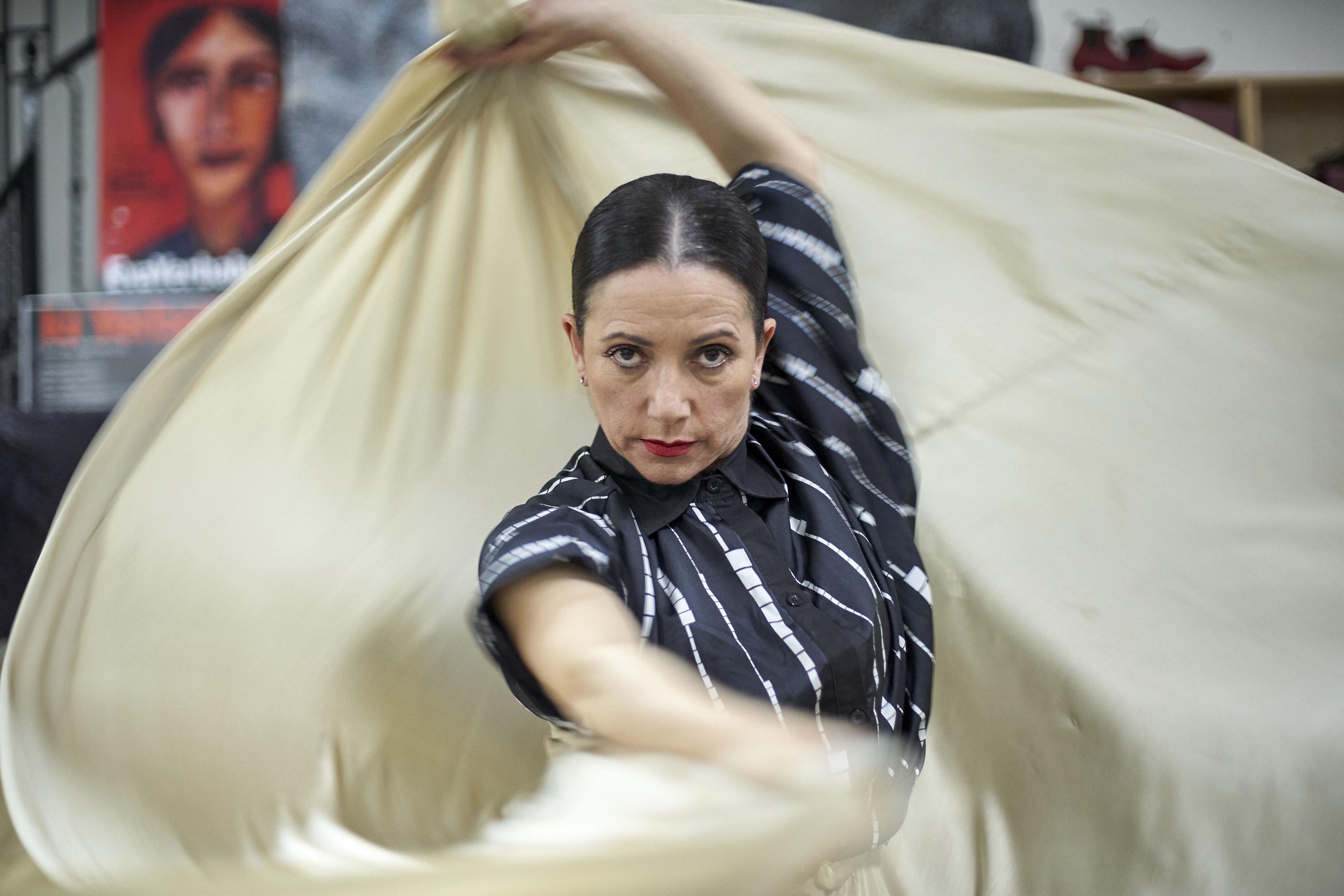
The doors of Tiffany's jewelry store on Fifth Avenue in New York have opened wide for Ángeles Toledano, the singer from the small town of Villanueva de la Reina in Jaén. She did not enter to buy any jewelry or to engrave a ring like Audrey Hepburn in Breakfast at Tiffany's, but to pose for EL MUNDO on the terrace of the building, next to the iconic bronze sculpture shaped like an apple by artist Claude Lalanne. And she does so just a few hours before her debut in the city of skyscrapers.
Ángeles Toledano, one of the most promising flamenco singers, apologizes for the little time she has for the photo shoot on the cold New York morning. After touring half the city in just two days, she finally rests at the hotel to arrive in full vocal form for her performance at the Roulette venue in the Brooklyn neighborhood, as part of the 25th edition of the Flamenco Festival of New York directed by Miguel Marín.
"This city is incredible. I am very excited," she says on the taxi ride from the hotel to the jewelry store. She has already debuted in the United States, and her first album, "Sangre sucia," was nominated for Best Flamenco Album at the Latin Grammys held in Las Vegas last November, where she paid a memorable tribute to Raphael. But she was missing the capital of skyscrapers, which she conquered shortly after this interview last Saturday. "We have visited flamenco associations and dance schools in several American cities, here people are eager to see us," she says, acknowledging the special respect that the city that never sleeps inspires.
Eva Yerbabuena showers praise on the New York audience. Facing the debutant singer, the dancer and choreographer is a veteran with awards such as the Olivier Award, the most prestigious in the performing arts in the UK, or the Gold Medal for Fine Arts Merit. "Those who stay to greet you at the end of the performance even say that it has changed their lives," she assures. "People come with fear of not understanding such a profound art, but they discover that it is not about understanding but about feeling. I have heard: 'From now on, I am addicted to flamenco.' For me, this is very important, it goes beyond the anecdote."
The dancer performed three shows on February 26 and 28 and March 1 at the NY City Center, one of the oldest and most prestigious theaters in the city, and participated in the Flamenco Gala, directed by Manuel Liñán, where they also danced, in addition to Liñán himself, El Farru and Juan Tomás de la Molía, with the guitars of Paco Jarana and Francisco Vinuesa.
Although Eva Yerbabuena feels her artistic maturity, she prefers to avoid talking about to whom she will one day pass the torch, the expression brings more negative connotations than positive ones to her mind. "When you are in this world, you are creating, researching, and constantly passing on the torch with all the things you do. It is not something for a specific day," she says. One of the most emotional and special moments Eva Yerbabuena experienced in New York was last year when, after finishing her performance at the City Center with the show Yerbagüena (dark brilliant), the Russian master Mikhail Baryshnikov came to her dressing room to congratulate her. "The possibility of personally meeting one of the great world dance stars, even being able to hug him, was wonderful," the artist confesses.
The legendary dancer, who has also dabbled in acting in several films and had a recurring role in the series Sex and the City, fully embraced flamenco in this edition of the festival. He did not quite tear his shirt in the middle of the flamenco party held at his center, the Baryshnikov Arts Center (BAC) in the Hell's Kitchen neighborhood of Manhattan, but almost. At 78 years old, the Russian master started dancing with Manuel Liñán and the rest of the artists at the end of the performance. Amid the flamenco explosion, he took off his jacket, a handkerchief, and a belt and handed them to the dancer Juan Tomás de la Molía. The next day, the artist tried to return the garments, but it had been a gift, his particular version of the gypsy shirt tear. Among the fortunate audience who witnessed the unusual scene were actresses Jessica Lange, Baryshnikov's ex-wife and mother of his daughter, and Isabella Rossellini.
The party was actually the idea of the Russian master, a close friend of the Flamenco Festival director. The artistic director was Liñán, the choreographer and dancer who best handles the train of a dress. The show flowed with the dancers and singers moving among the audience, who were seated around several tables, almost like in a "tablao" but without a static stage. "It has been something new, and everyone has been very excited to have the artists so close and see their expressions and movements," details Liñán, who says he will leave New York with a heart full of the warm reception of such an "enthusiastic" audience. The first of them, none other than Baryshnikov himself, who, seeing him giving his all with his art, said: "You are heavenly evil," which would roughly translate to: "You are a heavenly villain," a definition that fits perfectly with the show and the passion that the National Dance Award winner displayed in the heart of Manhattan.
Another great artist giving her all on the other side of the pond is Sara Baras, the highly acclaimed dancer and choreographer with the National Dance Award, the Gold Medal for Fine Arts Merit, and the prestigious Olivier Dance Award, although her greatest achievement is selling out almost all her performances, both in and out of Spain. "Flamenco has no passport or borders," she proclaimed, amid the controversy over the repression that U.S. President Donald Trump is subjecting immigrants to.
She did so with the audience that packed the City Center Theater standing and applauding wildly for the two hours of her show Vuela, dedicated to Paco de Lucía. The artist thanked the audience for their "affection and respect" for flamenco and thanked them for accompanying her during the 25 years she has been with her private company. "I owe everything to the audience, and I will leave my soul, my heart, and whatever it takes in this city," she affirmed, jokingly, upon seeing the warm reception: "It's hotter here than in Cádiz."
After giving her all on stage, Sara Baras and her company moved to Times Square with the costumes they wore in the show, the square full of neon lights that attracts hundreds of foreigners and New Yorkers at any time of day or night. With temperatures hovering around zero degrees, the artists danced with enthusiasm and bare-chested to the amazement of the impromptu audience. "But what is this?" wondered a couple of Hispanic tourists. It was the filming of a documentary that Miguel Marín is preparing about the 25 years of the Flamenco Festival in the city of skyscrapers.
Audiences' dedication is not only perceived by the artists. It is felt, seen, and heard in each of the scheduled performances. On Friday, an hour before Sara Baras' performance, dozens of apprentices attended a flamenco class taught by Xianix Barrera, a New Yorker of Hispanic descent and a dance teacher in several public schools in New York. "Apple in your pocket," she instructed her students, evoking the classic "I pick the apple, I eat it, I throw it...".
Patricia Guerrero, director of the Flamenco Ballet of Andalusia and also a National Dance Award winner, already performed at the City Center last year, and the reception was spectacular. "The American audience is pure emotion, and this art fascinates them, moves them, and motivates them," she explains. In similar terms, flamenco singer José Valencia expresses himself. "Flamenco is a very visceral and anarchic music. Americans love it because it is a way to liberate themselves. And we are the liberators wherever we perform," he jokes.
Pedro "el Granaíno" lights up when asked about the city of skyscrapers. It was 2010, and the artist was singing with the Farrucos company. The critic from The New York Times noticed his voice and praised it. Months later, he triumphed at the Festival de Jerez. "It was the prelude to all the good things," he recalls. "With maestro Paco de Lucía, I went to New York several times, and every year more fans appeared. It was a music that was boiling. It still is," says guitarist and composer Juan Manuel Cañizares. For singer Rosario "La Tremendita," who performed yesterday, the city has "a very special energy" that even reminds her of Seville during the April Fair. "It gives you a rush when you cross the Brooklyn Bridge at night and see the lights. Then, in Times Square, with the smoke, people eating, the lights... Just like the Fair," she describes.
For Ángeles Toledano, the rush she experienced in her New York debut with the audience on their feet, shouting "one more," was unmatched. "This is different, it reaches the heart," says Jem, born in Turkey but living in New York for 27 years. Beside him, Eileen, a true New Yorker, agrees: "There is a very deep connection." Backstage, the singer savors the sweetness of her debut with her feet on the ground: "I am still an apprentice in this art."