The first day Hero Fiennes Tiffin (London, 1997) found himself on a film set with Guy Ritchie, the British filmmaker placed a machine gun in his hands so he could mercilessly annihilate a group of Nazis. The scene, part of The Ministry of Dirty War, initially filled the actor, who had grown up as a teenage star in the After universe and had been raised in one of the great sagas of British and world acting, the Fiennes, with doubts. Just a few takes later, that same young man was excited about the idea of delving into violence, of killing anyone who got in his way with his machine gun.
Something about that moment, that of a beautiful, exquisitely educated young man in the midst of war, also captivated Guy Ritchie. He called him back, but this time there would be no Nazis and no machine guns—although there might be a few. He would only have to become an absolute legend of British literature. The most famous and replicated detective in world literature, who had already been brought to life by Buster Keaton, Peter Cushing, Roger Moore, John Cleese, Michael Caine, Charlton Heston, Jeremy Irons, Robert Downey Jr., Benedict Cumberbatch... Hero Fiennes became his childhood hero: the new Sherlock Holmes.
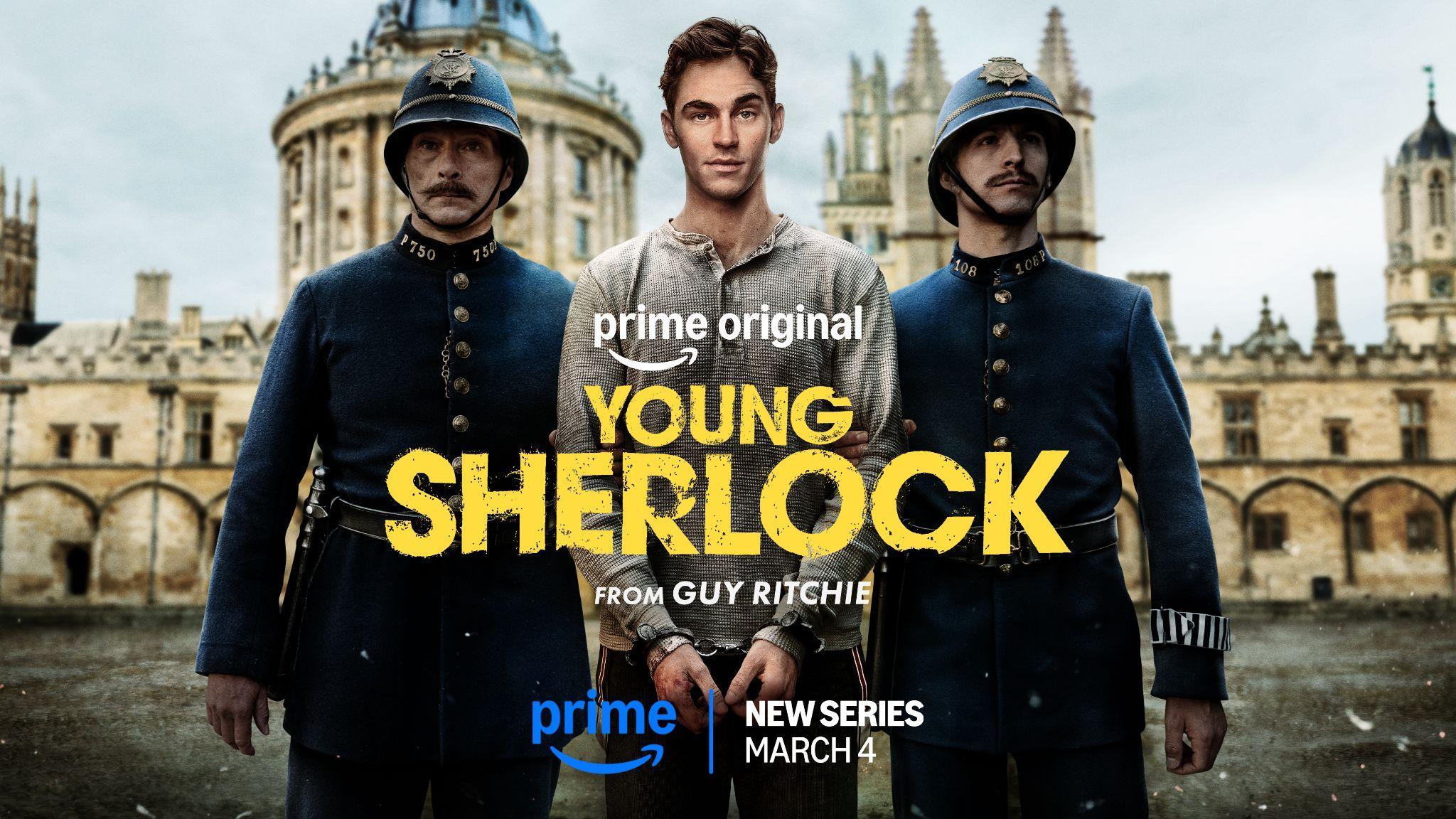
"I would say it's a dream come true, but I don't think I ever realized it was a dream I had. I've always been a fan of Sherlock Holmes, but I'd never seen anyone play him, and I'd thought that I wanted to be the one to do it, even if it was just for a moment," explains the star of Young Sherlock, the new adaptation of the detective series created by Matthew Parkhill and Guy Ritchie, which has just premiered on Prime Video, at the Rosewood Hotel.
Although here Sherlock is still just a sketch of the astute detective he will become. For now, he is a young know-it-all, confident and idealistic, seeking to spread justice in the world, who ends up, thanks to the intervention of his brother Mycroft, at Oxford University with a job as an assistant porter. Parkhill and Ritchie's intention, between doses of violence, is to delve into the roots of this young man and search for what will turn him into the character he will become in the future.
"My brother was probably a little more mischievous at school than I was. I saw him make mistakes and thought I wasn't going to make the same ones. I wasn't too much of a know-it-all either. I'm not saying I was perfect, but I definitely wasn't Sherlock," says Hero Fiennes. He continues: "What I find very interesting about him is that he is so exceptional and unrecognizable that we are all quite fascinated by him. Seeing him at an even earlier stage than the one we all knew makes this even more apparent. For example, we know his potential, we know who he will become, but he still has a long way to go. We can explore how his relationships with his mother and brother influence him.
These family ties are what Hero Fiennes has been trying to unravel since his beginnings in the film industry—at age 11, he landed his first role in the sixth Harry Potter film as a young Lord Voldemort. Those of being the son of filmmaker Martha Fiennes. Those of being the nephew of actors Ralph and Joseph Fiennes. "I am very aware of what it means to be born into my family; I don't think I would be here if I didn't belong to that family. I didn't wake up one day thinking, 'I have to be an actor'; my mother simply taught me. I played a couple of roles, but I wanted a normal childhood. Then you reach an age where you realize you have to start paying the bills, and I felt very fortunate to have the opportunity to start acting."
"I will always be grateful that my family and my surname helped me get a foothold in show business."
Did your family make it easier for you to enter this profession than for other colleagues?
I did hundreds of auditions that probably went terribly and that I hope will never be shown. That's where I learned. I will always be grateful that my family and my surname helped me get a place in show business, but I have always been very aware of the importance of contributing something. If I'm here, I have to contribute something myself. But that doesn't mean I'm not grateful to my family.
How do you feel about the term "nepotism baby"?
I think I accept it because it's a term that can be applied to me. I wouldn't tattoo it on myself or put it in my Instagram bio, but if someone says I'm a product of nepotism and privilege, I totally agree with them.
Since your beginnings, you've been linked to very important sagas—Harry Potter, After...—did that mean you had to deal with fame from a very young age?
Honestly? I know it's very easy to say this, but I really never wanted to be famous. And I have a group of friends and routines that keep me grounded. I still play soccer with my close friends. I spend a lot of my time doing things that make me feel like I'm not as famous as I am. Of course, I've had bad moments when I've been recognized, but the advantages greatly outweigh the disadvantages. I can't complain too much about that.
Even if it means having to change your life?
It's difficult, but it's also interesting. I remember when I made the first After movie, the producers told me that my life would change, and it did. Although not as drastically as they said it would. I don't know, it's a matter of taking each day as it comes, keeping an open mind, and, I guess, seeing what happens. But I also have a family that keeps me grounded. They're very experienced in this, and I always have someone to talk to if I need to.
Many actors say that coming out of a huge teen success, like After, is really complicated and that they end up trapped there.
I think that, with luck, if you do a good job in a different movie, you rewrite yourself in other people's memories. That's why, as an actor, I think it's very important to know how to choose the right jobs. I always want the next role I play to be different from the previous one. That helps me make sure I'm not getting typecast. That's why I think you have to be aware of the roles you choose. And if you're a reasonably decent actor, you can bring a character to life in a way that people see him and not someone you've already played.
Watching the first episodes of 'Young Sherlock', I get the feeling that this is the one that is closest to today's world and society. There is a clear focus in this series on the debate about social class. Also a defense of reality against falsehood...
Your question is making me much more aware of this; I hadn't seen it that way until now. But I think it's true, especially in terms of exploring social class, with Moriarty's origins and background. And yes, good and evil too. I think I learned a lot about why Sherlock does what he does; it's not just about trying to be the smartest and solve it all, but rather to have a moral compass, for there to be justice in the world.
That's an entirely political approach.
People might misinterpret Sherlock as someone who just wants to be the smartest person around, but I think he's driven by a much less narcissistic spirit. He wants people to face justice, not an eye for an eye, and he believes there's a right way to do it. I think having a moral compass is a good starting point for making the world a better place. We could all follow that example, strive to improve the world, call out people who do wrong, and encourage people to do the right thing. It's a shame we don't have more time because delving into this could take us a while.
As a lifelong fan of the character of Sherlock, having seen so many big stars play the role, did you feel the pressure of stepping into his shoes?
Yes, I did feel it, but I feel pressure with every role I have to play. For me, that means I care about what I'm doing because if I lost that feeling of pressure, I would probably become complacent and not do a good job. But as a big fan of Sherlock, I'm very willing to criticize anyone who brings him to life incorrectly. I can put myself in those fans' shoes, and that's when I feel the pressure. I just have to know how to use it as motivation. I'm backed by Guy Ritchie, an incredible cast, and Amazon, so I can give it my all.
I get the feeling that, besides being a fan of the character, there's something else that led you to accept this role that you're not telling us about.
Guy Ritchie plays a very important role because I'm also a big fan of his. This is a great opportunity to be the most reimagined and retold character in history, and when Guy is leading it, you're going to do entertaining things. My answer is, why wouldn't I do it? Who wouldn't want to play this character? We could be here all day talking about why I would want to play this character.
Because maybe the young man with the machine gun never really left. And he's the same as Sherlock Holmes.