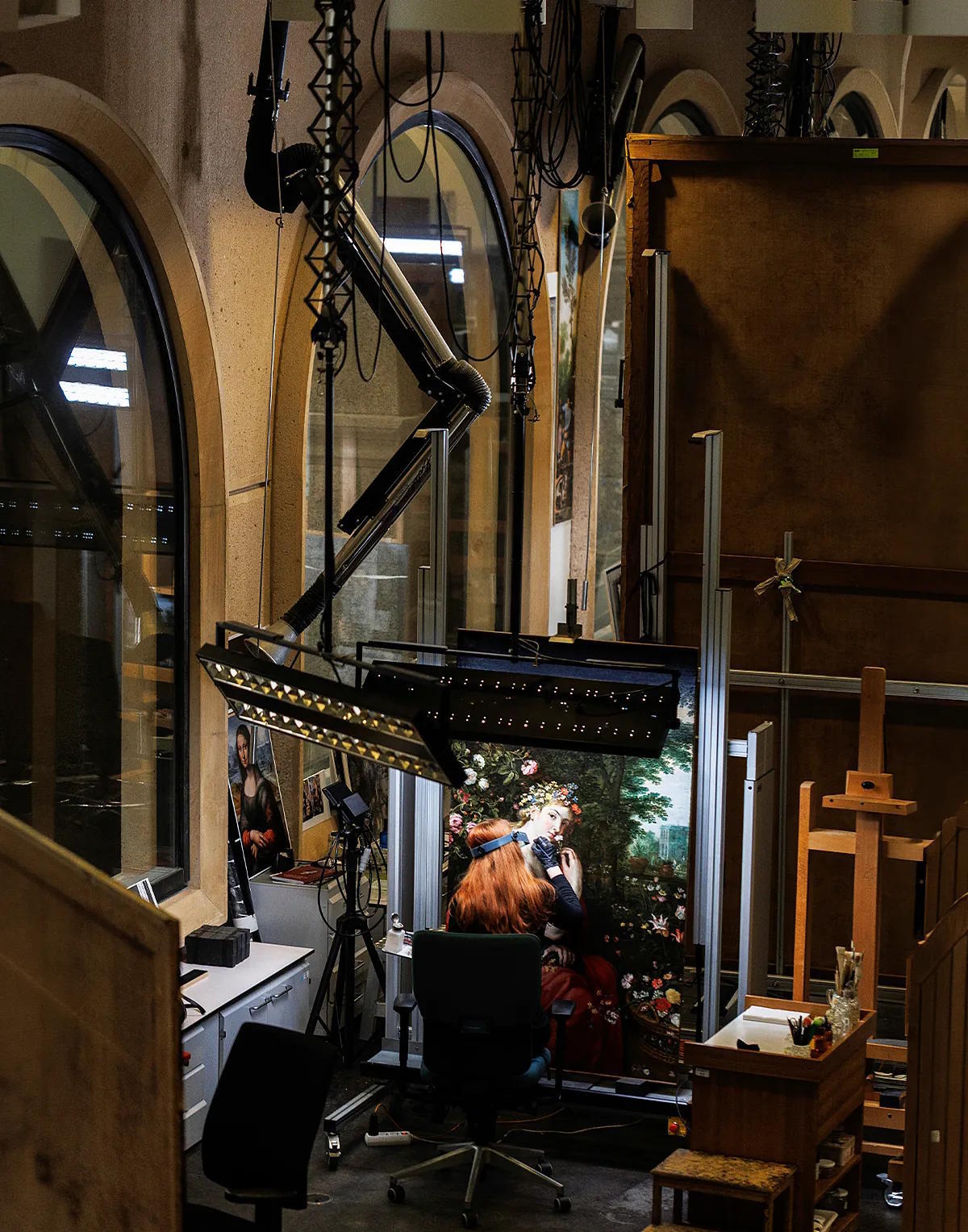
The feeling is indescribable when the two gigantic metal doors open to the sides and the filtered light from the cloudy sky pours in from the cloister windows. The almost physical assault of beauty was expected, but the emotion is unpredictable, uncontrollable, dizzying. Something like what those who accuse what they call Stendhal syndrome must feel. A peaceful silence reigns in the wide space that opens around the windows. Dominating the scene is an immense naked painting by El Greco, with all its bright reds, deep blues, impressive yellows in the air. Also, its wounds, scratching the faces, the sky, the garments.
A woman leans over the canvas perched on a metal ladder, wearing glasses straight out of a science fiction movie and a very fine brush like a scalpel that brings back the present. Even, the past. Around both, the woman and the artwork, perfectly aligned canvases full of flowers, vegetation, mythological scenes, religious scenes, or simply pure botanical hedonism rest. In front of some of them, more women; more futuristic glasses; more surgical precision, more soft murmurs of work.
Enrique Quintana drops the key piece of information four hours after entering his domain, already retracing the labyrinth of corridors and elevators on the way out, still with the beauty etched in the heart and in the pit of the stomach and a slight intoxication of data, names, and faces. He mentions it in passing, as if it were of no importance: "Notice how unique the Prado restoration workshop is, the Louvre, the largest museum in the world, does not have its own workshop. They outsource each job".
The chief coordinator of Restoration and Technical Documentation at the Prado Museum boasts of his feat, and rightfully so, because behind the exhibition walls of the Madrid art gallery lies one of the most cutting-edge restoration workshops in the world, where craftsmanship and technology, experience and modernity converge in a true hospital of art where the heart, the painting restoration workshop, is just the beginning. Sculpture, graphic arts, and even wooden frames and supports have their own services, to continue with the medical metaphor, and the chemical analysis laboratory and technical documentation office serve as diagnostic and consultation units. The whole forms a well-oiled mechanism in constant communication, and that, says the chief, is the key to their success: avoiding unnecessary bureaucracy.
The first time a painting restoration made headlines, Enrique Quintana was a 26-year-old apprentice restorer. It was in 1984 when the British John Brealey, chief conservator at the Metropolitan Museum of Art in New York, arrived at the Madrid art gallery with the task of restoring the lost luster to Las Meninas by Velázquez. After 23 days of cleaning practically in secret amidst a loud uproar in the streets - How could the government allow a foreigner to intervene in a national symbol?! - Brealey left a first layer of varnish on the work and a gift to his four local disciples: they would be in charge of the final touches.
The day before undertaking such an imposing mission, Quintana broke his wrist. The rematch against bad luck came 24 years later when he was entrusted with coordinating that cutting-edge workshop that once again made Velázquez's masterpiece shine. Those who know him say that his ability to move around the studio without disturbing but keeping a close eye on each work in rehabilitation was inherited from that British man who arrived from New York. He is about to come of age in the position.
"One thing I ask of you, do not talk about me. Let the restorers speak, I am just a guide." Quintana will forgive us for not complying with his request, but the passion of the man at the helm of one of the most important restoration workshops in the world, also thanks to him, is inseparable from the life that bustles behind the security door that separates the Prado open to the public from where only the chosen ones can reach, where the magic happens. He opens the door as if it were the first time, he has the "wow effect" well calibrated. "Let's go up by the freight elevator that we use to transport artworks. As you will see, the floor is all smooth, without bumps, to avoid vibrations," he explains as the metal box reaches the fourth floor.
Restorer Marta Méndez works on 'The goddess Flora', from the workshop of Peter Paul Rubens.
After the initial impact, we follow the guide's orders and enter the painting workshop in search of the first-person narrative of its protagonists. The woman on the ladder adjusts her glasses and descends a couple of steps. She is Almudena Sánchez, the dean restorer of the Prado, her professional home since 1982. "It is a real privilege," she acknowledges. "Keep in mind that we examine the painting millimeter by millimeter, it is impossible to contemplate it with this level of intensity in any other circumstance."
Before her stands The Baptism of Christ by El Greco, the last great work of the Cretan painter in the hands of the Prado that remains to be rehabilitated. Almudena has been working on it since September, and her work will likely extend for a year. "I have already finished the cleaning phase, removing the layers of aged varnish that dulled the work and gave it a yellowish appearance, and just recently I started with the chromatic reintegration, which will be very long due to the large number of losses it has. Do you see here how the painting seems better preserved, without damage? That is the part I have already intervened," she points to the spot where she was applying pigments with her millimeter brush a while ago. "My job is to bring the artist back, to tell him: 'Don't worry, you will breathe again and they will see you as you wanted to be seen'," she explains.
"Our mission is to improve communication between the visitor and the artwork. Facilitate their conversation"
The alarm to start a restoration can be raised by the professionals themselves, who have the collection distributed for periodic reviews, but also by the gallery attendants, responsible for reporting any anomalies and who even have a small emergency kit to facilitate an eventual intervention in case of a disaster, whether accidental or vandalistic. Also passing through the workshop are works destined for temporary exhibitions, many coming from storage and in need of a good touch-up before being exhibited to the public.
The floral exuberance that fills the easels in the workshop today responds, in fact, to the exhibition Botany in Art. Plants in the collections of the Prado Museum, organized in collaboration with the La Caixa Foundation and which already started last summer in Girona. "Our ultimate goal is to improve communication with the viewer, for the visitor to engage in a fluid and intense conversation with the artwork, to suggest reflection and distract them from their problems as when we read a book, watch a movie, or listen to a song," explains Quintana. "And you might say: How are you going to relate to an angel or a religious scene from the 15th or 16th century? Well, fantastically well, we are still human and our problems are still similar. Paintings contain more stories than can be appreciated at a glance, we must listen to them well, and we must facilitate that conversation."
Sorry, Enrique, it turned out very nicely.
Wooden support expert José de la Fuente transports a portrait of Catherine of Austria by Antonio Moro.
Let's go back to Almudena and the spectacular three-and-a-half-meter-high Greco that she repaints point by point. "You find an eye, a mouth, something tiny that gets lost in the whole. You look at it very closely and with a magnifying glass and discover those tiny brushstrokes that are building something truly great, which up close sometimes looks like a blur and from afar forms a perfect construction with all the luxurious details," she marvels while pointing, with the end of the brush, at tiny white reflections in Christ's iris and in the water falling on his head.
In 44 years of career, the restorer holds onto two particularly exciting works: "The Annunciation" by Fra Angelico - "When we think about it, there is no need to explain why, it is sublime" - and "the Gioconda", which under successive layers of varnish hid a revelation as mysterious as her smile: it was not just any copy of Leonardo da Vinci's "Mona Lisa", but a work from his workshop painted at the same time as the original by one of his students. Almudena was the one who unveiled the yellowed veil: "Something like this only happens once in a lifetime. Or never." Back to back with Almudena Sánchez and her monumental canvas, a young woman immerses herself in a small panel full of botanical details.
She is Elisa Baronti Marchiò, born in Rome, trained in Florence, and arrived at the Prado with the first of her numerous scholarships without speaking a word of Spanish. Years later, she practically expresses herself without an accent and has been a permanent member of the museum staff for a month. She is the latest to arrive.
This combination of experience and youth is a pattern that is repeated in every area of this restoration workshop, all with fellows to ensure their future. Each specialty functions as a craft in which masters like Almudena train their disciples. "What surprised me the most during my learning period was the enormous generosity of all professionals in sharing their knowledge.
That is not common," Elisa acknowledges. "It is a dream to be here, I hope to live up to it," says the Italian who has managed to turn her imposter syndrome - "Inevitable for a young woman," she points out - into a working tool: "Works must always be approached with great humility and with the idea that you still know practically nothing about them even if you have studied them for years."
Among the open doors of the freight elevator emerges a man, one of the few we will see in this workshop throughout the morning, such is the feminization of the artistic profession. His gloved hands carefully transport a painting on wood, a portrait of Queen Catherine of Austria by Antonio Moro.
He is José de la Fuente, a worldwide institution, one of the very few experts in wooden supports still active. His interventions have been as significant as those on "The Three Graces" by Rubens, "The Adoration of the Shepherds" by Mengs, "Adam and Eve" by Dürer, "David with the Head of Goliath" by Caravaggio, or "The Holy Trinity" by Botticelli.
However, the work he remembers with the most affection is perhaps the one he did with "The Descent from the Cross" by Rogier van der Weyden in 1991, because it was the one that changed his life.
"My work was in the painting workshop, and the museum management assigned me to work with George Bisacca, a curator at the Metropolitan Museum of Art in New York. My first impression upon learning his way of seeing and understanding painting on wood was that he went from the 19th century to the 20th century," he recalls. "Life led me to a specialty that did not exist in Spain and that in the world has no more than five or six people. And consider that, until 1470, all paintings were done on wood."
José de la Fuente's discipline lies at the perfect intersection between art and engineering and requires both ingredients. No, he is not just a kind of master cabinetmaker: "Understanding the material is not enough, you have to understand the painting. I do not work with wood. I work with paintings," he concludes. On his table, all kinds of gadgets spread out, all designed by him. Also his are some peculiar articulated nylon screws emerging from a braided frame supported on an easel. "It is to be able to transport the paintings without damaging them. This invention allows all kinds of movements in the wood: expansion, contraction, vertical flexion...
The canvas is almost an inert support, but the wood is not, it moves with changes in humidity and that makes it much more fragile. I often worry more about transportation than about the restoration itself," he admits. De la Fuente says that his work is very anonymous: "Once we have finished, no one knows what is behind it."
Also, that in his specialty, they take more risks than any other restorer, and he picks up some small wooden wedges used to fill the small cracks to which the passage of time and atmospheric changes condemn most works predating the 16th century. "We carve them to fit from behind, but we always go to the edge. The closer you get to the painted surface, the better the result. But if you are not careful, you go through the paint. It is a very delicate balance," he describes.
Still fascinated by the technical demonstration of a demanding master, who has trained a couple of dozen disciples but would not entrust an important job to more than three, we change the scene to arrive at the sculpture workshop, where Sonia Tortajada is immersed in cleaning a portrait of Isabel of Portugal, a work by Leone Leoni.
"This jewel of the Renaissance was in the Gardens of Aranjuez on a ground of albero soil, so the entire bottom was full of orange splatters. Look, there are still some left," she points out. "And what does the laser do, some kind of peeling? Wrong question." "No, for God's sake, no! That would be a mortal sin!" she jumps up like a spring.
"The original surface is never sacrificed. This laser allows us to shoot in three wavelengths and cause a phenomenon known as photoablation. To put it simply, it removes the bad from the pore and leaves all the good." Behind her, an imposing bust of Antoninus Pius displays the lower half of the face wrapped in plastic. "We are giving him a hydration treatment in his beard," the restorer laughs. "In reality, we have applied a gel solution that we made ourselves to remove a very aged and deeply embedded wax coating; so much so that it would be impossible to clean it and restore the marble surface with a swab soaked in solvent no matter how much we insisted for hours."
If what has been seen so far has not exuded enough magic, it is necessary to immerse oneself in the depths of each work. Literally. That is the task of the technical documentation department, created in 1975, to which the chemistry laboratory was added in 2007, responsible for analyzing the materials of which the works are composed.
Maite Jover proudly shows off the latest X-ray fluorescence analysis technology acquired by the Prado to create overlapping pigment maps that sometimes reveal hidden works beneath the visible. On her computer screen appears a Ferrer Bassa.
With each click, the image turns into a spectrum, each time a different color. Click. "Here we highlight where there is gold." Click. "The green represents pigments containing copper." And suddenly, from a smooth, golden sleeve, a hidden Latin inscription emerges. "The painting was completely overpainted. A few years ago, this almost archaeological work was unthinkable. You could reach certain pigments, but this complete image was pure science fiction," Jover rejoices.
Maite Jover, restorer in the chemistry laboratory: "A few years ago this almost archaeological work was unthinkable, analyzing a work like this was pure science fiction." In the adjacent door, at the back of a room full of computers, a white screen covered with X-rays lights up. "Unlike other museums, we continue to work with film to analyze paintings because its range of grays allows us to reach a level of detail and focus that digital does not achieve. If I can, I will retire with film," says a passionate Laura Alba in the technical documentation department. For sculpture, however, the team has designed an industrial tomograph with a rotating axis.
"It is like a medical CT scan, but here what rotates is the piece," explains the restorer, returning to her computer to display all the possibilities that technology opens up in the study of a sculpture. Before our eyes unfolds the three-dimensional image of a work by Pedro de Mena from the National Museum of Sculpture. And suddenly, the view shows a tangential cut that exposes every joint, every material, every trick. "Here we see the teeth, there are seven on top and six below, but only three are visible, and in the eye, he has inserted half a glass sphere painted on the inside and placed a metal sheet at the back. The light passes through the glass, bounces off the metal, and comes out again, hence that feeling that culture is alive," Alba narrates. A long walk through underground corridors, flanked by warehouses housing the hidden treasure of the largest Spanish art gallery, leads to an atypical workshop in a museum that, on the other hand, has received the most recent investment in museum technology, such is the importance given to it. Gemma García is a restorer and head of the frame collection at the Prado Museum. "The frame has an artistic historical journey, like the rest of the pieces, and it decisively influences how the work is perceived," she states. "Our idea is to restore them to the image closest to the original, but also to find a frame for pieces that arrive without one, and that is not easy. We have almost a thousand available in our warehouse, if none fits, we try to find original materials and order them, and as a last resort, we resort to 3-D printing."