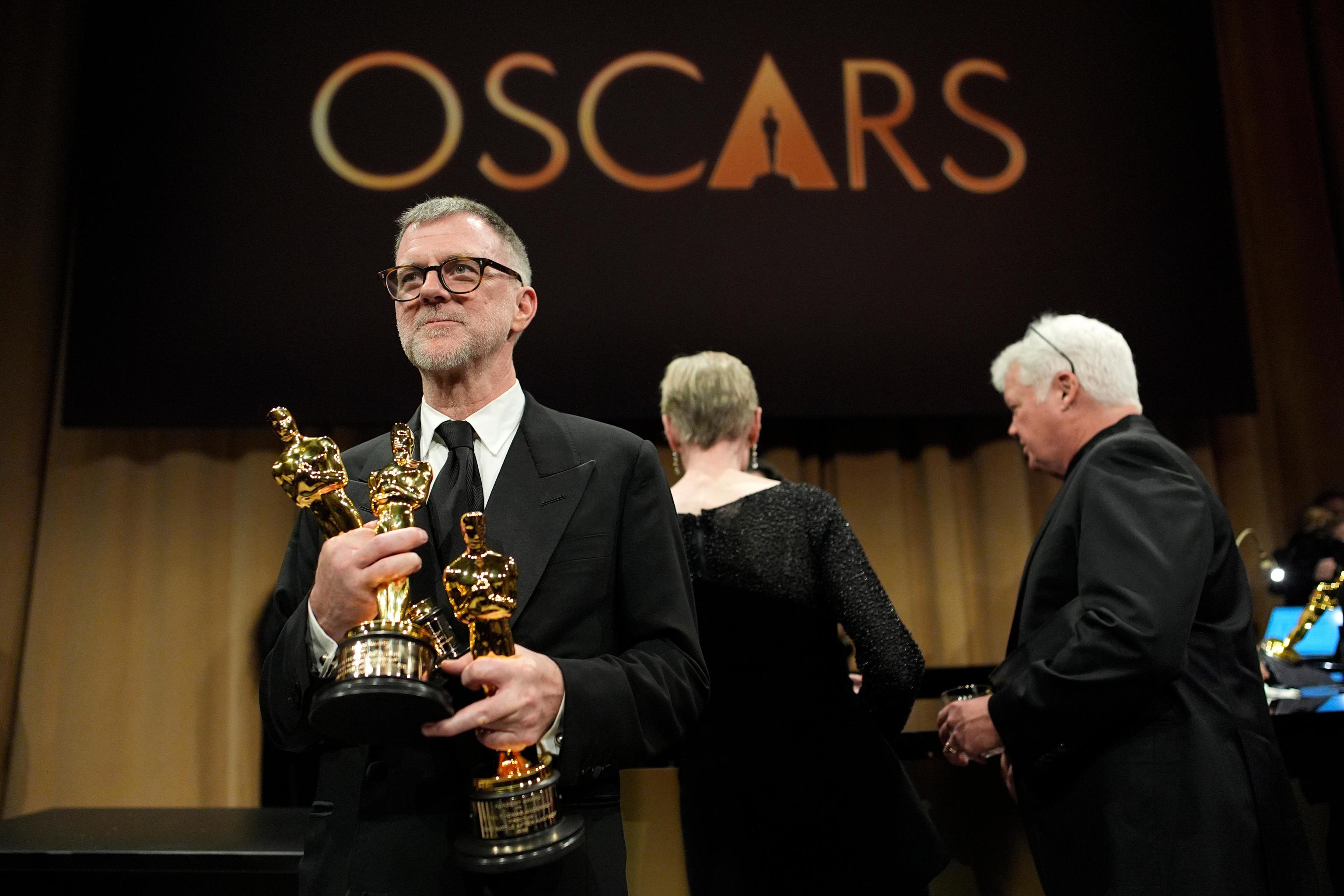
First, Hollywood exorcised the historical neglect it subjected Paul Thomas Anderson to, its most admired student since 28 years ago when he was first nominated for Boogie Nights.
Second, that same Hollywood, always determined to find the philosopher's stone of an auteur cinema capable of reaching the widest audiences, honored the season's star with 16 nominations at the 2026 Oscars, none other than director Ryan Coogler, the creator of the most surprising and danceable vampire film ever made.
And third, Sirat did not win against the steamroller of Sentimental Value, nor did Laia Casanovas, Yasmina Praderas, and Amanda Villavieja -- who lost to the noisy F1-- make history as the first all-female sound team. But there remained their mark, their mastery, and their explosive will. Forever.
Let's say that, in its own way, One battle after another serves as a culmination, a summary of an entire filmography always as close to tragedy as to the most outrageous nonsense. Destiny, chance, or logic, depending on how you look at it, has made the adaptation of the neurotic, unhinged, and unpredictable novel Vineland by Thomas Pynchon premiered at the most neurotic, unhinged, and unpredictable moment in recent times. That is, the film arrives on time and does so with the appearance of a manifesto. And for that reason or whatever it may be, it was the moment to expiate guilt, forgive oversights, and acknowledge the obvious.
Paul Thomas Anderson and his film not only won at the 2026 Oscars, but they also healed an old and deep wound. That One battle after another, being essentially a politically satirical film that portrays the paranoia of a racist, xenophobic, and conspiratorial far-right, only adds the gift of opportunity to a fair list of awards. However, all within the context of a terrifying contradiction of an incomprehensibly white, apolitical, and even tiresome gala. Only Javier Bardem with a resounding "No to war" dared to break the deafening silence out of complicit necessity for all. Sad.
But to the point, up until this year, Paul Thomas Anderson had been nominated directly eight times as a writer or director. Three of his films prior to One battle after another had also made it to the final as the best production of the year. And yet, despite the clamorous unanimity that each of his works gathers along the way, the shelves of his home in the San Fernando Valley of California were tidy and, most notably, completely free of dust and any Oscars. Until Sunday morning. Long before the Golden Globes, everything seemed to indicate that it was time for Hollywood to settle its debts with the last great heir of the most genuinely American tradition. From the electric virtuosity of his early works to the expressive restraint and always dynamic nature of the films after There Will Be Blood (2007), his cinema has been characterized by being a compendium, expansion, and critique of the best tradition of storytellers of American society's traumas from the 1970s to the present. A disciple of Robert Altman's organic chaos and always very close to the psychological mazes of characters 'Scorsesean' for being obsessive and choleric, his cinema has persistently sought to x-ray each of the contradictions of an essentially cruel and, indeed, contradictory capitalism.
For One battle after another, there were a total of six Oscars. And many of them came with news. It won the first Oscar in history in the casting category for Cassandra Kulukundis, when everything indicated that the favorite was The Sinners, and Sean Penn honored his third Oscar with his ritual and resounding absence. He never attends. It was one of the surefire awards and came hand in hand with a certain absence. When the award for adapted screenplay arrived, Paul Thomas Anderson shone. "I feel the disaster of a world we are leaving you," he said in reference to his children, "You are the generation destined to change it," he concluded in what seems to be another way of telling the story. Then came the editing for Andy Jurgensen and the others: director and film. Hollywood finally made amends.
Vampires and blues at the 2026 Oscars
Of the important awards, the big ones, the memorable ones, only one escaped the dictates of battles and vampires and was, of course, Jessie Buckley for her devastating performance from every point of view in Hamnet, by Chloé Zhao. The award was so evident that the time on stage for the actress was experienced not as a surprise but as a prologue to the final award, which was that, indeed, the ceremony was finally ending. The gala and the long and tedious awards season were coming to an end.
True to predictions, betting pools, and bookmakers, all at once, Frankenstein, by Guillermo del Toro, swept almost all the awards that point to cinema as a creator of shadow and dream, as trompe-l'oeil, illusion, and wonder. From the production design by Tamar Deverell and Shane Vieau, to the makeup and hairstyling by Mike Hill, Jordan Samuel, and Cliona Furey, passing through the costume design by Kate Hawley, everything belonged to them in the perfect construction of the monster. They missed out on the special effects, but for now, that remains the exclusive domain of the team from Avatar: Fire and Ash, by James Cameron, led by Joe Letteri, Richard Baneham, Eric Saindom, and Daniel Barrett.
The insistence on jokes almost exclusively designed to be retweeted, the constant appeal to sentimentality in any of its forms, or the unappetizing dialogues in pairs just before the presentation of each Oscar made the gala oscillate between the cheesy and the tiresome with no middle ground. It is striking that a list of nominees poisoned with legitimate denunciations against racism, xenophobia, dictatorship, or simply war, barely led to some bland, bland, and, worst of all, fearful thank-you speeches. Do they fear exactly who? Or do they? Only the team behind the documentary Mr. Nobody vs. Putin, by the Czechs David Borenstein and Pavel Ilyich Talankin, dared to speak out against the oligarchies that hijack democracy, against the authoritarian drift of certain governments... but, of course, it was Putin, not, for example, Trump. Thank goodness we have Javier Bardem.