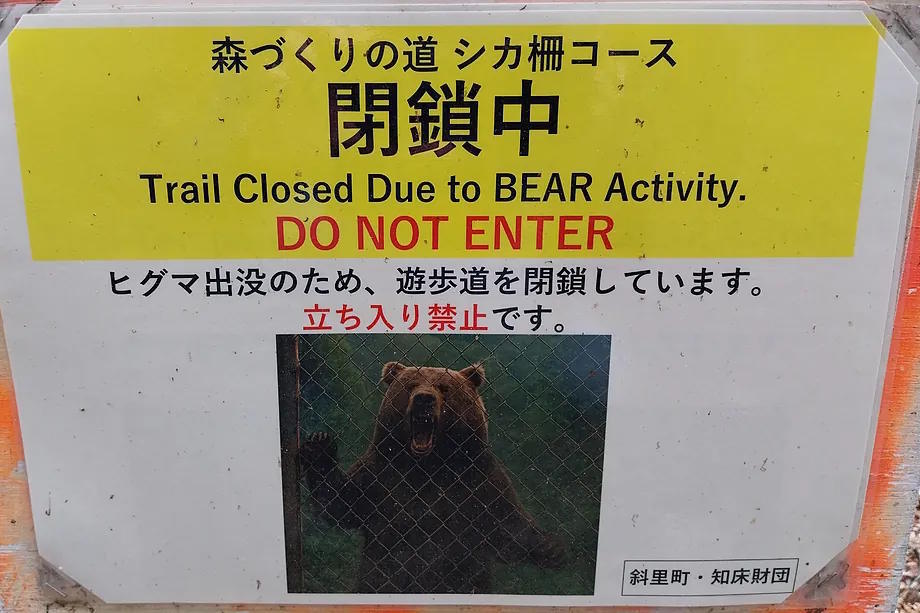
The rangers of the Five Lakes of Shiretoko are as friendly as they are insistent. They know they are in the heart of the epicenter of bears in Japan, the peninsula at the northern tip of Hokkaido, the island that last year recorded a record number of attacks on humans, with more than a dozen dead and 200 injured.
Accidents are not common here, but sightings are a certainty. That's why upon entering the area, visitors must fill out a passport with their personal information. Then, they must pay attention to a video that explains in English and Japanese how to avoid unwanted encounters with bears, and even how to behave if such encounters occur. Next, another friendly ranger repeats the instructions verbally to ensure all visitors understand. Tourists, mostly Japanese, look at each other with a somewhat forced smile that reveals more nervousness than they intend.
Now ready to embark on a tour that follows a decreasing route, starting from number 5. Each stop on this self-guided tour is more picturesque than the last, with wooden walkways leading to water surfaces reflecting the Iwo and Rausu mountains, an active volcano. The jingles of bells hanging from backpacks can be heard around corners to prevent surprise encounters with any animal. The end of the trail connects to number 1, a spectacular electrified boardwalk at its base, accessible even with wheelchairs for visitors coming from the parking lot.
But are all these precautions based on reality or are they just part of a scaremongering folklore? A large brown bear crossing the road that connects the Shiretoko Interpretation Center with the Five Lakes makes it very clear. The car brakes abruptly, and the automatic system stops the engine. The bear crosses the road, stands on its hind legs, and hits the fence next to the guardrail with its front paws. It barely looks at the two vehicles stopped on the asphalt. It seems bothered by something. It retraces its steps, agilely climbs a slope, and disappears into the forest.
Visiting this beautiful, unique, and wild Hokkaido peninsula requires preparation. The Shiretoko Nature Center, on the outskirts of Utoro, is a good place to learn about the local fauna and flora and start immersing oneself in this hiking experience with the precautions required in this remote part of Japan. In their shop, visitors can stock up on bells, repellent, and all the information related to bears. Then take a stroll to the Furepe Waterfalls, a viewpoint showing how two streams flow into the sea. Or hike the Pioneers Trail, a circular route through the forest that takes just over half an hour, where there is a house and a farm from the late 19th-century Japanese colonization of this land.
It is not an exaggeration to say that the entire Shiretoko peninsula is home to bears. It's not that the animals approach humans, but rather that we invade their territory. In fact, the latter half of Shiretoko lacks roads and settlements. More than avoiding unwanted encounters, the goal is to preserve this species as a wild animal that does not become accustomed to civilization.
There are two reference towns, Utoro and Rausu, with more logistical than touristic attractions. They must be passed through by car, the ideal means of transportation: the roads are well-maintained, well-signaled even for Westerners, and Japanese civility also prevails behind the wheel.
Utoro is a town that lives from and by the sea during the seven mild months, from April to October. This is evidenced by its fishing port and restaurants, where one must not miss the sake oyako don (fresh salmon and roe over rice), king crab, sea urchin, or black conger eel. Near this town are the Oshin Koshin waterfalls, cascading over rocks along the road, facing the ocean, an ideal spot to watch sunsets over the Sea of Okhotsk.
The point dividing the western from the eastern part of the peninsula is the Shiretoko Pass, where road signs of bears crossing the road coexist with signs informing of sightings of hungry bear specimens (how do they know?) with exceptional views of Mount Rausu, the highest in this region. The hike to the top of this peak, not too demanding, and to the Iwaobetsu onsen, outdoor hot springs in the middle of the forest, a fairytale setting, are highly recommended, although one must ensure they are not off-limits due to wildlife presence. The peak season is between May 10 and July 31, but sometimes these treks are prohibited outside this period.
The descent to Rausu reveals two hidden gems on either side of the winding road. The first is the Kumagoe waterfalls, with their hidden access at the exit of a tunnel, just a 400-meter walk along a narrow trail. The reward is a beautiful 15-meter waterfall. The second surprise is the Kumanoyu onsen, communal hot springs before reaching Rausu, free to access and well-maintained, where one only needs to bring a towel and enjoy the hot water in nature. And forget any prejudices, as these baths also strictly adhere to the rule of complete nudity.
A completely different way to see the Shiretoko peninsula is to cruise its western coast on one of the tourist boats departing from the Utoro port. The minimum tour is an hour and a half, but the four-hour one to reach the northern tip and glimpse the blue silhouettes of the Kuril Islands, a territory of eternal dispute between Japan and Russia, is worth it.
The coast is a succession of black volcanic rock cliffs crowned by forests. The boat's loudspeakers point out the names given to the anthropomorphic shapes of the rocks, but the most interesting part is to keep an eye on the shore just in case. And suddenly, bingo! A bear strolls with two cubs by the river. It prowls the water and leaves the cubs on land to plunge abruptly and suddenly throw several salmon into the air. Good catch. Other fish are already jumping in the sea, perhaps celebrating having escaped the predator's clutches. Dolphins also perform around the boat. The wind is cold on the deck, even in summer. During winter months, these ships offer rides among the ocean ice when everything freezes and bears hibernate.