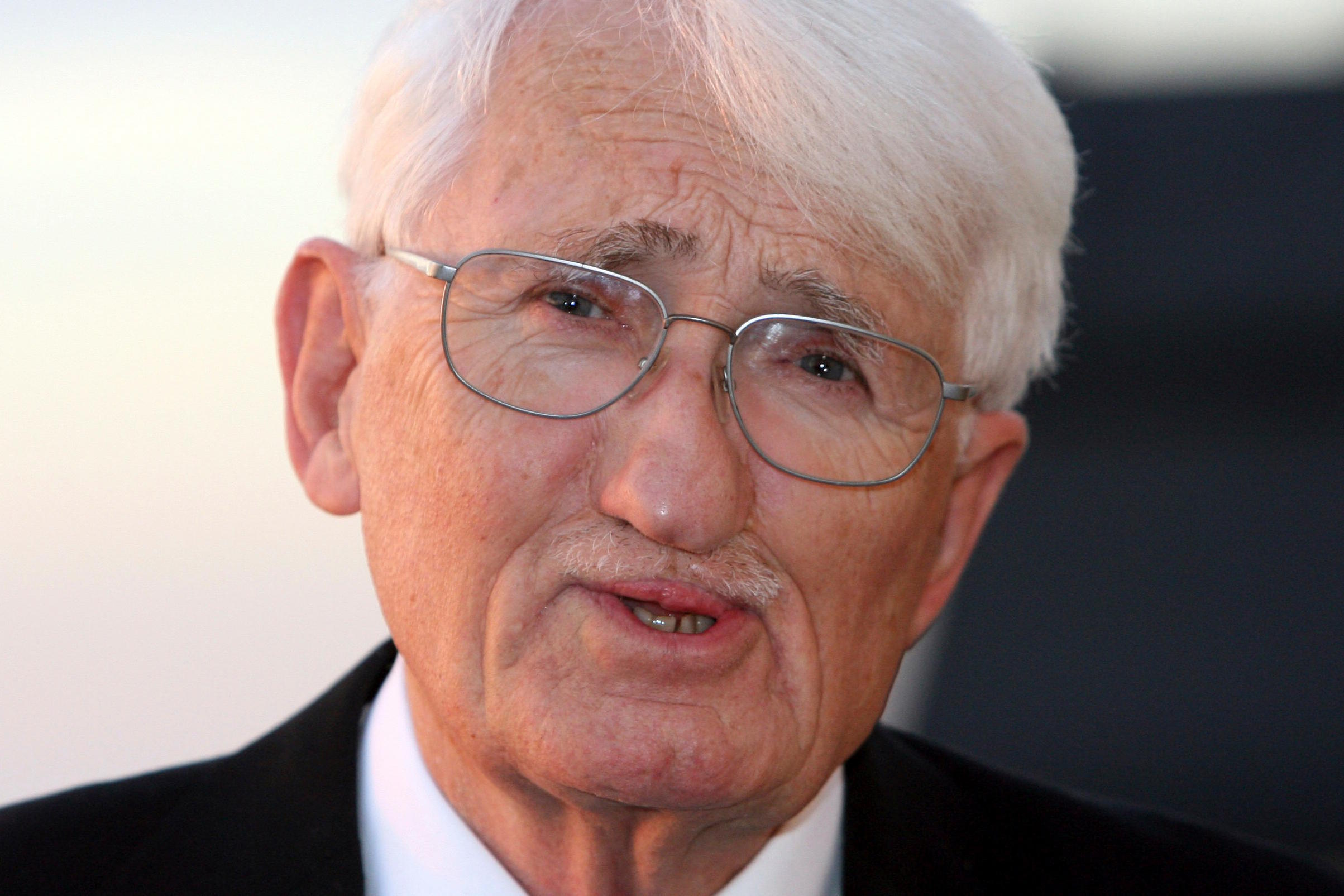
Trying to summarize the immense philosophical, sociological, and even literary production of an uncontainable and tenacious polemicist like Jürgen Habermas seems as adventurous as it is probably impossible. When, on the occasion of the publication of his philosophical texts collection in 2009, he was forced to describe the scope and meaning of his work, he confessed that all his effort for decades consisted of "clarifying the conditions under which those involved can respond rationally to both moral and ethical questions." In plain language, or simply put, much of the thinking of the last great bastion of the Enlightenment tradition (that's what it's about in the face of postmodern and late modern whims and confusions) was based and fought for understanding, for comprehension through dialogue, for the construction of a common and rational space. In the words of Ferrater Mora: "Habermas's efforts are aimed at a new theory of reason, which also includes practice, that is, a theory that is both justificatory and explanatory."
What Habermas always aimed for, then, was to reconfigure the parameters for global thinking in a global world, an endeavor on par with only the greats: Kant, Hegel, Marx, or himself. "Discussing is more important than eating," he once said, a man who never took refuge in theory or in the towering heights of his chair to avoid participating in any public debate that crossed his path: from the legacy of Nazism to the shameful silence of his own, passing through the construction of Europe or, much more recently, the war in Ukraine. He argued, so to speak, with Peter Sloterdijk, with Michel Foucault, with John Rawls, with the neoliberal sociologist Wolfgang Streeck especially, and even with Pope Benedict. He discussed with everyone, understood everyone, and refuted everyone.
His death at 96 leaves the Academy, in general, without the most important, influential, and comprehensive thinker (due to his constant syncretism with all branches of thought, all schools, all tendencies, and even fashions), and society as a whole, also in general, is left without its most restless, respected, and enlightened moral reference.
He was born in Düsseldorf, but his childhood was spent in Gummersbach, not far from Cologne. His father, in his high position at the Chamber of Commerce and Industry, collaborated, if only by omission, with the regime. During the war, young Jürgen was enlisted in the Hitler Youth. He never participated in the war, but Nazi totalitarianism would definitively mark his biography. His commitment to democracy led him radically to denounce in every possible way all those who readapted to the new society that emerged from the great conflict without purging their guilt.
The most accelerated biographies point to him as the last representative of the Frankfurt School of Critical Theory. In fact, he joined the Institute for Social Research in 1955. His godfather was none other than Theodor Adorno, surprised by the analytical capacity and sagacity of a very young thinker who, at only 24, published a definitive and already legendary article in the newspaper Frankfurter Allgemeinen Zeitung with the resounding title Thinking with Heidegger against Heidegger. The publication caused a real shock in a society struggling to save the monumental figure of the author of Being and Time from all his clumsiness and unconfessed commitments during, once again, Nazism. At that time, few could imagine that this impertinent polemicist would end up taking the place of the character he criticized to the point of going down in history as the Hegel of the Federal Republic.
In the main institution of the famous Critical Theory and responsible for reformulating Marxist theory after Hitler and Stalin, Habermas did not last long. Disagreements soon arose with his director, Max Horkheimer, from whom, by the way, he would inherit the chair.
"The labels attached to theories say more about the impact of misunderstandings than about the theory itself," he later commented to make clear his differences with the Frankfurt School, of which he never renounced but never felt himself to be an heir either. And he continued: "I started from the most sordid aspects of the old Critical Theory, which had thematized the experiences with fascism and Stalinism. Although after 1945 our situation was different, this disillusioned view of the driving forces of a self-destructive dynamic of society was the first thing that led me to seek those sources of reciprocal solidarity that were not yet completely dry."
In short, and as his biographer Stefan Müller-Doohm writes, "instead of living off the inheritance of Critical Theory, Habermas transformed that theory by shifting it from social theory to communication theory."
His first major achievement was reflected in the fundamental book History and Critique of Public Opinion in 1962. For the first time, Habermas confesses himself as the best and last great reader of the Enlightenment and speaks of modernity, not from the murky defeatism of his predecessors, but as an ongoing and unfinished project. The old and brilliant idea that behind modernity lie extermination camps as a necessary and never admitted consequence is refuted with a passion for the future and, above all, for Europe completely unprecedented.
Habermas presents thought as a weapon against disillusionment, as a profession of builders, as an antidote against defeatist leftism. When the cultural landscape was flooded by the magnetic and glamorous French post-structuralism, the philosopher from Dusseldorf found the right enemy that every giant needs to become even stronger.
What follows is not one, but a thousand Habermas in constant and exhausting conversation with all branches of knowledge in an almost obscene manner. Habermas knows everything, discusses with everyone, and puts everyone in their place. The philosopher, who was born with a cleft palate and whose metallic voice navigating through endless sentences crowded with subordinates would seem to condemn him to solipsism, soon became the reference for everyone. Since then, all his efforts, hand in hand with the construction of the Theory of Communicative Action, the discourse ethics, and the theory of deliberative democracy, consist of finding normative patterns from which to base a critical social theory that responds to the contradictions of a late capitalism that escapes the classic categories of exploitation and domination, infrastructure and ideology, to become much more volatile, meandering, calculating, and even sinister.
To reach this space of rationality, philosophy was not enough without the contribution of the social sciences. He thus initiates a re-foundation and re-appropriation of the basic pillars that underlie liberal democracy behind the institutional assumptions underlying the public dimension of reason and language itself. Figures like Karl-Otto Apel or Richard Rorty would accompany him on a journey that includes a re-reading of Weber, Parsons, or Luhmann.
And all this, without ever ceasing to engage in any controversy that arose. This man, who in 1971 was appointed director of the Max Planck Institute for "research on the conditions of life in the scientific-technical world" until he returned to his chair in Frankfurt in 1983, where he retired in 1993; this man, who was always a lover of winter sports and a great skier; this man, who perhaps dreamed of being an architect to the point of designing his own house according to the patterns of the most classic rationalism; this man, who boasted of being an inveterate traveler; this man, we say, never gave up on, indeed, being just a man.
He got himself into a mess up to his eyebrows in what was called "the historians' debate" as soon as he sensed the slightest hint of condescension, understanding, or justification of the Nazi past from the most casually liberal academic chairs. Imagine what he would have said about the Francoist revival happening around here. He engaged in a heated discussion with Sloterdijk regarding the genetic manipulation debate. He always jumped into the fray whenever someone discussed the idea of Europe in the context of the war in Ukraine, even positioning Macron (the old Macron, not the current one) as an example to follow. Imagine what he would have said about the advancement of today's far-right Euro-skeptic Trumpists if his strength hadn't already waned. He even managed to reformulate, from a deeper (unwavering) understanding, a good part of his rational thought to exhaustion in the debate he had with the still Cardinal Ratzinger on the relationship between faith and reason.
In 2019, he surprised everyone with what is probably his last major work (although he published another one in 2022: The New Transformation of Public Space and Deliberative Democracy). Surprisingly, and as if starting anew, he decided to completely rewrite the history of thought, all of it. Perhaps it was a final attempt to discuss everything, to find the root of what is common, of what makes man be man, of what constitutes the essence of language itself. A History of Philosophy (whose first volume published by Trotta is titled The Western Constellation of Faith and Knowledge) covers the last 2,500 years of humanity. Nothing more.
The writer (who attended a lecture by Habermas at the Goethe Institute in Madrid when studying Philosophy at too young an age) ran into the philosopher one spring day at the Kunsthalle in Hamburg. Pure chance. He was with his wife. Like a silly fan, he followed them for a while. They stopped in front of The Sea of Ice by Caspar David Friedrich. In the painting, large blocks of ice are stacked like a strange cathedral in the middle of the Arctic. On one side, of little importance and unrelated to the main theme of the painting, the remains of a shipwreck can be vaguely seen, barely a reminder of a man's effort and determination in an inaccessible and desolate landscape. It serves as a metaphor for the greatest thinker humanity has produced since World War II.