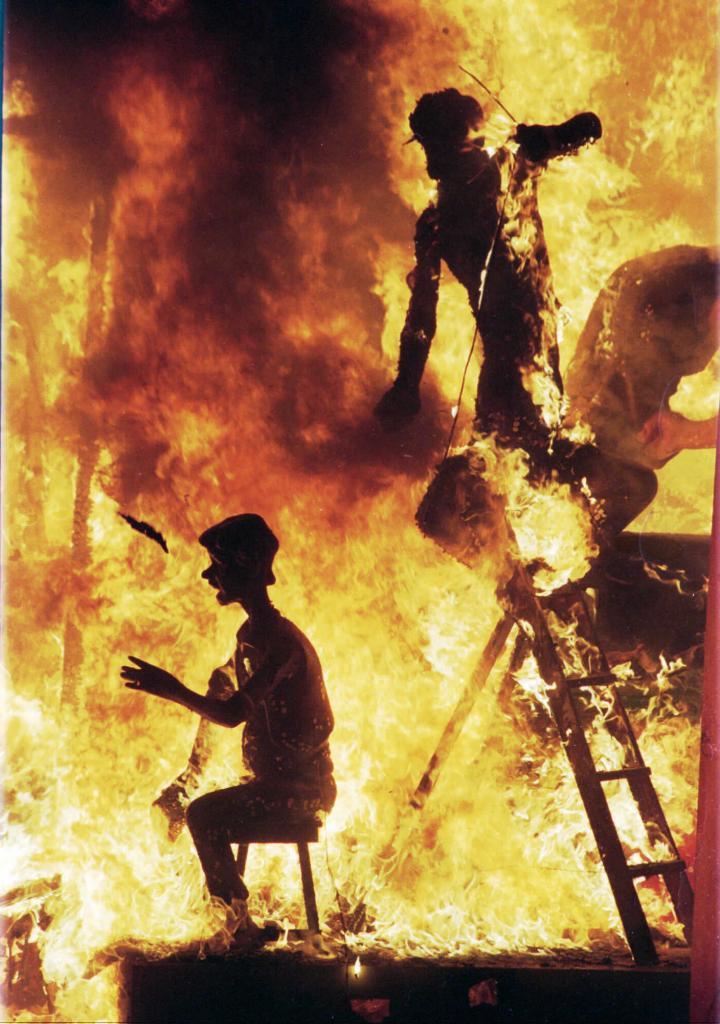
On November 30, 2016, UNESCO declared the Fallas of Valencia Intangible Cultural Heritage of Humanity, the culmination of a festival documented since the 18th century but now facing a challenge that will shape its future: how to avoid being engulfed by a tourist boom that brings with it a growing and perhaps unsustainable overcrowding. The debate, in 2026, is already embraced by the Fallas community itself, aware that the time may have come to set limits on a festival that continues to grow in the casales, cannot leave the streets, but cannot turn Valencia into a hostile city for its own citizens for three weeks.
The essence of the Fallas remains in the 768 monuments that are erected in the streets and squares from March 14 to 19, when they burn under the purifying fire symbolizing the arrival of spring, the gunpowder, with mascletàs and castles, the traditional attire, music, and the brotherhood in the streets. But to this cultural expression of a people, elements have been added that, due to their excessive growth in recent years, have cracked the coexistence with the festival for part of the city, and now even its metropolitan area.
The Fallas census has grown by more than 8,000 people in just one year. There are 128,000 registered in one of the 384 commissions spread throughout the neighborhoods of Valencia. In some cases, there are up to five commissions on the same street. The activities allowed are regulated in the so-called Falla Decree, published each year by the Fallera Central Board, the municipal body that regulates the festival. It specifies what can or cannot be done during the Fallas week, from which streets can be closed, to what time fireworks can be set off, and from which day or how commissions can finance themselves to cover their monuments, partly subsidized. The problem is that it is not always complied with or, as some groups see it, not enforced. Even when it is complied with, it generates conflict.
The Fallas officially begin with the plantà of the children's monuments on the night of March 14, but in reality, they extend many days before. It's heading towards three weeks. The festival call, the crida, is always the last Sunday in February, and the daily mascletà at the Town Hall Square starts on March 1. This means that, increasingly each year, Falleros start taking over the city weeks before the festival. That is, to block between 300 and 400 streets to extend their casales with tents, make paellas, or establish, as they must, a fireworks area. This 2026, these closures started on March 6, either to install lighting in the streets (there is also a lighting contest) or the outdoor seating.
From that day, mobility in Valencia begins to be chaotic, with traffic closures and public transport diversions a week before the official start of the Fallas. "The city has a very big problem due to traffic congestion, and the tents are set up and, in many cases, empty. It makes no sense," laments María José Broseta, the president of the Federation of Neighborhood Associations. In addition, when they are active, it can be bothersome. "You can't sleep because there's a party right below your house. It used to be just a week, now it's at least two," she adds. The description made by the British singer Morrissey a few days ago is shared by many residents: "an indescribable hell" that left him "catatonic" and led him to cancel his concert last Friday at the Palau de Les Arts Reina Sofía. "It will take me a year to recover, and I am being conservative," he complained.
The commitment of the City Council, as the regulator of the festival, is to adjust the calendar as much as possible, a promise that is always given in March. "The tents will be set up much later next year because the calendar is different," anticipated the mayor, María José Catalá, a few days ago. A year ago, the commitment was to allow them from the 10th, but they were set up four days earlier. The festival aims to exploit its tourist and economic potential beyond the traditional sectors that sustain it. "The commissions need to have days before the big days to fundraise," justifies the Fallas councilor, Santiago Ballester. Honorary Falleros dinners (who pay to be one) or street parties are the main activities.
Faced with this situation, the exodus of residents has been increasing, although they have been replaced by visitors. This is reflected, for example, in the water consumption data made public by the city council a few days ago: it increases by 5% despite the usual population leaving.
The Fallas are not only a national attraction, but the festival has expanded its borders. The international interest has grown by 26% in the last year, attracting not only national visitors but also Italians, Germans, and French. This has been reflected in a 100% occupancy rate in tourist apartments last weekend, which dropped to 70% from Monday, according to Aptur CV data. Hotels had slightly lower figures, although above what was anticipated a week ago when weather forecasts predicted bad weather that did not occur. The sun shone, and it was Fallas weather. According to Hosbec, the hotel association, occupancy had a "moderate growth," but far from full capacity. The weekend was at 83%, and until today, it is expected to be at 70%, figures that improve on the rainy Fallas of 2025.
For hospitality, commerce, and transportation, the festivals have always been a driving force, although the situation is starting to change. The Taxi Federation has staged a Japanese-style strike and has been suffering from mobility problems for too long. Despite the impossibility of finding a table in restaurants in the city center and near the Special Fallas, they compete with a city full of street food stalls with international cuisine, churro stands, and mojito sales that have grown disproportionately in recent years. They are a source of income for the Fallas commissions, which are allowed to charge a fee for the use of public space in their areas. Merchant associations, such as Valencia Central Commerce, are starting to denounce the lack of municipal control. "Before, some didn't make money for four days, now it's two weeks," they lament.
Some see this path of exploiting the commercialization of the festival as a loss of traditional identity to give way to the appeal of coming to Valencia to participate in a street "megaparty" with music and fireworks. Even gunpowder has attracted the so-called pyrotechnic tourism, which travels to engage in battles with devices close to homemade bombs. In 2025, 12 men were arrested with over 2.5 kilos of highly dangerous pyrotechnic material, and through digital channels, organized groups of Germans and Dutch were detected planning to travel to Valencia with manipulated and illegal fireworks. This year, police surveillance has increased, but in some areas, such as the Ruzafa neighborhood, the situation has gotten out of control on more than one night.
Another distinguishing feature of the festival is the mascletà, a daily firework display that has sparked a crisis between the regional government and the city council over how to manage the crowds that gather in the Plaza del Ayuntamiento every day at 2 p.m. to witness the explosion of 200 kilos of gunpowder. The security perimeter has been expanding over the last two decades, but so has the number of attendees. Without capacity limits, there's not a spare inch in the heart of Valencia, where the mascletà blends with the city's usual bustle and the proximity of the Estación del Norte (North Station), the main connection to the metropolitan area.
Last year, a surge of over 100 people requiring medical attention led the city council to request that trains be suspended between 1 p.m. and 3 p.m. from March 13th to 19th, to prevent mascletà spectators from mixing with commuters. The measure, announced on the 10th, has been highly controversial, with harsh accusations flying between Mayor Catalá and the Minister of Transport, Óscar Puente, but it hasn't been changed because the security arrangements prevented any modifications. Those traveling to Valencia by train from Gandía or Xàtiva, whether for the festival or any other business, will have to travel before 1 p.m. or their last stop will be Albal, 10 kilometers from the city. There, however, shuttle buses provided by the Generalitat (Valencian regional government) will be waiting to take them to the MetroValencia station in Torrent or to the village of La Torre, where the city bus service arrives.
The debate sparked by this decision regarding rail travel is whether to limit capacity at the mascletà (firecracker display), a controversial decision that will have to be addressed for the next Fallas festival and which will come just months before the municipal elections. Compromís (a Valencian political party) proposed this measure this year to prevent train service from being canceled. The government delegate, Pilar Bernabé, who will be the Socialist candidate for mayor, raised the issue as pending tasks for the upcoming Fallas festival, but Catalá, who is seeking reelection, is avoiding the debate because he knows the pool of Fallas votes at stake—votes that Rita Barberá so effectively capitalized on.
The chaos hasn't been limited to the fireworks displays, open to the public, but has also affected some events reserved exclusively for Fallas members, such as the collection of the ninot (papier-mâché figure) that each commission contributes to the exhibition. These ninots gather at the City of Arts and Sciences so the public can vote on which one will be spared from burning that night. Last Saturday, there was overcrowding due to the large number of children participating in the Fallas, so for Sunday, the Central Fallas Board set a maximum of 10 people per commission.
One way to alleviate this burden on the city, according to Compromís and the PSOE, is to implement a tourist tax, at least during the Fallas festival. Catalá refuses, arguing that it currently lacks legal backing because the legislation that supported it, approved belatedly by the Botànic coalition, could not be implemented. With the arrival of Carlos Mazón to the government, it was immediately repealed. Even Juan Roig, president of Mercadona, called for "more monetization of the Fallas." "We have to charge tourists more," he said, without specifying whether for public services or for the festival itself.
This political, and controversial, reflection on the direction the festival should take and the limitations it needs to avoid being swallowed up by unchecked growth rises each year like a Fallas monument, only to be reduced to ashes as soon as everything else burns. The fire devours it like the Fallas themselves.