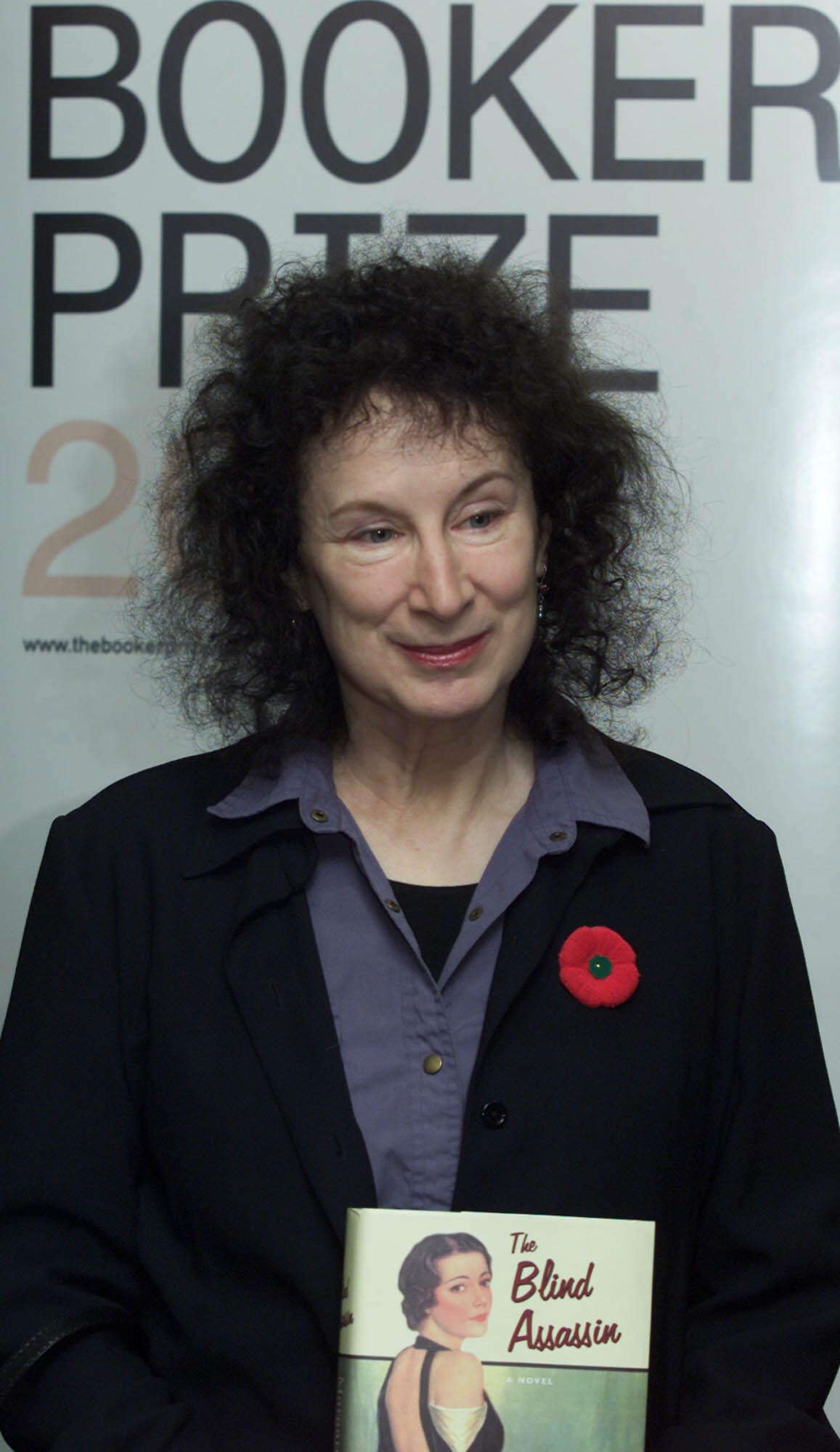
The reason for interrupting her writing is to celebrate World Poetry Day, this Saturday, March 21, discussing her new poetry book, Sincerely (Salamandra), a collection of verses written between 2008 and 2019 where a clearly twilight tone resonates, but also the sharp, sarcastic, and combative voice of the writer. She addresses a varied range of topics that, as always with the author, range from the intimate - the passage of time, memory, old age, grief, and enduring love - to the political - ecological awareness, female identity, and human history.
Atwood speaks with a mix of precision and dry humor that makes even the most abstract ideas seem anecdotal. When explaining how her poems come to life, she doesn't mention any epiphany or creative trance. "I would say with some words. Sometimes those words refer to an image, others to a person or a situation, but the starting point is always the same, language, because poems are made of words," she explains, "just as music is made of notes". She likes that comparison because it emphasizes something essential for her, the difference between writing a poem and writing a novel. "A novel needs architecture, characters, narrative time. A poem, on the other hand, can arise from a small verbal fragment, from a rhythm that suddenly appears. Ultimately, all literature is oral. The written page is not literature until the reader translates it into a voice."
Throughout her career, Atwood has published dozens of books of poetry, novels, essays, and short stories, however, the public usually identifies her mainly with her narrative, especially with the ustopia [a neologism she coined that blends uchronia and dystopia] she imagined in The Handmaid's Tale in 1985. However, she insists that there was never a deliberate choice between genres. "Why should it be one thing or the other? Can't I be both? In children, we clearly see that rhythm and the drive to narrate, both such human things, coexist. They come from different parts of the brain, true, but there's no reason you can't use both. It's allowed," she says wryly.
In fact, she started writing both things at the same time. "What happened is that in Canada in the 60s, it was much easier to publish poems than novels. Novels were expensive to edit, and there were very few publishers. Poets, on the other hand, managed on their own, creating magazines, small labels, fanzines. Today it would be the same, only with websites and digital publications," she points out. When she recalls that literary scene, she does so with a mix of nostalgia and irony. "In Canada, when I was twenty, there wasn't much competition because only a lunatic would have chosen to be a writer. That bohemian community, she explains, was made up of a rather peculiar group of young people who lived on the fringes of conventional life, and Atwood felt a bit out of place among them. "I was quite abnormal. I wasn't an alcoholic, I wasn't a drug addict, and I didn't want to commit suicide, so I didn't fit into the literary scene," she says sarcastically.
"At my age, I am in an enviable position, I have the freedom to say everything that others fear to say. And I enjoy it"
In those years, an older poet gave her advice that she still remembers: "She told me that if I wanted to dedicate myself to writing, I would have to learn to drive a truck. It wasn't a metaphor. It was a rather literal reminder that literature rarely pays the bills." And yet, Atwood has managed, for over half a century, - after working as a waitress, teacher, fashion journalist, and even financial analyst - to become one of those rare authors who have managed to live solely from their writing. "I haven't had a job since 1972," she proudly says, "and that has given me a very practical and real freedom because nobody has ever been able to fire me from anywhere," she acknowledges. "And then there are the years. At my age, I'm not too concerned about the brilliant career I have ahead, to put it bluntly, so I'm in an enviable position, I have the freedom to say everything that others fear to say. And I enjoy it to the fullest."
An age that inevitably marks the poems of Sincerely, which seem to be written from a very clear awareness of the final stage of life. Atwood doesn't bother to soften the expression: "We could simply call it old age," she points out frankly. But old age, in her case, doesn't appear as a tragedy or as a solemn revelation, but rather as a different way of looking at things where nostalgia doesn't have much room.
"It's true that youth is always longed for, but if old age serves for something, it's not to idealize it. When you're young, you think you're living a superior existence, but then you learn that being between 20 and 30 is hell," says the writer, for whom generational miscommunication is to some extent inevitable. "When you're young, you don't understand old age, you don't conceive it, but the elderly are also unable to understand how a young person thinks. You can listen to them, but only to guess what they're thinking, just as they can only guess how you think. It takes willingness."
Age also changes the way fundamental emotions like love are perceived, whose references in the book naturally lead to thoughts of her late husband Graeme Gibson, who passed away in September 2019 after 50 years together. "Certainly, love changes with age. At 80, you no longer have the same romantic illusions or those idealized expectations you had at 20, so love is less passion and more a lifetime of shared experiences that you have lived. And the language of love becomes more complex, more realistic," she reflects. "You become more tolerant yourself, unless you're a grumpy old lady," she says laughing.
Something similar happens with memory, another of the great themes that run through her recent poetry. In Sincerely, the past often appears as a fading archive: photographs losing color, words falling out of use, memories becoming imprecise... But Atwood resists interpreting this process sentimentally: "Remembering can be a blessing or a burden. Some people prefer not to remember because the past was too painful, while others wish to remember because it was happy, yet this brings them sadness as they can no longer return there. In my case, I consider myself fortunate to have memory," she says.
A torrent of memories that she recently distilled in her monumental and detailed autobiography Book of My Lives, where she freely expressed herself about many people, including herself. "When you reach my age, many people you have known have already passed away, so you can tell stories about them and about yourself that you might not have told 30 years ago," she says with a mischievous smile.
This interest in biographical details is key in how she constructs her fictional characters. When she starts a novel, she confesses, one of the first things she does is note down the character's date of birth. Year and month. "It's not a trivial obsession, it's something fundamental that allows placing them within the major historical events that could have shaped their lives. When I develop a character, I need to know what was happening when they were ten years old, or fifteen, what they ate, where they lived, what wars or crises occurred during their youth... And all of that influences greatly how someone sees the world," she states.
In her own case, she says, the date is significant: 1939, which she considers "fortunate." "I am one of the few people alive who remembers those years. It was the times of war and the Great Depression, so there was low birth rates, but then came the baby boom. When we were young, there weren't enough of us to keep up with the pace of growth, so it was much easier to find work," she reminisces. "It wasn't about whether we would have a job, but what kind of job we would have, that's why we were so lucky."
A prophetic writing
Perhaps that's why Atwood views the present and the future with a very particular mix of skepticism and stubborn hope. Something she applies to the current political unease with a blend of irony and pragmatism. "Difficult times are looming for several reasons: aging population and low birth rates, environmental degradation and global warming, or the possibility of someone trigger-happy pressing the nuclear button," she reflects. "However, it's curious how today the major global concerns are the same as in my youth: unemployment and the economy, the atomic bomb, climate change... It seems like we are not progressing."
Despite this sense of repetition, she asserts that living for so many years also gives her a broader historical perspective. "With age, one becomes more inclusive, you understand that it's not just your own society that has horrible things, but that all societies hide monsters." This leads her to put things into perspective, for example, the fact that the United States is led by "an illiterate liar." "I remember when Donald Trump was first elected and then re-elected, many young people who had lived in a fairly stable society until then said, 'Booooo, booo, booo [mimicking babbling], this is the worst thing that has ever happened!'. I, however, state that it is not. Worse things have happened and will happen," she asserts.
In fact, Atwood recalls when she herself was labeled as exaggerated: "When I wrote The Handmaid's Tale in 1985 and toured Europe, Europeans called me crazy. They didn't believe that the United States, that 'beacon of freedom and leader of the free world', could end up being an authoritarian theocracy like in my novel. Now they always call me a prophet," she states with self-assurance and a sly smile. And she emphasizes: "living in Canada gives us a very clear perspective on what the United States under Trump is like. And no, we don't want to be the 51st state, thank you very much."
The reference to her novel opens the door to feminism, one of the writer's major hallmarks, very present in her poems as well, such as in "The Princess's Clothes," a sharp critique of the repression of the female body through fashion throughout history, or "Songs for Murdered Sisters," which addresses gender-based violence. "I know these are raw and controversial topics, but what would be the alternative? Not addressing them? No thanks, I am too old to write with scruples, doubts, and concerns," she affirms.
Regarding the current state of feminism, she laments the regression that reminds her of the 1980s that inspired her most famous work. "Everything comes from the past. In the history of any country, there are ancient ideas that remain latent and can resurface if the right conditions are met." I was inspired by the ancient theocracies of the foundational era because the era of President Reagan brought a rise in religious fundamentalism, reminiscent of the witch-burning era. And I came up with a very simple question: if a society wanted to impose that view of women, how exactly would it do it? The answer was Gilead," she explains. "In the 80s, we saw a reaction to the feminism of the 70s and its achievements, and today it is being attacked again for what has been achieved in the 21st century. Right now, I don't think it's a good time for feminist writers, because people are tired of #MeToo. It worries me, but it also gives me hope, as those ideas resurfaced then and will in the future," she hopes.
The vocation of literature
But beyond how bad the world may be, the writer is not in favor of revolutions. "It worries me that this term is used, not because it's associated with radical left, but because people are not aware of what a revolution really is," she asserts. "It doesn't matter which one you choose, they all start as utopian visions: 'Things will be much better for everyone if only...'. And before you know it, you end up with Stalin or the Terror of 18th-century France. So I'm not sure if anyone really wants that kind of revolution," she says ironically.
After discussing politics, the last topic of reflection in Sincerely is, of course, death, a topic the writer does not shy away from. "In reality, only people of middle age are afraid of death. When you are young, you don't think about it, you see it as very far away. And when you are old... I'm not thrilled about the prospect, but I've come to terms with it," she jokes. More seriously, she adds: "There's no point in thinking about it because we can't do anything about it. Contrary to popular belief, I can't predict or control the future, so what's the use of worrying," she concludes.
What she does worry about is continuing to write, on a computer, she confesses, but without any extra technology: "I only know that artificial intelligence is terrible at writing poems and imitates my style quite poorly," she jokes. Atwood writes not because she expects something specific from literature or because she has a defined goal, but rather because writing is a vocation.
And a vocation, she recalls, "does not work like a conventional job. There's no fixed schedule or guaranteed outcome. Sometimes inspiration comes, other times it doesn't, but you keep writing," she states before refusing to reveal what occupies her. "I hate talking about what I write because you can make plans, but in reality, you don't control until the last minute if a fantastic idea will turn into a book. You have to discover it during the process." And with that process, we leave her, with a sunny day ahead to pursue writing.