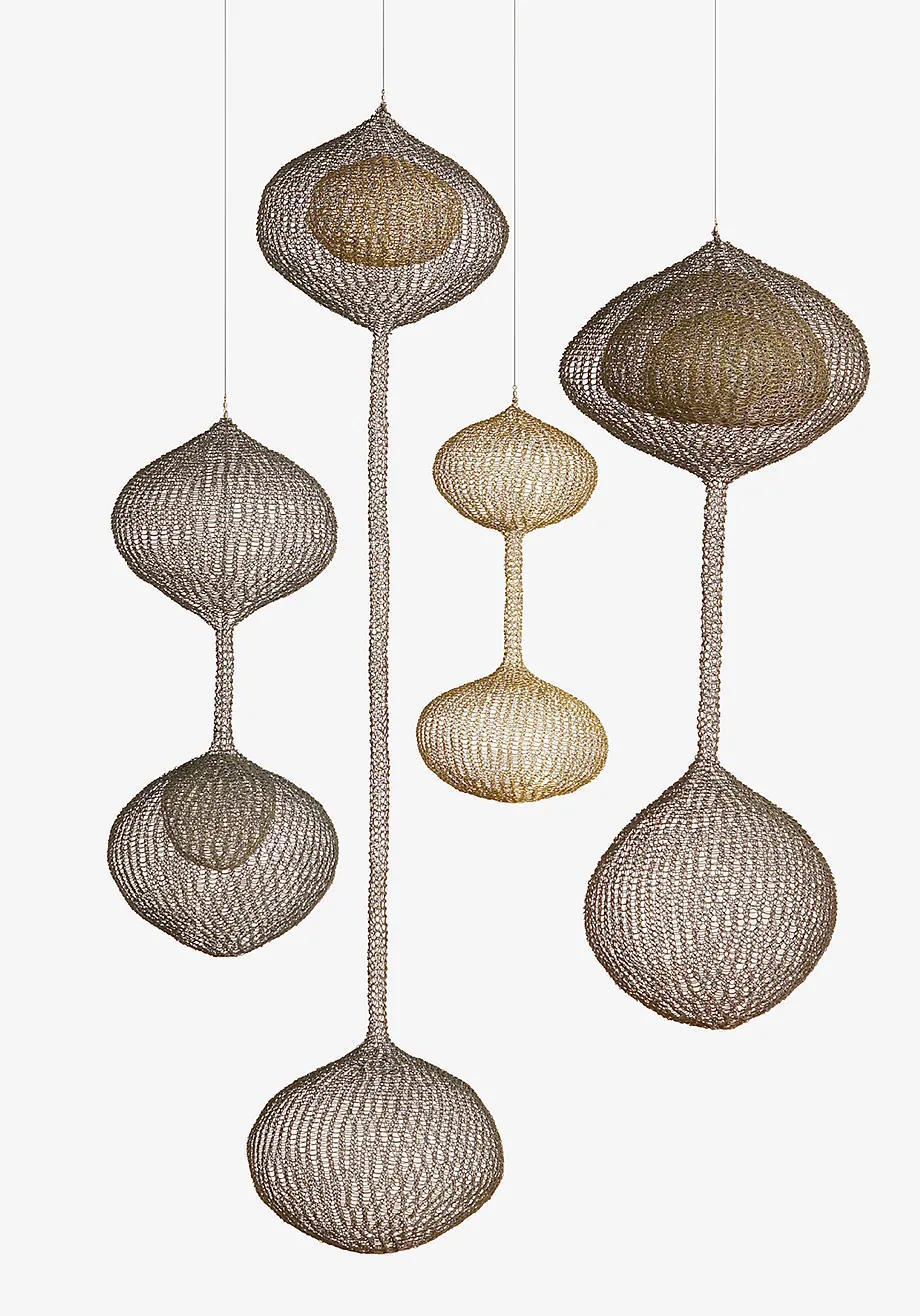
When she was 16 years old, Ruth Asawa (Norwalk, 1926) saw two FBI agents show up at her family's farm to take her father into custody. He had done nothing wrong, except being Japanese in 1942, during the post-Pearl Harbor psychosis. Her mother, her six siblings, and she would not see him again until the end of the war. A few months later, the rest of the family received the order to pack two suitcases per person and report to the former Santa Anita racetrack, converted into an 'internment center' for Japanese-Americans, a euphemism for the infamous detention camps that proliferated in the United States and to which President Roosevelt gave the green light. Over 100,000 citizens - mostly born in the country but of Japanese descent - were detained for years.
In the early 90s, when Ruth Asawa was already a recognized artist with several public sculptures in San Francisco, her city, she was commissioned to design a four-meter bronze memorial in the center of San Jose about life in the camps. Just in Santa Anita, there were around 18,000 people crowded in stables: the most unlikely place for a young Ruth to take her first artistic steps with three Japanese artists who had worked at Disney studios, also detained, and who taught her to draw from life. The hands of the teenager were already weathered: every day, after school, she and her siblings worked in the fields until dark, picking beans, planting onions, sorting tomatoes... The bronze mold of her hands, small, strong, and yet delicate, is one of the most symbolic and evocative pieces of the major retrospective dedicated to her by the Guggenheim Museum in Bilbao, coinciding with the centenary of her birth. It is her first anthology in Spain and practically in Europe (Oxford dedicated one in 2022), which will later travel to the Beyeler Foundation in Switzerland.
"For the Spanish public, it will be a discovery. In the United States, she is already recognized as one of the great artists of the country, although like many other female creators, she was marginalized in the history of 20th-century art," points out curator Geaninne Gutiérrez-Guimarães about another flagship exhibition at the Guggenheim, like that of the Swedish painter Hilma af Klint, the American Helen Frankenthaler, the Japanese Yayoi Kusama, the Brazilian Tarsila do Amaral....
"In the 1950s, Asawa emerged as a powerful creator, exhibited in galleries in San Francisco and New York, participated in the São Paulo Biennial of 1956... Her works appeared in magazines like Time or Vogue coinciding with the rise of minimalism. She is linked to figures like Alexander Calder and Naum Gabo, for her handling of transparency and hanging structures," contextualizes Gutiérrez-Guimarães.
The retrospective is preceded by her great success in the United States: it premiered at the San Francisco Museum of Modern Art, where it received over 285,000 visitors, a record, and when it arrived at the MoMA in New York, it did so in a grand way, with many more works (almost 400) and being the largest exhibition ever dedicated to a woman in the museum's history.
Seeing her spectacular sculptures in the spacious and airy rooms of the Guggenheim, with nearly 250 works, has a sense of historical justice. Asawa applied for a Guggenheim Fellowship three times: in 1952, in 1987, and in 1994. Three times she was rejected, even in the 90s when she intended to write a book about her research to create the San Jose Memorial.
But the word sculpture falls short in defining Asawa. She goes beyond. With a simple wire that she intertwined endlessly, she was able to create a universe natural, spiritual, or abstract. She discovered the technique in Mexico, at the popular market of Toluca, where wire baskets shaped like chickens to hold eggs were common, and she perfected it at the experimental Black Mountain College. But Asawa developed her own path: in her sculptures there is a sense of dance (she studied with the great choreographer Merce Cunningham), the gesture of Japanese calligraphy, a certain Zen spirit... All to form a "continuous form within another form," as she called it herself. Like a Moebius strip.
"Today we value her work beyond the craftsmanship, recognizing her as a precursor of minimalism and concepts like transparency, volume, and space. Asawa challenges sculptural tradition: her pieces are not massive, static, or anchored to the ground, but objects that capture air and volume," points out Gutiérrez-Guimarães. The Guggenheim showcases all facets of Asawa, her nearly six decades of creation, from 1947 to 2006: her prints, her drawings, her early paintings... "In 1989, she was diagnosed with lupus and lost strength to continue with sculptures. Then she focused on drawing the flowers in her garden, creating tirelessly morning, afternoon, and night. Her legacy is impressive, she never stopped," adds the curator. When the wire started to weigh her down, she continued drawing the air.