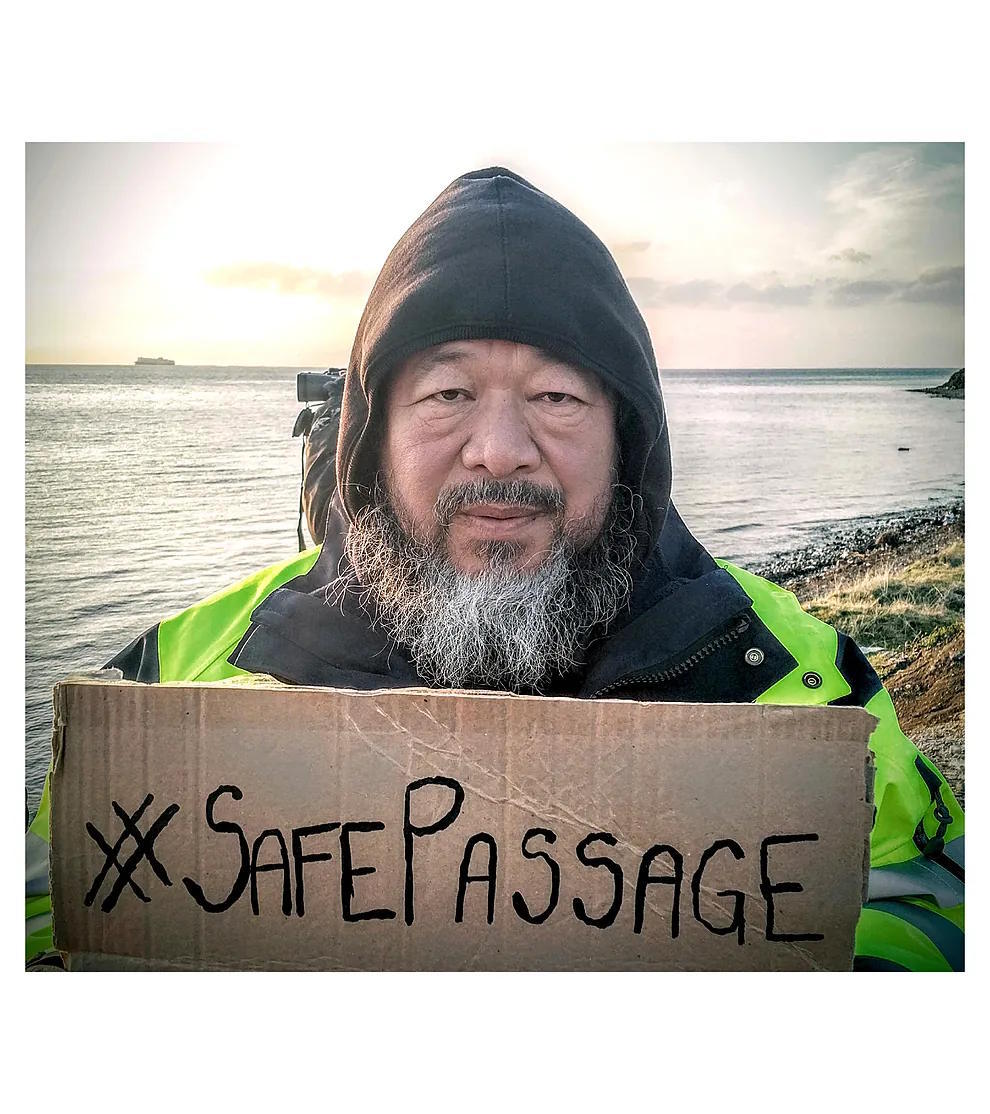
For Ai Weiwei (Beijing, 1957), his own fairy tale was obtaining a passport and visa for 1,001 Chinese citizens to travel to the 2007 Kassel Documenta: unemployed workers, police officers, novelists, street vendors, students, farmers, struggling artists... Most had never left the country before. It was one of the most radical "works" of Documenta 12 due to its political and social implications, denouncing the repression of the Chinese government. The same government that would surveil him in his own home for years, revoke his passport, detain him at the Beijing airport, keep him in a windowless cell for weeks, force him to demolish his studio in Shanghai (literally)...
Weiwei turned all of this into art. Like the piece S.A.C.R.E.D. (2013) depicting his 81 days of captivity in giant dioramas, or the ironic - pay attention to the title - The animal that looks like a llama but is actually an alpaca (2015), an installation of wallpaper with golden surveillance cameras and a reference to the alpaca, a subtle symbol used in China to bypass censorship.
To summarize over four decades of his career, from his beginnings in 1980s New York with only $30 in his pocket, to the past decade where his work has become even more confrontational, Taschen is releasing a comprehensive monograph of over 700 pages. Here you will find everything about Weiwei: when he smashed a millennia-old Han dynasty urn into a thousand pieces (1995), when he filled the Tate Modern's Turbine Hall in London with 100 million porcelain sunflower seeds made by 1,600 workers (Sunflower Seeds, 2010), his selfies during house arrest, his paintings with Lego pieces recreating masterpieces (from Van Gogh to Goya; he actually donated his reinterpretation of The Third of May to the Musac in León), the filming of his first documentary, Human Flow (2017), where he visited over 40 refugee camps in 23 countries, from Iraq to Afghanistan...
In recent months, Weiwei has traveled to Ukraine several times, even visiting the front lines. Last summer, Kiev transformed a former Soviet-era industrial pavilion into a contemporary art center and Weiwei was one of the first to exhibit with his poetic installation Three perfectly proportioned and uniform camouflage spheres painted in white, a dialogue on war and peace, rationality and irrationality. A few weeks ago, he returned to Ukraine to complete filming a movie and several artworks. Upon his return, after a long train journey to neighboring Poland, he boarded a flight from Warsaw to Lisbon. Via email, he says: "I am answering these questions while seated in seat 3A of Polish Airlines; their delicate seats are quite comfortable."
'Three perfectly proportioned and uniform camouflage spheres painted in white' (2025), Weiwei's installation in Kiev.