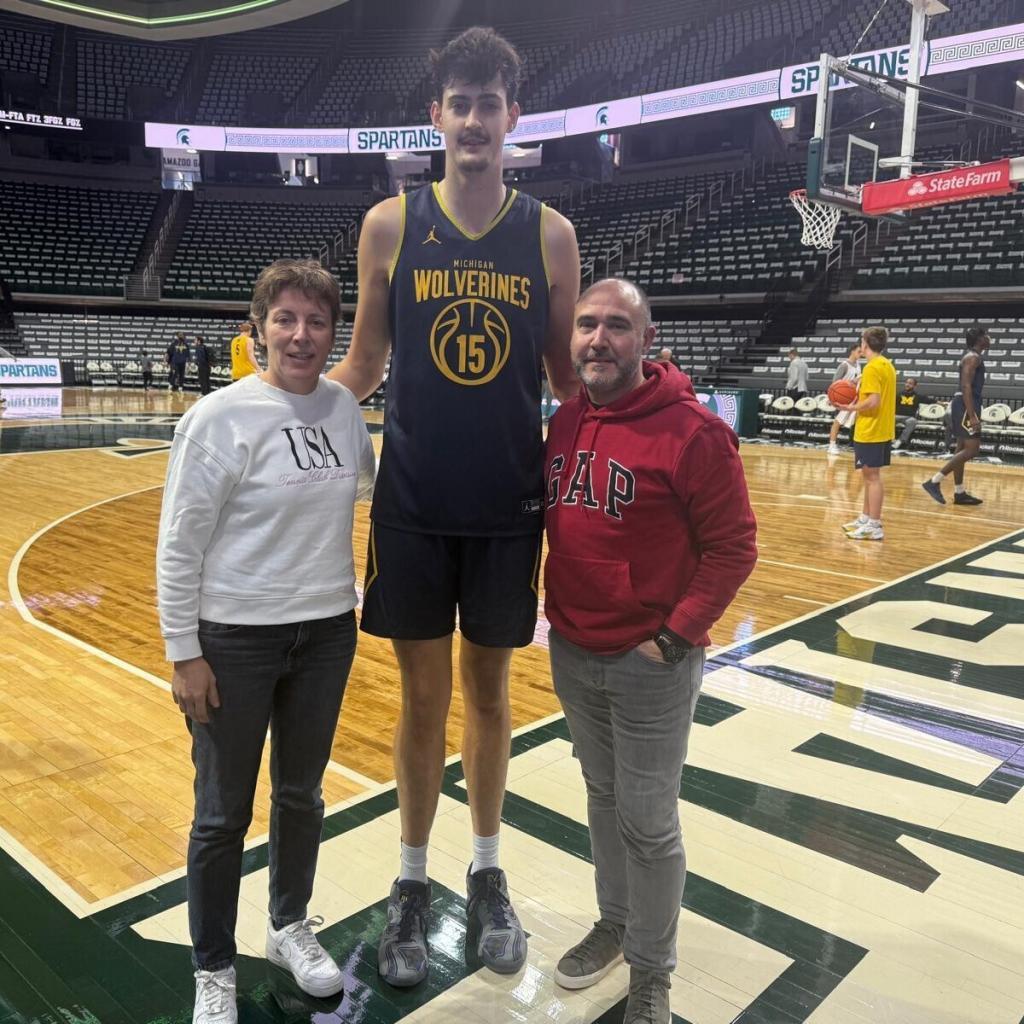
A giant of 221 centimeters and almost 230 wingspan. A giant like Spanish basketball has never seen before. A slowly rising giant, who now, about to turn 21, is irresistibly breaking into the elite. Aday Mara (Zaragoza, 2005) is grabbing headlines and going viral in the NCAA as it experiences its March Madness on the road to the Final Four (in Indianapolis, from April 4 to 6). He is chasing the title with one of the top contenders (Michigan, facing Alabama tonight in the round of 16) and rapidly boosting his credentials for the draft.
He could present his candidacy if, as everyone predicts, Aday is selected among the top 20. Or he could save the bullet for next year. But as his future takes shape (also with the Spanish national team, where Chus Mateo awaits him with open arms: "I have high hopes for him"), we must not forget a few challenging years. For one reason or another, everything seemed to get tangled up in Mara's journey, the son of a professional player and one of the legends of Spanish volleyball, the Canarian Geli Gómez.
"Aday's evolution is very positive. This year, he is being as important as he had not been in the previous two at UCLA. Michigan has trusted him from the start. He has the ball, is playing high-quality minutes, and contributing in many ways: rebounding, assisting, scoring from the low post, even a bit further out, and blocking shots. Especially shot-blocking, which is a huge virtue and truly he is a game-changer defensively," explains the Spanish coach to EL MUNDO about the perceptions of the center. Mateo visited Aday in Ann Arbor at the beginning of the year. He talked with his coach, Dustin May. The same coach who called him after two years at UCLA where Mara was always under suspicion. "Now I have confidence. I was afraid of making mistakes, I looked to see if they were going to sub me out," he admitted recently on Drafteados.
Under the Bruins, under Mick Cronin's command, he played 61 games but only started nine. In Michigan, he has doubled his minutes and production: from five points, 3.1 rebounds, and 1.2 blocks to 12, 6.9, and 2.7. He started shooting threes and was named the best defender in his conference, the Big Ten, the same conference the Wolverines - unforgettable those Fab Five who lost the finals in '92 and '93 - conquered five years later, losing just three games all season. "He has improved in something that is surely important for his future: his love for basketball. You can see he is passionate right now, obviously because he feels useful and part of what he is experiencing. He has regained a hope that he possibly didn't have in previous years," praises Mateo, who also values the learning from tough moments: "They have helped him work against adversity, which always helps to grow."
In the American universe, they value Mara's differential size, of course. But what made the Aragonese player special was his early intelligence, his passing ability. From that U17 World Cup in Malaga where he won silver with Spain to his early flashes in the ACB with Zaragoza. He left the club where he grew up in a bad way, and that started to complicate his path. All forgotten, like his two years at UCLA. "May spoke very highly of Aday to us. He was very pleased with how he was evolving, with how his teammates respected him for being a player who understood the game. He valued this a lot, spoke very highly of his education in Spanish basketball in terms of competitiveness and game knowledge," Mateo recounts from his meeting with the Michigan coach.
And the coach outlines the path that could soon lead him to become the leader of his national team. Without haste but without pause, perhaps even in the upcoming windows in July. "Hopefully, he will be with us very soon. The sooner, the better for him and for everyone. So that he can start making right and wrong decisions with the national team, to have experiences, to feel the team as his own," he acknowledges. "He will be around for many years. I consider him a player of the future, but also a player of the present. It is important that he continues working and, above all, that he is not pressured prematurely. We must let him mature," he concludes.