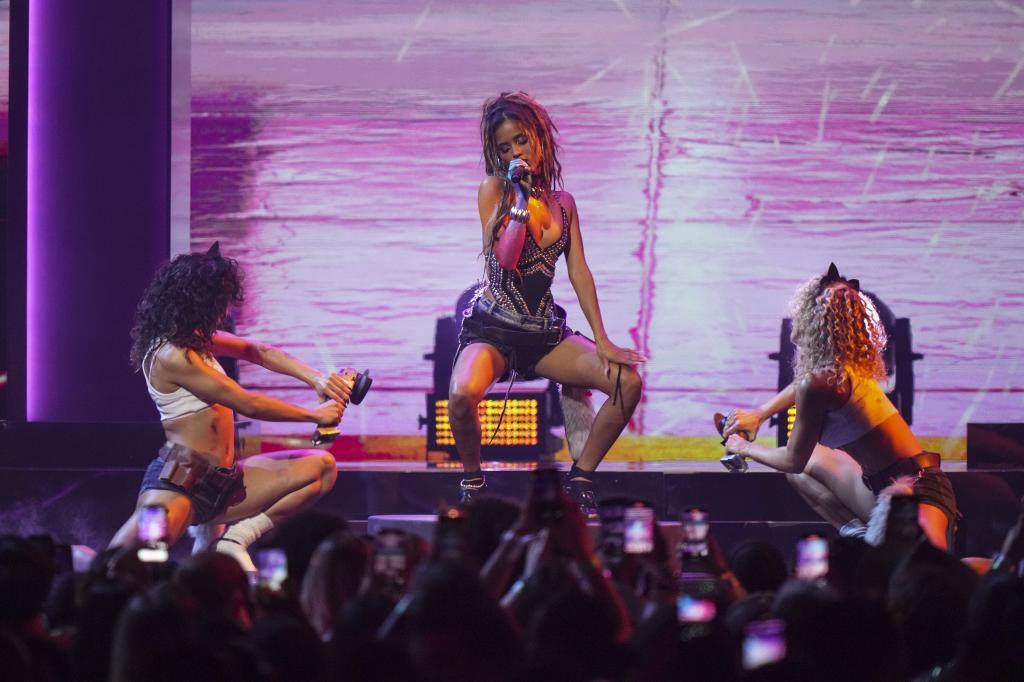
You've had a catchy tune stuck in your head for days and you're not sure where it's from. It happens to all of us: a catchy snippet on TikTok, a leaked chorus in a live stream, an impromptu dance on the street. The music video for your next favorite song doesn't exist yet, and maybe it never will. The lyrics and melody circulate in small doses, like a fuse that hasn't fully ignited. If it catches on, it multiplies. If not, it evaporates.
"The orthodox music video has been displaced in the pantheon of contemporary entertainment," says Noel Ceballos, music journalist and pop culture expert. "This process is changing the way songs are marketed; it's another maneuver designed to maximize plays on streaming platforms, as many people don't get past the first five seconds of a song before moving on to the next one."
Since MTV began broadcasting in 1981 with a promise of uninterrupted music 24 hours a day, the relationship between image and sound changed forever. Songs were no longer just heard; they were seen. The channel served as a global showcase that legitimized the music video as a space for constructing collective imaginaries. "In reality, at first this new reality received a barrage of criticism. Many saw the music video as a tool of the industry to restrict the listener's freedom to imagine what the song was about, as well as a danger to young people," explains Eduardo Viñuelas, professor of Musicology at the University of Oviedo. "It was later on when it became an icon of popular culture and a generational anchor for those who grew up in the 80s and early 90s."
The music video ceased to be an accompaniment to become a device that set trends in aesthetics, fashion, and public conversation. It became a territory for formal experimentation and a creative laboratory for directors who later transitioned to film. Each premiere was practically an event: they were large-scale productions with their own narrative, multi-day shoots, and million-dollar budgets.
Fast forward to 2026, the inevitable question arises: Has the music video died, or has it simply taken a discreet backseat?
"There are cases where the music video is the next layer after the song, the starting point for other additional content, and others where it is part of a broader toolbox," explains Domingo Olivo, Marketing Director at Sony Music Spain. "In a world saturated with advertising messages and entertainment offerings, with a high deficit of audience attention, we have to be more original. Just take a look at the cultural impact and conceptual ambition of Rosalía at Berghain."
The first golden age of this model began with the arrival of YouTube in 2005 and the subsequent birth of VEVO, an international service that hosted high-quality music content. The music video then became a measurable digital event down to the second; the viewing figures in the first few days were practically headlines. Adele surpassed 1 billion views with the official video for Hello in less than three months; Shape of You by Ed Sheeran reached 4.5 billion in that time, and Despacito by Luis Fonsi featuring Daddy Yankee remains the most-watched music video in YouTube history with 8.96 billion views.
However, since January 17, YouTube has stopped providing playback data toBillboard, which measures song popularity in the United States, as its new chart configuration methodology ignores fans who consume music for free on video-on-demand services.
Viñuelas recalls that when music videos started being made for the internet, they "included easter eggs, hidden messages that required multiple views to discuss them in forums." Today, platforms like TikTok have further altered the dynamics: virality no longer depends on a closed piece but on its ability to fragment into 15 to 45-second clips. The algorithm prioritizes repetition, participation, and remixing.
For Itziar Oltra, a teacher and content creator specializing in marketing, the music video has not died, but it has ceased to be the core of promotional strategy. Its function has shifted to a more diffuse territory, where the image no longer belongs to a single piece but to a continuous flow of content: "It has become a tool for storytelling, more of a support than a pillar. Nevertheless, it remains symbolic within the artist's narrative universe."
"In a world saturated with entertainment offerings, we have to be more original with each new release."
Budget priorities have also changed. Now there is also a focus on developing attractive visualizers, promoting acoustic sessions, investing in playlisting on Spotify and Apple Music, or designing specific viral challenges for TikTok. The logic is no longer to concentrate resources on a single piece, but to disperse them across multiple touchpoints with a user accustomed toendless scrolling. In this regard, Olivo explains that at Sony Music, a significant budget is allocated to audiovisual content "to accompany the artist on their creative journey," and in the last five years, investment in visual works has grown to represent 33% of spending on projects by Spanish artists: "We seek filmmakers and audiovisual production partners who understand the artist and their musical work, and who embrace the entire narrative strategy to deliver the whole of its parts."
"Campaigns are not only structured around a release, but around an entire ecosystem of content and trends. Not adapting implies losing acquisition channels, as has historically happened with each new medium," states Oltra. "Short audiovisual formats circulating on social media serve as effective hooks: they guide users' attention to other content," Viñuelas agrees. "It's a transmedia logic by which teasers, lyric videos, behind the scenes, or making of complement fans' experience."
Artists like Rosalía or Sombr, among others, have used social media to test sounds and concepts before formally releasing songs, in order to gauge their potential success. Aitana generated anticipation with snippets of the composition of 6 de febrero in her documentary Metamorfosis before venturing into any traditional rollout. The same happened with the numerous dance challenges for Superestrella on TikTok, propelling it to the top of the charts in November. "There are songs that seem to be written with the platform in mind, either by the lyrics or even by the potential dance it could generate," admits Oltra. "Even if all the ingredients that should make a song go viral are added, the algorithm plays a key and unpredictable role, as does the investment in creators and the platform itself to promote the selection of certain audios in video dissemination. Creative differentiation remains the only non-replicable factor."
International artists like Taylor Swift have also reduced the number of official videos in their recent releases to prioritize a more distributed strategy. The release of the video for The Fate of Ophelia, the first single from her latest album, premiered in movie theaters before online platforms as bait for a film that included the lyric videos of the other songs. Essentially, promotion has become a laboratory. A choreography or a phrase can circulate autonomously and generate millions of views before an official video exists. Sometimes, that virality comes after the song has already been a success. Other times, and despite everything, it never comes.
"The displacement of the orthodox music video is a maneuver to maximize plays on streaming platforms."
"The audiovisual aspect of a song has always been a combination of artistic expression and marketing formulated to enhance the listeners' experience. That hasn't changed since music videos were invented," argues Olivo. "If the artist shares content that fosters algorithmic trends prior to the release, it multiplies the anticipation campaign we are editorially working on. Everything serves to fuel the transmedia narrative of an album."
The gradual disappearance of VEVO and MTV's music channels in Europe symbolizes a changing era. The network that made the music video the dominant language has been relegating music to the margins in recent years. "It hasn't been a shadow of its former self for years. Since the late 90s, they've been airing more reality shows than music videos," notes Viñuelas. But reducing it all to nostalgia would be simplistic. Experts agree that the music video remains a powerful tool for consolidating an artist's aesthetic universe and expanding their narrative. What has changed is its hierarchy: it has ceased to be the centerpiece of the strategy and has become just one more piece within an ecosystem where attention is increasingly fleeting.
"My feeling is that in the future, many versions of the music video will coexist, without any one being hegemonic on its own. The format will be an extension of proposals that transcend the musical. In many cases, the music is the least important thing," asserts Noel Ceballos. The Marketing Director of Sony Music Spain agrees, stating that the spirit of MTV, "seeing the music," remains powerful: "Audiences have fragmented, platforms have multiplied, and the brand hasn't survived; but the music video and its audiovisual counterparts, on the other hand, are more alive than ever."
For decades, the music video was where music took shape. Today, that shape is breaking down into short clips, vertical screens, and ephemeral trends. Perhaps we're not witnessing its death, but rather its definitive mutation. The question is whether there's still room to transform three minutes of a song into a small, shared cultural event, or if it's enough for the algorithm to simply make it dance.