Curacao, Cape Verde, Jordan, and Uzbekistan will participate in a World Cup for the first time, Haiti and Congo will return after 52 years (Congo played in 1974 as Zaire), Iraq will return after playing in Mexico 86, Austria, Scotland, and Norway have not been in one since France 98, Czech Republic since 2006, and Bosnia, which once again left Italy out for the third consecutive tournament, has secured a spot 12 years later. These are the advantages of the expansion of the World Cup to 48 teams, a detail that broadens the map of the edition and allows for "a better representation of the planet," announced FIFA in 2017, the year of the final decision. 104 matches, previously 64, marked by the at least three that Iran will play on U.S. soil in the midst of the war in the Middle East, filling the approach to the event with uncertainty.
"Iran will play in the World Cup and will play their matches where they were drawn," announced Gianni Infantino, FIFA president, after the Iranian Federation requested to move their group stage matches to Mexico due to alleged security concerns.
A couple of weeks ago, Donald Trump stated that the Iranian national team was "welcome" to the World Cup in the United States but added that he did not believe it was "appropriate" due to "risks in the current context." If nothing changes, Iran will play in Los Angeles against New Zealand and Belgium and in Seattle against Egypt. "FIFA will continue to support the team to ensure the best conditions for preparing for the World Cup. I look forward to them sending a positive message to the world," Infantino reiterated yesterday.
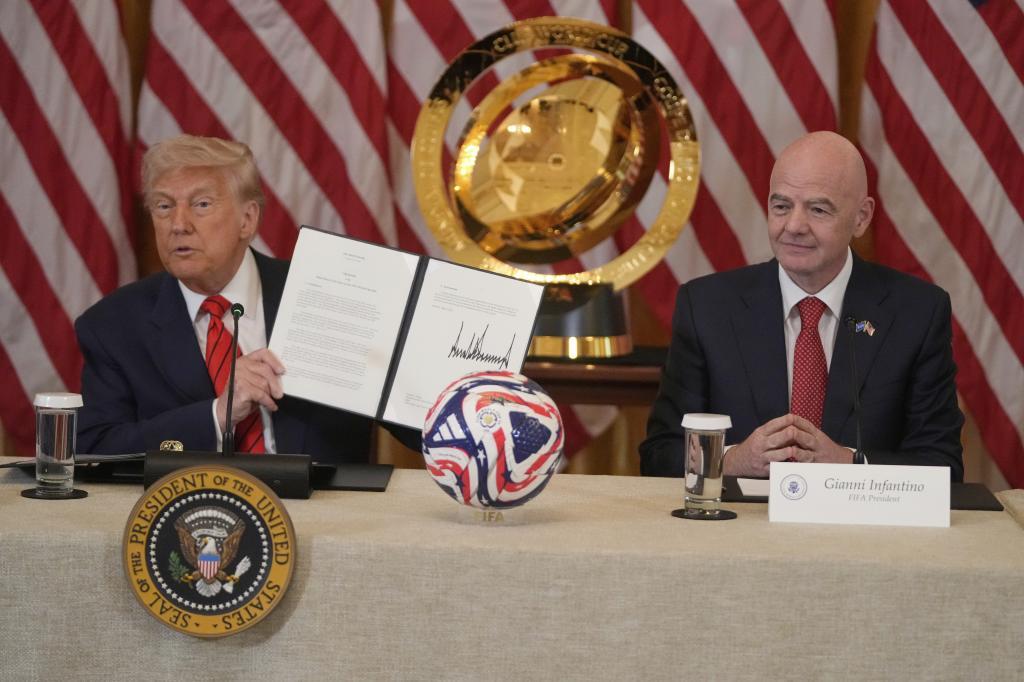
The escalating war in Iran and the countries of the Persian Gulf has put Infantino, an ally of Trump in recent years, in a difficult position. The FIFA president awarded the FIFA Peace Prize to the U.S. president during the group stage draw, just after Trump did not win the Nobel. Another detail showing the good relationship between them, crucial also for the good relations between FIFA and several countries in the Middle East.
The FIFA statutes do not contemplate a hosting country being at war, but in its article 3, it demands that the organization commits to respecting international human rights standards, and its article 4 states that all this must be done "in absolute political neutrality."
Beyond the war, the World Cup faces uncertainty due to internal issues in the United States and Mexico. In Trump's country, protests continue over the actions of ICE, the Immigration and Customs Enforcement. Amnesty International has denounced "arbitrary and mass detentions and the deportation of over 500,000 people in 2025."
"The wave of illegitimate detentions and deportations, which has broken records, has only been possible through the erosion of due process safeguards and has undermined the rights to freedom and security of hundreds of thousands of migrants and refugees. These policies have shattered communities and created a climate of fear throughout the United States. The country is experiencing times of uncertainty that will undoubtedly extend to fans who wish to participate in World Cup celebrations," says Steve Cockburn, director of Economic and Social Justice at Amnesty International.
There are explicit travel bans for citizens of Ivory Coast, Haiti, Iran, and Senegal, who will not be able to enter the country to attend the World Cup unless they had a valid visa before January 1, 2026.
As for Mexico, its issue is drug trafficking. The government has mobilized 100,000 security agents, including military personnel, in response to high levels of violence since the death of El Mencho, the most wanted drug lord, after a shootout with the army in which over 20 National Guard members died. Guadalajara, the city where the most dangerous moments have occurred in recent weeks, will host four matches, including one featuring Spain, and the government continues to use 24 surveillance planes and 33 drones while Trump continues to threaten to bomb drug cartels.
These situations leave the World Cup with many uncertainties, while the sporting aspect focuses on the expansion to 48 teams: 16 from UEFA (Europe), 10 from CAF (Africa), 9 from AFC (Asia, including the Australian national team, which plays in that confederation), one from Oceania (New Zealand), six from South America, and six from Concacaf (North America). All in five additional weeks of competition added to an already tight schedule and a title for which, it seems, there is no clear favorite. Spain will seek glory.