They are named Digit, Atlas, Aeon, Optimus, Cyberone, or Calvin and would be the desire of any human resources manager in a car factory. In a sector where absenteeism has doubled since the pandemic - reaching nearly 10% - none of these 'employees' complain, ask for vacations or pay raises, nor do they stop to eat.... If anything, they require a thorough check-up from time to time to continue working tirelessly.
But we are not talking about those large articulated arms that have been moving large car body parts from one side to the other for decades or welding them with millimeter precision thousands of times a day.
Nor are we talking about the friendly developments of companies like Honda, with the Asimo launched in 2000 and retired in 2020; or the more recent ones from Chinese companies Xpeng or Chery, which have designed a kind of cyborgs oriented more towards interacting with humans, serving them, or taking care of the elderly.
We are referring to the latest humanoid robots, a kind of friendly Terminator with a design and articulations that mimic ours and whose presence will become increasingly common in car factories thanks to Physical Artificial Intelligence (AI). In other words, robots based on AI capable of learning in real industrial conditions.
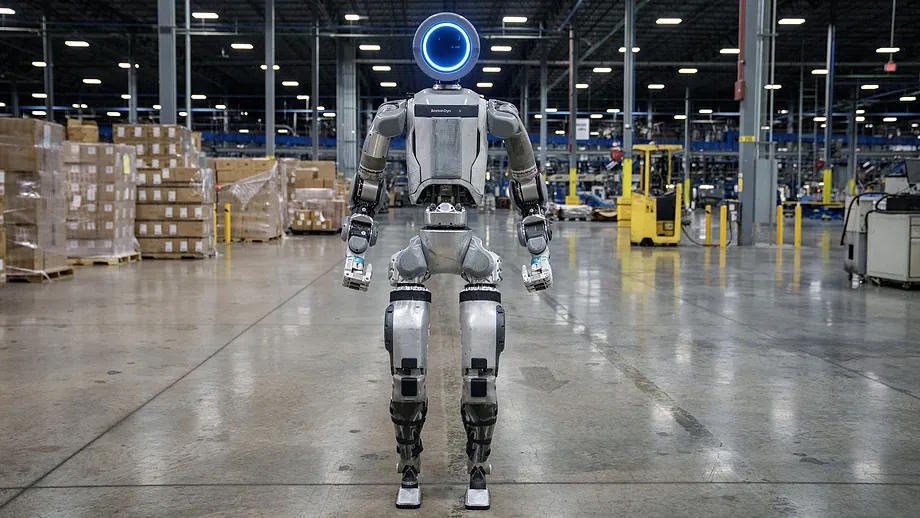
For example, Hyundai has had Spot for years, an agile quadruped that collects data and supervises safety. Or Stretch, a warehouse robot, that has unloaded over 20 million boxes since 2023. However, the evolution of the species arrives with Atlas, which made its debut at the last CES in Las Vegas.
Hyundai plans to manufacture 30,000 units per year of its Atlas model
Capable of lifting 50 kilograms
It is a 1.90 m tall device with 56 degrees of freedom in its joints - most of them fully rotatable - and human-scale hands with tactile detection. Additionally, it can work outdoors, lift loads of 50 kg, and excels in environments that require repetitive and exhausting manual work.
In other words, tasks such as transporting parts or tires that "compromise the ergonomics of people" according to Renault and which Calvin - their particular version of a robot worker - already takes care of in Douvet, France. In total, the company will deploy 350 of them in different factories within 18 months.
Hyundai's plans are much more ambitious. They plan to manufacture up to 30,000 units per year of the Atlas model starting in 2028, when they plan to introduce it to their Georgia plant (USA) and start training it. Initially, it will focus on part sequencing, to be capable of performing complex assemblies by 2030.
Although the manufacturer's unions in South Korea have already warned that they will not allow any robots into the factories without prior negotiation, Hyundai insists that they are not looking to replace humans with machines, but to "establish a safe and collaborative relationship between both, starting with manufacturing environments."
Technology company Xiaomi proposes a similar approach with Cyberone, the humanoid they designed in 2022 - at a cost of around 100,000 euros per unit - and have started using in the factory that produces their electric vehicles. The company's president, Lu Weibing, does not refer to them as workers but as "interns" since they do not have a defined task and are experimenting. For now, they are handling simple missions like moving components from one place to another or placing parts.
The tests conducted have been successful. Placing a nut may seem simple, but the robot has to pick them up from a dispenser, turn around, and place it exactly in its place while also keeping up with the assembly line speed, which produces a vehicle every 76 seconds. Therefore, Xiaomi believes that in five years, these machines will be just another one of the workers in their factories.
Mercedes-Benz, Toyota, or BMW are also working in this field. The first has Apollo, a robot barely 1.20 meters tall that they are training at their digital campus in Berlin to become "a reliable assistant for tasks such as logistics, assembly, and quality control." Functions very similar to those that Digit (1.75 meters tall) will perform in Toyota Canada.
As for BMW, last year they already tested the humanoid Figure 02, which helped in the production of over 30,000 units of the BMW X3 in Spartanburg (USA). Working 10-hour shifts from Monday to Friday, it was responsible for removing and positioning sheet metal parts for the welding process and in that time, it moved over 90,000 components.
Now, it will be succeeded by another named Aeon, which, after several pilot tests, will sign its first employment contractthis summer at the Leipzig factory in Germany. It will be used in the assembly of high-voltage batteries and in component manufacturing.
Of course, Tesla could not miss out on this party, with its Optimus. Initially designed for more social tasks, it will also have a place in the company's factories. Interestingly, it will be installed in the Texas plant where the Model S and X were previously assembled.
According to the consulting firm Accenture, the integration of Physical AI combined with robotics and digital twin technology applied to factories could help reduce costs and time to market by up to 50% or even more. McKinsey estimates that $150 billion annually could be freed up to boost R&D.
So, the inevitable question arises: Will there be vehicle factories without humans and when? This is a critical step due to the significant impact on employment, although - as will also happen with electric cars, which require less labor - many workers could be retrained for new roles.
First Dark Factory in China or the USA
Regarding this matter, Automotive News reports the opinions of experts from Gartner and Warburg Research who first point out that cars, or at least their assembly, would need to be redesigned to allow humanoids to handle the cable harnesses or assemble interior components.
That said, they believe that it will be a US or Chinese manufacturer that will have a factory of this kind by 2030. In fact, in the latter country, there are already examples of so-called Dark Factories in other areas, as they are operated 100% by robots and do not require lighting like traditional factories.