They say that George Clooney always jokes about the names he wanted to give his children: House and Friend. Just like that, in Spanish. His wife, Amal, obviously refused, but the actor used the combination of the terms, Casamigos, to name the spectacular twin mansions he built with his best friend, Rande Gerber, husband of model Cindy Crawford, in Los Cabos, the paradisiacal destination in the Mexican state of Baja California Sur linked to luxury, glamour, natural beauty, and a laid-back lifestyle. There, between the Pacific Ocean and the Sea of Cortez, in the exclusive community of El Dorado, surrounded by golf courses designed by Jack Niklaus (the greatest player in history), Clooney placed these residences designed for socializing.
Hence the common hall or the open kitchen with a central bar to socialize for hours with tequila in hand. However, they did not find any that fascinated them, so they used the Casamigos name again to create their own, soon becoming a millionaire brand.
So, the star of Ocean's Eleven serves to illustrate the high standard that is customary in Los Cabos, the southernmost enclave of the Baja California peninsula —referred to as the "edge of the Earth"— and the one that concentrates the highest number of rooms in ultra-luxury hotels and villas in all of Latin America: more than 3,000 (with prices up to 50,000 euros per night) out of the 19,000 offered by this municipality of 350,000 inhabitants where private jets are a daily sight. Moreover, this sector has increased by 80% in recent years, according to the Tourism Trust.
This is the case for the long list of celebrities who, like Clooney, often visit or live in Los Cabos. From Britney Spears (official resident) to Shakira, Nicole Kidman, Madonna, Leonardo DiCaprio, Justin Bieber, Jezz Bezos, or the Kardashians, whose reality show was partly filmed in "Cabo," as Beyoncé says. Jennifer Aniston celebrated New Year's Eve here, and Selena Gomez had her bachelorette party here.
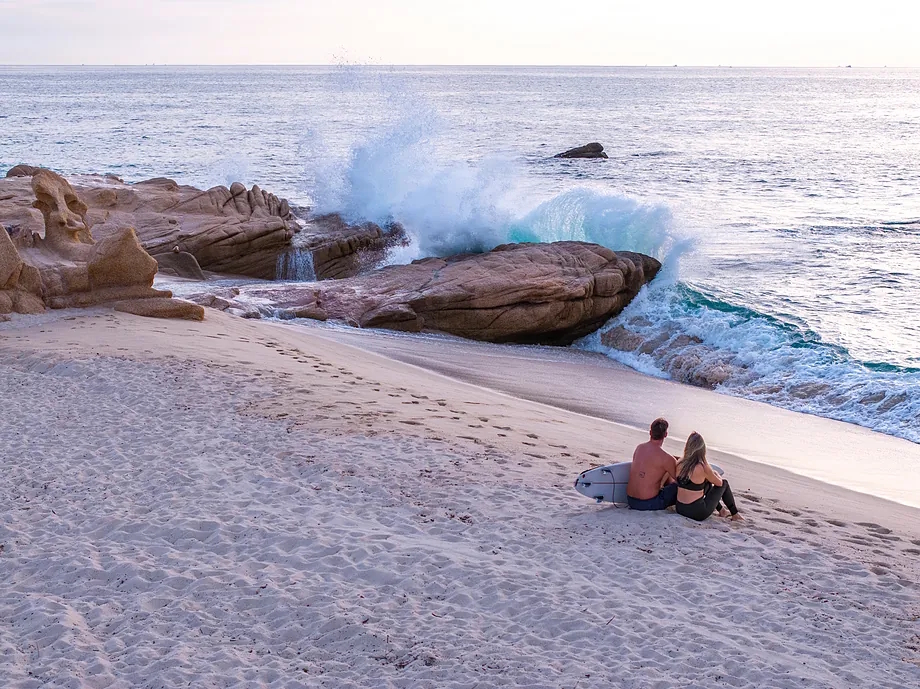
The passion of the celebrities is not new. The Hollywood actors of the 1950s were the first to land in this wild refuge crossed by the Tropic of Cancer with 355 days of sunshine a year, a privileged microclimate (always around 25º), turquoise beaches, endless deserts, breathtaking sunsets, and an underwater world where turtles, humpback whales, marlins (it is the world capital of this fish), manta rays, and 900 more species thrive, which is why Jacques Cousteau himself described the place as "the aquarium of the world."
Especially Cabo Pulmo, a national park UNESCO World Heritage Site still untouched, which can be explored by jeep through a desert full of choyas —the local cactus; hence the locals are called choyeros— leading to beaches with pure waters where surfing and diving take on a different dimension. It is part of the 42% of protected territory in the state.
The discovery of this brutal California is blamed on Lucille Bremer, an American actress who triumphed on the big screen dancing with Fred Astaire and who married Abelardo Rodríguez Jr., son of the former Mexican president of the same name, so she spent a lot of time here. It was she who first brought John Wayne, Bing Crosby, Steve McQueen, Liz Taylor, James Dean, and other friends from the film industry and beyond, like writers Ernest Hemingway and John Steinbeck —his novel The Pearl is set here—, President Dwight D. Eisenhower, and Conrad Hilton, the hotel chain founder.
They all promised an oasis of sun, relaxation, and privacy just a jet ride away from Los Angeles. "Rodríguez himself was a pilot and also the owner of the hotel where they stayed, Las Cruces Palmilla, now transformed into the five-star One & Only Palmilla, the favorite of today's celebrities," recalls Diana Rodríguez, a local guide. After a few days of oysters and sea —most of them loved fishing, turning it into a mecca for the sport, which still continues—, they returned delighted, activating the effective word-of-mouth machinery.
Thus, little by little, tourism began to arrive in the real California, the first one, the one named by the conqueror Hernán Cortés recalling the 15th-century chivalry novel Amadís de Gaula by author Garci Rodríguez de Montalvo, "who was inspired by the popular medieval work Amadís de Gaula, mentioned in Don Quixote," our guide points out. In his, he spoke of California Island, located "to the right hand of the Indies, near a side of the earthly paradise. Populated by black women, without a man there. Their weapons were made of gold, and the same metal was used for the beasts' harnesses they used to tame to ride, because there was no other metal on the island but gold," reads the guide. Cortés' troops encountered something like that, although in his California, there were indeed very brave men, the indigenous Pericúes and Guaycuras. Also gold, which is what they were looking for. Them, and pirates like Francis Drake or Edward Cooke.
The exact place where the colonizers arrived was the rock formation of The Arch (it draws that figure), known as "the end of the earth" for its location at the tip of the peninsula, which is its main icon, as well as one of the most used screensavers in the world. It is also believed that in its underwater caves, the treasures hidden by the corsairs that Cortés so desired are still hidden. There are even talks of the abundant telluric forces that roam around.
The best way to discover it is on a cruise through the bay of Cabo San Lucas, the municipality's largest town, with a population of 200,000. From its harbor, teeming with pelicans and where sea lions can already be spotted, yachts, sailboats, and catamarans set out, making stops for swimming, snorkeling, paddleboarding, and scuba diving. Humpback whales and dolphins escort the route, dotted with beaches of the finest sand: El Amor, Santa María, Gavilancito, Chileno, and Faro Viejo—where the movie Troy was filmed, by the way. Meanwhile, you can spot incredible mansions suspended spectacularly above the cliffs. No wonder this is one of the best sailing experiences in the world, according to TripAdvisor.
Adrenaline galore
Back in town, you must check out the artisan markets, the Natural History Museum, the luxury boutiques at the Puerto Paraíso shopping center, the nightlife (it's the ultimate party destination), and urban beaches like El Médano, one of the 25 Blue Flag-certified beaches in Los Cabos. If you want to get your adrenaline pumping on a jet ski or soaring through the air with a parachute attached to a boat (parasailing), this is the place to be. You can ask at the Bahía Hotel's beach club to sign up for a session before pairing ceviche and margaritas on their lounge chairs. Plus, the accommodation is the perfect base of operations for exploring the area. Just like Marquis Los Cabos, a five-star adults-only resort located in the Tourist Corridor a 35-kilometer stretch of idyllic beaches lined with the finest hotels and resorts.
There are countless options for lunch or dinner, as the region is one of the world's hottest culinary destinations. From the homemade tacos and live music at La Lupita to the "contemporary Mexican cuisine" of chef César Pita, who offers "a sensory journey crafted with soul and intention" at his restaurant Fénix, located high above the Pedregal neighborhood, one of the most exclusive in the city. Grilled cuts of meat—the wood-fired grills and brick ovens are right there in front of diners—along with fresh seafood and fish take center stage, as do the views of the bay. The most beautiful sunset, however, is best viewed from Sunset Monalisa, a vantage point for seeing and being seen. The exact moment the sun sets is signaled by the blast of a conch shell. Afterward, two tenors perform opera pieces to accompany Mediterranean dishes with local touches.
Looking for more gourmet options? Try the Nikkei-Mexican fusion cuisine at Toro Cabo or the farm-to-table restaurants, a trend that champions sustainable, locally sourced cuisine. Examples: Jazamango, an open-air restaurant surrounded by its own vegetable gardens; Límo Heritage Kitchen, which celebrates "authentic Baja California cuisine," in the words of its chef, Guillermo J. Gómez; or Acre, with a Green Michelin Star and a farm producing over 60 organic products.
Our next stop takes us to San José del Cabo, the municipality's second-largest town by population (135,000) and one of those charming Mexican colonial-style towns brimming with color and history. The best time to experience its lively atmosphere is Thursday afternoon, when the town hosts its art walk—an invitation to discover the work of local artisans right on the street or in galleries like En Blanco, Corsica, or Iván Guadarrama, featuring fascinating interactive installations.
The cantinas, lounges, and restaurants come alive with live music, signature cocktails, and original botanas (tapas). Don't miss the central church, built on the site where one of California's famous Jesuit missions was founded—missions that still stand in towns like La Paz, Loreto, Santiago (located in an oasis in the middle of the desert), and Todos Santos.
The latter is well worth a leisurely visit, as it is one of Mexico's "Magical Towns," renowned for its rich cultural and historical heritage. Nestled among its cobblestone alleys and brightly colored whitewashed facades are craft shops, cozy cafés, food markets, and numerous studios of painters and sculptors. Not to mention the Hotel California, which, they say, inspired The Eagles to write their legendary song. Or design spaces like Terra Santa, which combines independent boutiques, art galleries, a winery, and an oyster bar in a former sugar plantation.
All that's left is to plan a multi-adventure session in any imaginable form: hiking through the Cañón de la Zorra in the Sierra de La Laguna Biosphere Reserve (with a final dip in the Sol de Mayo waterfall and its natural pools), quad bike, camel, or high-performance 4x4 (RZR) rides along the beach, or—why not—the world's longest bike zip line. It measures 339.39 meters. Are you up for it?
PRACTICAL GUIDE
HOW TO GET THERE
From Spain, you can fly to Mexico City and then on to San José del Cabo.
WHERE TO EAT
The culinary scene offers a wide range of options. From signature restaurants like Fénix, in the exclusive Pedregal neighborhood of Cabo San Lucas, to farm-to-table spots like Acre, Límo Heritage Kitchen, or Jazamango; fusion cuisine (Toro Cabo); or luxury restaurants with stunning views (Sunset Monalisa), featuring Mediterranean cuisine with local touches.
WHERE TO STAY
Bahía Hotel & Beach House (www.bahiacabo.com). An elegant 89-room hotel in Cabo San Lucas offering boutique service, a beach club on El Médano Beach—one of the best in the area—and a water sports center (parasailing, sailing, jet skis, snorkeling...).
Marquis Los Cabos (marquisloscabos.com). A five-star, all-inclusive, adults-only beachfront resort located in the Tourist Corridor. It features several restaurants, infinity pools, shops, and sunrise yoga classes.
MORE INFORMATION
On the Los Cabos Tourism website: visitaloscabos.com And on the website of the tour operator Cabo Adventures (cabo-adventures.com), which organizes all kinds of activities (excursions, diving, horseback riding, 4x4 tours, boat trips, ATV rides...) in the area. Many of these can be enjoyed at the Tierra Sagrada resort in Cabo San Lucas.