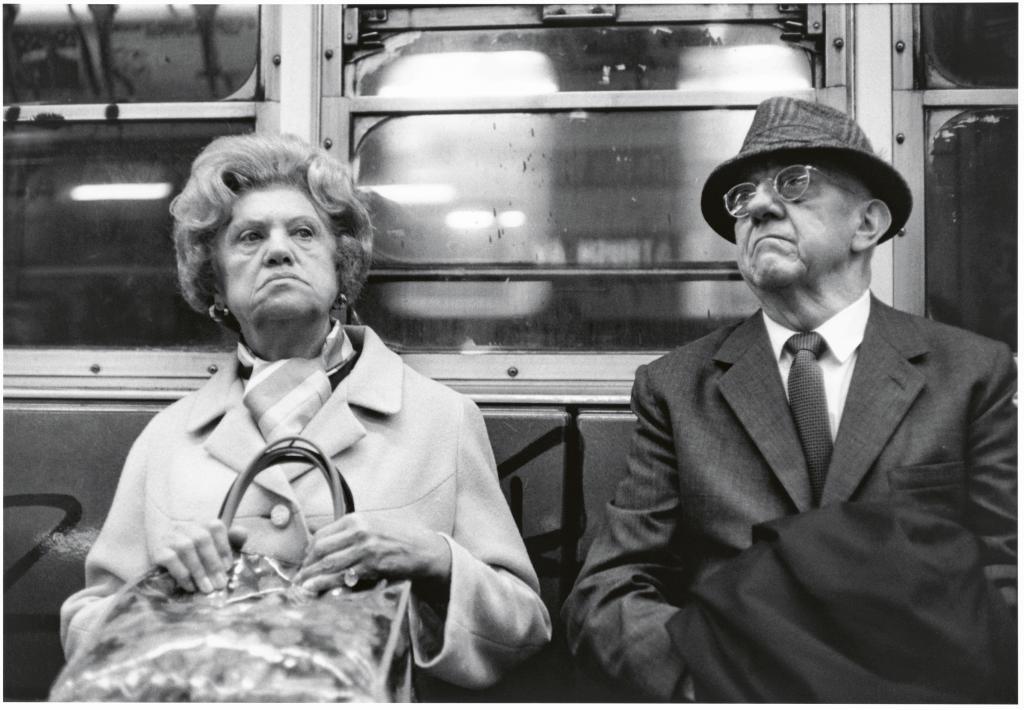
"What an eye she had. Look at how she captured this situation." These words are not from a famous writer or renowned artist. On the contrary, they are from mesmerized spectators, amazed by the depth of the work displayed on the walls. Hands on faces, fingers pointing at photograph after photograph, trying to decipher the motive behind each one. This scene unfolds at the Fundación Mapfre, which portrays the perspective of one of the pioneers of this art. Her name is Helen Levitt (New York, 1913-2009), almost better known as the "poet laureate" precisely for her sensitivity in capturing and understanding the lyricism and rhythm of the environment around her. This title was well-earned after years of expanding her professional career, posthumously becoming an authority from whom inspiration is still drawn today.
Levitt's portfolio spans decades of development and a wide variety of phases. All of them are now part of the Fundación's exhibition, Helen Levitt, which for the first time reveals the entirety of the stored archives, over 200 photographs, and a film titled In the Street. "On any given day, between 1,200 and 1,400 people can visit," the team of workers in charge of the exhibition hall points out. Her work was groundbreaking even back then. In fact, James Agee, one of the photographer's collaborators and friends, described her work as the perfect representation of the "unintentional grace of human existence."
Curated by Joshua Chang, the exhibition explores the professional trajectory of the photographer, who for years chose to capture the reality experienced in the poor neighborhoods of New York. She did so without condescension or from a perspective of moral superiority, but rather as a way to express sensitivity to the most everyday gestures, in a choreography that became her essence. "No one else has made the city pavement resemble a ballet stage so much," noted John Szarkowski, one of the great curators of the New York MoMa, where the photographer herself exhibited her images on multiple occasions.
Helen Levitt is grouped into nine sections, divided between the central and lower floors of the building in a kind of labyrinth that compels the viewer to travel to an almost forgotten reality. Levitt traveled with her Leica camera and photographed what she saw, whether it was scribbles on walls or families from the gypsy community in their daily lives. "All I can say about the work I try to do is that the aesthetics are in the reality itself," she often stated.
In the end, old age and emphysema took a toll on her health, and her professional career dwindled to an intermittent hobby. Her final works were a representation of everything she had captured in the past, like the closing of a life cycle. The "poet laureate" passed away in 2009, but her work lives on in the memory of all who admire it. Exhibition spectators agree with this notion, describing her life project as a "true wonder." And it is clear: she was a pioneer in photographic art, one who managed to capture the pleasures and complexities of human existence.