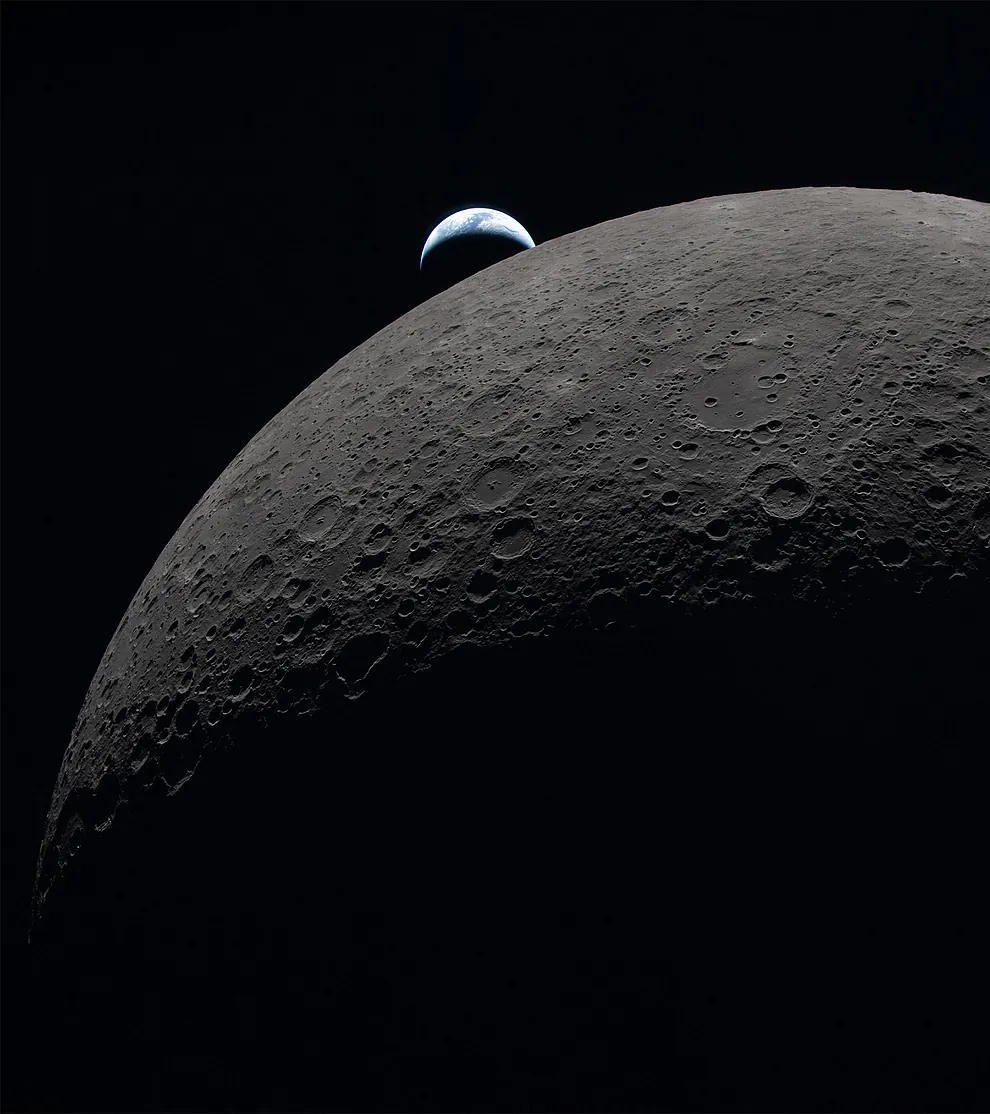
In December 1968, while Apollo 8 orbited the Moon, astronaut William Anders took a photograph that would become more powerful than any speech: the Earthrise, Earth rising over the lunar horizon. More than half a century later, Artemis 2 takes the baton, with Earth dawning again from the far side of the Moon.
Anders' image reached a tumultuous planet. The U.S. was experiencing one of its most violent years with the assassinations of Martin Luther King Jr. and Robert F. Kennedy, racial riots in dozens of cities, and a society torn apart by the Vietnam War. Artemis 2's image, too. With President Donald Trump waging an open war against Iran that threatens to spread across the Middle East, another in Ukraine, and a rift in Europe testing NATO's cohesion.
Anders' photograph served as a moral pause. And now, 400,000 kilometers from Earth, we are reminded once again that no line marks the Donbass, the right, the left, or the races. Just a blue marble floating in the darkness, while microscopic discussions rage. Perhaps that is why, that 60s photograph, like the one taken at 00:41 on Tuesday in Spain from a window of the spacecraft Orion, feels both evocative and uncomfortable.
Apollo 8 orbited the Moon 10 times, and on one of those orbits, Anders captured the bright blue Earth standing out against the immense darkness of space, intensified by the desolate and monochromatic lunar horizon in the foreground: "We came all this way to explore the Moon, and the most important thing is that we discovered Earth," Anders declared upon his return.
As Apollo 8 was emerging from the far side of the Moon, the crew did not expect to see Earth rise over the horizon, unlike now, where many months before liftoff, the exact time was already known. At that moment, the module was oriented in a way that the planet was not visible from the main windows. Then, Anders looked out of one of the side windows and saw Earth rising above the gray lunar horizon. It was unexpected, they would confess. The astronaut quickly asked for a camera. He first took a black and white photo, but then requested a color film while his colleague Jim Lovell helped him change the lens and the roll. In the mission's audio recordings, you can even hear the surprise and a sense of urgency among the astronauts before the spacecraft continued to rotate, and the planet disappeared from view.
In the Artemis 2 photo, once again a faint blue Earth, with bright white clouds swirling over Australia and Oceania, is set against a cratered lunar surface, reminiscent of either the Death Star or a massive clay tennis court after a fierce battle.
"Our astronauts have brought back such exquisite and scientifically rich images that will inspire future generations," stated Dr. Nicky Fox, from NASA's Directorate of Scientific Missions.
The crew shared their memories "while they are still fresh," NASA reported, about their time on the Moon. The astronauts documented impact craters, ancient lava flows, and surface fractures that will help scientists study the Moon's geological evolution. They also monitored differences in color, brightness, and texture on the terrain. And reported six meteor flashes impacting the darkened surface. Six hours of photographs of lunar sections and visual spectacles never before seen by the human eye.
NASA mission specialist Christina Koch mentioned seeing lunar dust being lifted, fine regolith particles, the material covering the Moon, rising from the surface and floating due to electrostatic forces. She and mission pilot Victor Glover also noted that after passing behind the far side, they observed Earth's glow reflecting on the spacecraft's windows. "It was so bright, so bright, it seemed out of place," while "the gray color of the Moon and the black of space seemed to blend together," Glover recounted.
Koch also mentioned how the Moon turned into a "sponge of light" that "lit up when Earth came close enough" into the spacecraft's field of view.
The astronauts discovered on their journey that the satellite is not as gray as it seems, but can also be "brown and matte." "I made some correlations and mentioned that it was like seeing the Grand Canyon, where you can see different layers," Glover narrated.
Among the images is also a spectacular solar eclipse. From the crew's perspective, there was a moment when the Moon became large enough to block the Sun, creating 54 minutes of a total eclipse. The corona formed a bright halo around the dark lunar disk, revealing details of the outer atmosphere that are normally hidden by its brightness. This unique viewpoint provided a striking image, but above all, a valuable opportunity for the astronauts to inspect the corona, protected by special eclipse glasses.
In another high-resolution snapshot, detailed lunar geological features can be seen. Even in the Oriental Basin, the two small craters that the crew proposed naming Integrity and Carroll. The first in honor of the Orion spacecraft that has taken them farther than any human in history, and the second in tribute to Captain Reid Wiseman's late wife, who passed away in 2020 due to cancer. The International Astronomical Union now needs to approve the crew's proposal.
Now, NASA astronauts Reid Wiseman, Victor Glover, and Christina Koch, along with Canadian Space Agency astronaut Jeremy Hansen, are back home. Shortly before 19:30 (Spanish time), they left the Moon's gravity, using it as a slingshot to propel their return, which will be completed in the early hours of Friday to Saturday in Spain.
Shortly after starting their journey, Mission Control in Houston arranged a cosmic chat with the current residents of the International Space Station (ISS): NASA astronauts Jessica Meir, Jack Hathaway, and Chris Williams, and European Space Agency (ESA) astronaut Sophie Adenot. Another milestone in space history. The first radio link between a lunar spacecraft and a space station. Glover, who has experience aboard the orbital laboratory, noted that the main challenge with Orion compared to the space station was the lack of space: "Here we don't have another module to avoid space conflicts. So everything we do essentially starts with a space conflict."
For Koch, the woman who has spent the most consecutive days on the ISS, the main difference with Orion was being able to better appreciate "how much darkness" surrounds Earth, making it "even more special."
At 2:03 (Spanish time), the spacecraft's thrusters were scheduled to ignite for the first of three correction maneuvers, which will adjust the spacecraft's trajectory and refine its course back to Earth. Astronauts Koch and Hansen will then review the procedure and oversee the systems for the return maneuver.
Upon returning to Earth, the crew will endure a high-speed, high-temperature reentry before splashing down in the Pacific Ocean off the coast of San Diego, where they will be greeted by a recovery team composed of NASA and Department of Defense personnel, who will bring them back to solid ground.