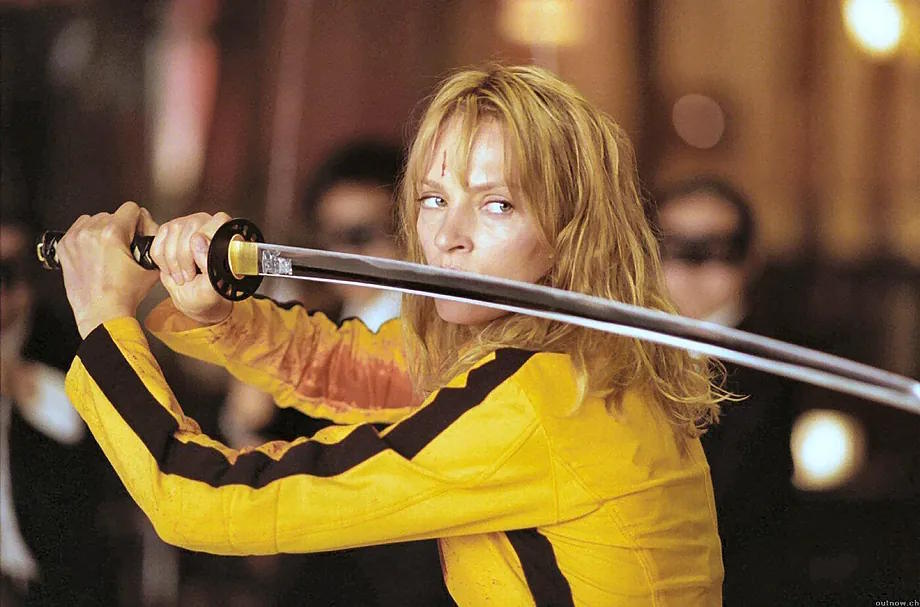
There are many reasons to revisit Kill Bill and probably all guilty. From start to finish, the masterpiece of the always controversial, always impertinent, always brilliant, and always very tiresome Quentin Tarantino (a masterpiece that followed two masterpieces the size of Pulp Fiction and Jackie Brown) was conceived as a film on the margins of almost everything, even of itself. Its vocation for pastiche, remix, and celebration of the most grotesque cinephile nostalgia made it a kind of cult object whose plot was composed of a thousand references themselves cult. Cult upon cult, cinema reappeared as a contradictory experience as pagan as it was mystical. Between uninhibited self-gratification and the simplest and most base of unconfessable pleasures, it was about elevating the geek (before geek became a commodity on Wallapop) to the status of a category.
Gianni Vattimo, for example, and in a postmodern way, spoke of a weak thought (pensiero debole) to designate a philosophy that abandons strong metaphysical foundations and renounces the concept of history (or History) as a unitary and linear progress. The idea is not so much to surrender to the flabby relativism of anything goes as to accept the challenge of embracing multiplicity, change, transience, and difference as a source of meaning. In essence, and without forcing the metaphor more than necessary, Kill Bill as a project becomes strong in that same weak ideology of cinema understood not from the inviolability and seriousness of the canon but from the playful diversity of all its bastard, violent, macho, and exploitative forms (all guilty) where what matters is not so much the learned opinion of the critic (white heterosexual man) but the act of resignification and reappropriation (what was once misogynistic is now bloodily feminist) for the emancipating and somewhat terrorist enjoyment of the free spectator, free from burdens and even from judgment.
All of the above, in its happy confusion, became clear in the first and second volumes released for strictly commercial reasons six months apart (330 million dollars raised worldwide are proof of the convenience of the decision) in 2003 and 2004. But in the mind of its creator, the over four-hour film was just that, a unique film without fractures. Or rather, it all had to be a fracture, a fracture with the past, with history, and with, once again, single thought. Its duration was art and part of the ideology. The film functions, so to speak, like a Sufi ritual determined to break time itself through a kind of dynamic meditation seeking union with God through constant rotation.
The plot is not even a plot. Kill Bill is simply five fights intertwined with diverse and disruptive stories. O-Ren's origin (Lucy Liu) in anime format, the long scene of our heroine The Bride (or Beatrix Kiddo or Black Mamba or Mommy or Arlene Machiavelli) with the sword maker, Elle Driver (Daryl Hannah) reading data on venomous snakes copied from a website, Bill's final monologue reflecting on Superman... Everything is nothing more than ruptures, one after another, in a crazy cinematic, musical, and memorial DJ session.
Therefore, Kill Bill: The Whole Bloody Affair is so enjoyable and timely, which is basically Kill Bill Volume 1 and Kill Bill Volume 2 together, but without that fracture in the middle that contradicts all the original infinite fractures. There is, however, a 15-minute break to visit the exclusive lobby or to use the restroom. And what's new? Quick answer: nothing. If you want details, that's another story. In truth, back in 2006, Tarantino combined the two parts and proceeded to screen them both at Cannes and in his own theaters in a 270-minute version of the story of a revenge-seeking former assassin who was brutally attacked on the eve of her wedding by her former boss and lover (Bill) and his four lethal colleagues (remember the fictional Fox Force Five series that appears in Pulp Fiction). What he did on that occasion was more about subtracting than adding. And the same goes for now.
The most relevant, affecting the very sense of the narrative, happens at the end of the first part. Or rather, it doesn't happen. Bill's dialogue (David Carradine) revealing that The Bride's daughter is alive is suppressed. In both the original version and in The Whole Bloody Affair, Thurman's character becomes aware of her offspring's existence at the end. Now the audience (or the new audience if it exists) will learn the good news along with the protagonist. The introduction in black and white that served as a summary to reintroduce Volume 2 is also removed. It's not necessary, although, truth be told, we liked it. But it's not all about removal. The mentioned animated chapter includes an additional action sequence where a young O-Ren fights another. Furthermore, the unforgettable scene of the House of Blue Leaves and the Crazy 88 regains its original color. Worldwide, except in Japan, it was turned black and white to mitigate the blood effect and avoid an NC-17 adult rating. Another opportunity to revel in the vivid, harsh, and hyper-realistic photography of Robert Richardson.
It is surprising that the additional scene on the DVD where Bill excelled with mastery has not been inserted. Even more surprising is that, after the credits, the new version adds another animated chapter where Yuki, the twin sister of the assassin with a schoolgirl appearance Gogo, seeks her own revenge against, of course, The Bride. Revenge for revenge. This sequence, as Tarantino confessed at the time, was exclusively in the first draft of the script. The surprise comes from the fact that The Lost Chapter: Yuki's Revenge, as it is called, was created last year for the video game Fortnite. Tarantino and Thurman used motion capture technology and for eight debatable minutes, some characters from the video game are even visible. On the other hand, it must be acknowledged that the idea or discovery, depending on how you see it, adds another rupture to the catalog of infinite ruptures that is Kill Bill.
And having said all that, postmodernities, versions, and fragmentations aside, what remains and admits no doubt is Uma Thurman. Uma Thurman in the best performance of her career and many others. Uma Thurman as a wounded animal capable of the most brilliant action scenes that cinema has ever seen, without giving up turning hatred, bitterness, and pain into the very material that makes up the worst nightmares. Unleashed Uma Thurman. Remember: in the credits, the signature Q&U (Quentin and Uma) appears as the authors and creators of all this. There are many reasons to revisit Kill Bill and only Uma Thurman is the true reason. It's not Tarantino, it's Uma Thurman.