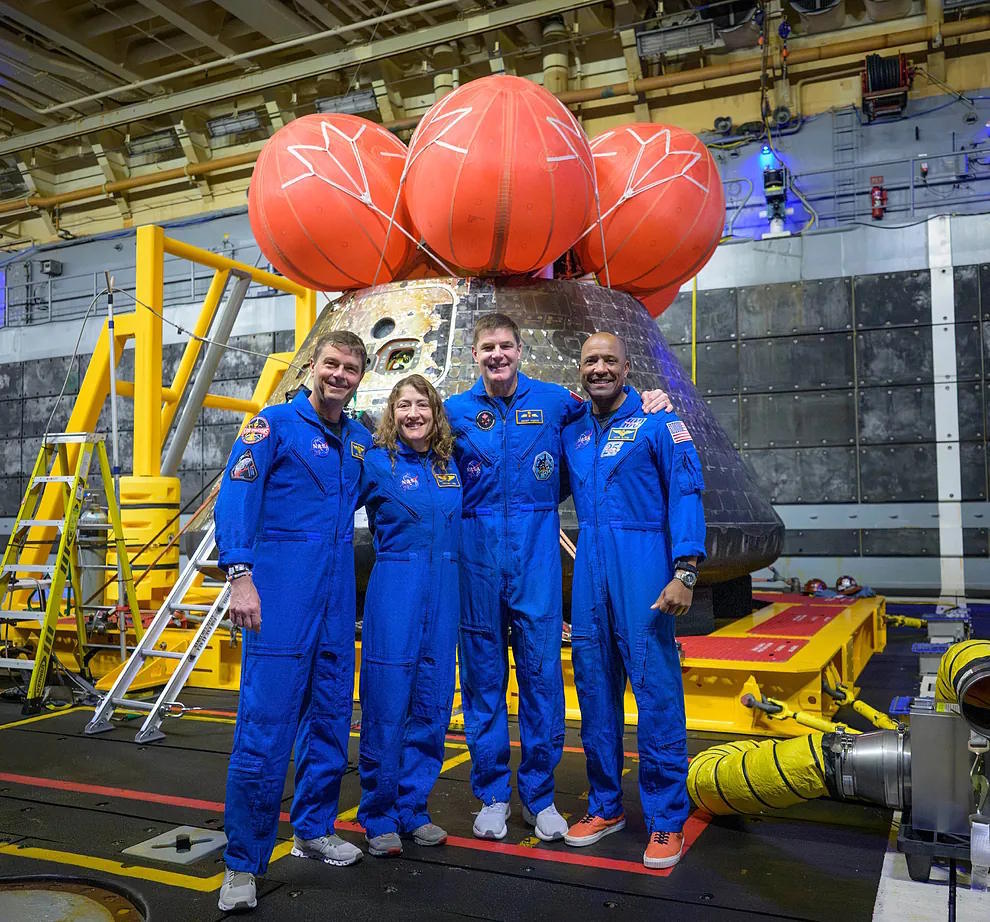
American TV networks managed to cover the critical phases of the first manned lunar mission since 1972 during the 10 days of Artemis 2, combining it with news about the war in Iran and Donald Trump's interventions. The U.S. President has been closely following the mission's success, which concluded with the successful splashdown of the Orion spacecraft in the Pacific Ocean. Reid Wiseman, Christina Koch, Jeremy Hansen, and Victor Glover were rescued by divers and transported to a military ship for a medical check-up before being taken to the Johnson Space Center in Houston.
During a call to the crew on April 6, when the astronauts made the historic flyby around the Moon, Donald Trump expressed the country's pride, even being the White House the first to release impressive images of Earth and the Moon captured during that phase of the mission. After the splashdown, the president congratulated them on social media, stating that "the next stop will be Mars."
NASA's director, Jared Isaacman, has repeatedly thanked Trump for his support to the agency. The entrepreneur and founder of the online payment company Shift4 has flown to space twice as a private astronaut on SpaceX's spacecraft, and took over the space agency in December after a tumultuous election process. Trump nominated Isaacman to lead NASA shortly after taking office, but unexpectedly withdrew his nomination in late May due to disagreements with Elon Musk. In November, the president changed his mind and re-nominated him to lead the space agency. His position was confirmed in December, coinciding with the most important mission in half a century.
"This has been the first of many more missions to the Moon to come," said Lori Glaze, head of Artemis, echoing the message repeatedly conveyed by Isaacman and deputy director Amit Kshatriya: "This time, we have returned to stay."
Listening to NASA officials and Trump, it seems that this Administration is truly determined to invest in space. However, this enthusiasm for the return to the Moon contrasts with the budget cut that the U.S. Government intends to make, once again, to NASA's budget in 2027. It was during the lunar mission that it was revealed that Trump has proposed a 23% cut in funding for the space agency in the upcoming national budgets. This would mean $5.3 billion less than the previous year.
A cut that comes precisely as the space race between the Americans and the Chinese has accelerated: both powers are working to send their astronauts to the south pole of our satellite before the end of this decade and to build a permanent settlement in the coming years.
Although the exploration program, which includes the Artemis missions to the Moon, would see its budget increase from $7.8 to $8.5 billion, NASA's scientific department would only have half the funding, facing a 47% cut, jeopardizing or canceling crucial missions.
In particular, the NASA Science Missions Directorate would see its budget reduced from $7.2 billion to $3.9 billion, marking the largest single-year cut to scientific funding in the agency's history and threatening the Nancy Grace Roman Space Telescope, expected to launch later this year. Other ongoing missions include the Near-Earth Object (NEO) Surveyor, which will search for hazardous asteroids, and Dragonfly, a spacecraft that will land on Saturn's moon Titan to investigate the chemistry of life.
This is the second consecutive year that Trump intends to significantly reduce NASA's budget. In 2025, he proposed similar cuts that sparked outrage and strong protests, both among agency workers and the global scientific community. The U.S. Congress, which has the final say on budget matters, rejected the proposal and ultimately approved a total of $24.4 billion for the entire agency in 2026 (of which $7.25 billion was for the science area), figures similar to the previous year.
However, very important scientific programs such as Mars Sample Return, the mission that aimed to bring back samples from Mars collected by the Perseverance rover, have been suspended. Furthermore, the relief that the budget cut threat did not materialize has been short-lived.
The independent organization The Planetary Society has expressed "disappointment with the budget proposal" and has called on the U.S. Congress to reject it again. They also recall that last month, over a hundred members of the House of Representatives signed a bipartisan letter requesting a $1.75 billion increase for NASA's Science area. "The President has expressed his desire for NASA to remain the world's leading space agency. The White House budget office is not in line with this broad bipartisan consensus," The Planetary Society denounces in a statement.
The Science in a Manned Mission
Within a manned mission, there is also a lot of science. In Artemis 2, pioneering experiments have been conducted to study the effects of deep space radiation and microgravity on human health, essential knowledge for living on the Moon or traveling to Mars as Trump intends. The most striking is AVATAR, a project that has allowed organs-on-chips to be taken to space. These tiny devices contain human tissues, cells from astronauts that will be compared with those on Earth.
These chips contain living human cells that are cultured to represent the structures and functions of specific regions of human organs, such as the brain, lungs, heart, pancreas, and liver. They can beat like a heart, breathe like a lung, or metabolize like a liver, according to NASA. Additionally, tissue chips can be linked together to mimic organ interactions, which is important for understanding how the entire human body responds to stressors or medical treatments.
Another milestone of Artemis 2 is that for the first time, health parameters of a woman in deep space have been taken, as although many female astronauts have stayed at the International Space Station (ISS), all those who traveled to the Moon were white men. In fact, Glover is the first black astronaut on a lunar mission.
In addition, space exploration with robots and Earth observation with satellites are two essential programs of NASA, whose missions are often carried out with international partners. There are many ongoing missions that have invested a lot of money that could be at risk due to the cuts Trump intends to make.
Meanwhile, a very ambitious schedule has been set for the following lunar program missions. What awaits us now after the excitement of Artemis 2? First, Artemis 3 is scheduled for 2027, a manned mission that will not land on the Moon: it will rehearse in orbit the docking techniques of the Orion spacecraft with the landing modules being developed by SpaceX (Elon Musk's company) and Blue Origin (Jeff Bezos' company). The details of this mission, whose objectives were updated a few weeks ago, have not been detailed yet.
One of these two lunar modules will land with astronauts on board on the lunar surface in Artemis 4, expected as early as 2028. Until a few months ago, it was going to be SpaceX's Starship HLS, a lunar landing module variant of the Starship spacecraft still in development. However, the delays SpaceX is experiencing are testing NASA's patience, so there is a possibility that Blue Origin's Blue Moon landing module, initially intended for more distant Artemis missions, could be used for the first landing.
There is still much to be done. Additionally, NASA workers need to analyze all the data collected during the 10 days of Artemis 2. On one hand, the high-resolution images taken during the lunar flyby will help the agency better select landing sites for future missions. On the other hand, they will have to address the technical issues detected in the Orion spacecraft.
The mission's goal was to test all the spacecraft's systems on its first manned flight. Failures were expected, and they have occurred. These will be specified in the coming days, but beyond the toilet issue, there have been several unexpected communication interruptions and a helium leak in the European Service Module's propulsion system, the part of the spacecraft provided by the European Space Agency (ESA), which triggered an alarm during the flight that will need to be investigated.
The controversial thermal shield that protects the spacecraft from high temperatures during reentry into the atmosphere, which had issues during Artemis 1, worked well, despite some experts' fears that it could endanger the astronauts. NASA's strategy of not changing its design for Artemis 2 but modifying the spacecraft's trajectory to reduce heating has proven successful. Opting for a design change would have further delayed the lunar program, which already has many delays, and time is of the essence.