"We have seen extraordinary things." While traveling through deep space, Canadian astronaut Jeremy Hansen, the first non-American citizen to participate in a lunar mission, summed up the meaning of exploration and its ability to excite humans with these words.
It hadn't happened in 53 years. No one had visited another world since the U.S. closed the Apollo program in 1972. But the success of Artemis 2, whose four crew members successfully splashed down, "happy" and "in excellent condition" in the early hours of Saturday, has made the promises of returning to our satellite credible. Despite Reid Wiseman, Victor Glover, Christina Koch, and Jeremy Hansen not having landed on the Moon, the flyby they made around the Moon on April 6 officially marks the beginning of NASA's ambitious program. The U.S. is competing with China to send its astronauts to the South Pole and build a permanent settlement.
Meanwhile, what can be affirmed is that the eyes of the four astronauts have seen for the first time areas of the far side that no one had seen with the naked eye, and they have become the people who have traveled farthest from our planet, surpassing by 6,000 kilometers the record set by Apollo 13 in 1970.
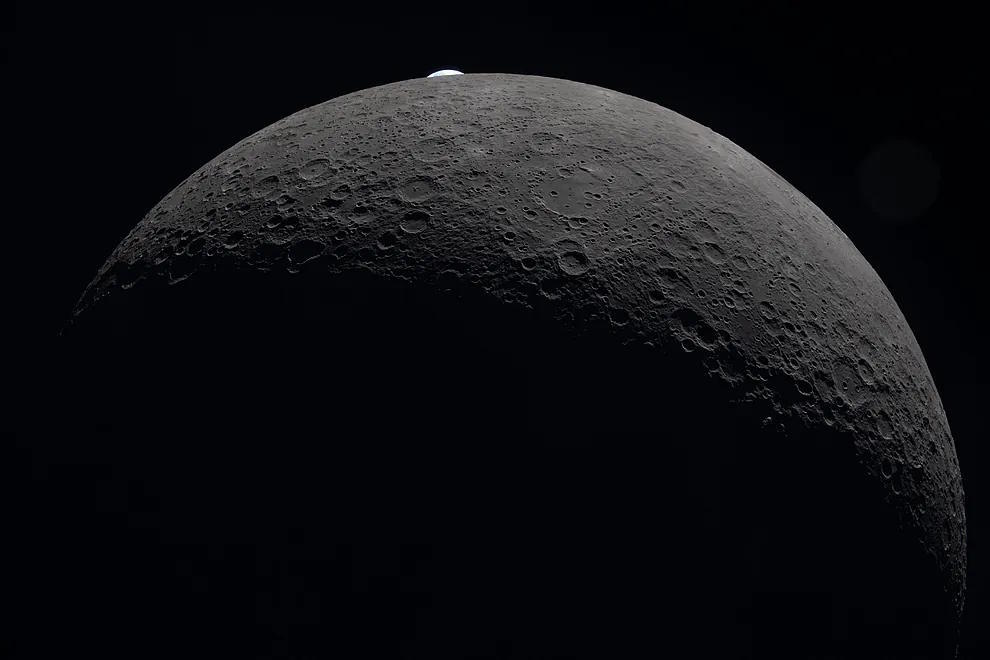
It has been 10 days full of adventure, emotions, and anecdotes that have left us with scientific milestones and amazing images of the Moon, Earth, and a solar eclipse that are already part of humanity's historical archive.
The day-to-day life on the Orion spacecraft, named Integrity, has allowed us to understand how a mission unfolds and to get an idea of the challenges of space travel for humans. We have followed the astronauts' daily routine, the good vibes among them, and a lesson on camaraderie and teamwork. We have heard the songs they woke up to every day - compiled by NASA in a playlist for enjoyment on Earth - we have grown fond of the mascot Rise, the small plush toy that indicates zero gravity, and they have shown us the dishes they have tasted in the spacecraft and how they prepared them, a topic that has generated a lot of interest.
Even NASA had to deny any covert advertising after a Nutella jar suspiciously appeared floating in the spacecraft, or after actress Jessica Alba showed her excitement upon learning that Christina Koch uses the hand lotion from her cosmetic brand Honest. During his call to the crew, Canadian Prime Minister Mark Carney joined in joking about his compatriots' preference for maple syrup over hazelnut and chocolate cream.
The repeated malfunctions of the new toilet - Artemis 1 flew at the end of 2022 without astronauts so the spacecraft did not have a bathroom - have been the biggest technical headache, although not the only one. Despite the inevitable jokes it elicits, it is not a minor problem because if it is about learning to live in space and humans reaching further, the toilet is an essential piece of equipment, as Christina Koch, self-proclaimed "space plumber," emphasized when she managed to fix the first malfunction that occurred shortly after takeoff on April 1 (already April 2 in Spain). NASA engineers will work on it to prevent it from happening again in future Artemis missions.
Their lunar adventure has been a topic of conversation in many families and workplaces, and it has made us wonder if we would be capable of boarding a rocket to go to space or how we would feel if a loved one did. Many people wonder why NASA has not been able to land on the Moon yet in 2026 if it did so more than half a century ago, and there have been heated debates about the usefulness of this mission. Conspiracy theories were quick to emerge, and faced with the magnificence of the high-resolution photos of the Moon and Earth, some claimed they were created with artificial intelligence.
For some, it has been historic; for others, disappointing, but Artemis 2 has left almost no one indifferent. You don't have to have been born in the U.S. or Canada to have had your heart in your mouth during the last 15 minutes of the dizzying descent of the spacecraft, which was engulfed in a fireball upon reentering the atmosphere at supersonic speeds. A phase that caused an expected communication blackout with Houston for six endless minutes. It was thrilling up to the lengthy rescue of the capsule after it fell into the Pacific by the U.S. Armed Forces, in an operation rehearsed to the millimeter to bring the new heroes of America back to land as soon as possible.
But beyond the entertaining routine of this crew, during these days, above all, their gestures and words have moved us. Their descriptions of the colors of the lunar landscapes they saw through Orion's windows and their reflections on our place in the cosmos. They touched us with the embrace of the four crew members after announcing that they had proposed naming a lunar crater after the deceased wife of Commander Reid Wiseman.
Pilot Victor Glover sent love from the Moon, to all earthlings in general and to his family in particular. And in the midst of the war in Iran, they have sent messages of peace and unity, both directly and symbolically. First, recreating the iconic photograph Earthrise taken by the Apollo 8 crew on Christmas Eve 1968, at the end of one of the most tumultuous years the U.S. has experienced, with the Vietnam War and numerous protests throughout the country.
The publication of that image showing the fragile Earth and our place in the cosmos had a huge social impact. Almost six decades later, when the U.S. is immersed in the war in Iran and engulfed in protests over Trump's policies on issues such as immigration, the astronauts of Artemis 2 have taken a very similar image from the Moon, showing our satellite and Earth in the background.
In their statements throughout the numerous video calls and press conferences they have held during their journey, they have expressed themselves in that sense several times. From Victor Glover's "we are all Homo sapiens" to one of Jeremy Hansen's recent reflections: "We live on a fragile planet and we are very lucky to live on Earth... Throughout life, I have learned from others that as humans, our purpose on the planet is to find joy by uplifting each other, creating solutions together instead of destroying. And when you see it from the outside, this is absolutely reaffirmed."
Before boarding the spacecraft, a journalist asked the Artemis 2 crew how they would like the mission to be remembered in the future. Christina Koch said she hopes it is not remembered because her wish is for humans to go much further. These 10 days, however, have already made history.