Bangkok has been the gateway not only to Thailand for decades but to all Southeast Asia. Year after year, the capital strengthens its dual bet, its dual face: that of an ultramodern Bangkok, with luxury shopping centers, technology, and freezing air-conditioned environments; the one with gastro-bars in Chinatown and hipster cafes in Silom; the one with cocktails in rooftop bars with panoramic views from the 60th floor of glass skyscrapers; the one with the metro, the skytrain, and the Grab app to order a car.
But there still exists that rough and traditional Bangkok, which coexists side by side with the other: the one that offers wonders of its historical heritage covered in gold leaf, like the buildings of the Royal Palace or the reclining Buddha; the one with noisy and smoky street food stalls in Chinatown; the one with cheap shopping in Pat Pong or Chatuchak; the one moving in tuk-tuks that backfire and test even the calmest nerves; or the one that decides to literally walk every sidewalk, because, after all, what does it matter to walk an hour more or less...
This gateway to Thailand is usually the prelude to descending to the southern beaches where winter does not exist, with their paradisiacal sandy beaches, palm trees, turquoise waters, and coconuts with a straw stuck in them. It's not a bad choice, of course, but here we are going against the current and looking north, inland (as it is known that beauty is always on the inside) of an immense country.
For example, less than two hours on the highway from the capital is the region of Kanchanaburi, reached by leaving behind tapioca plantations, sugarcane, the inevitable palm trees and bananas, flooded rice fields in a perfect plain, and always a golden dome of a modest temple. In the background, teak and bamboo trees, close to the mountains that mark the border with Myanmar.
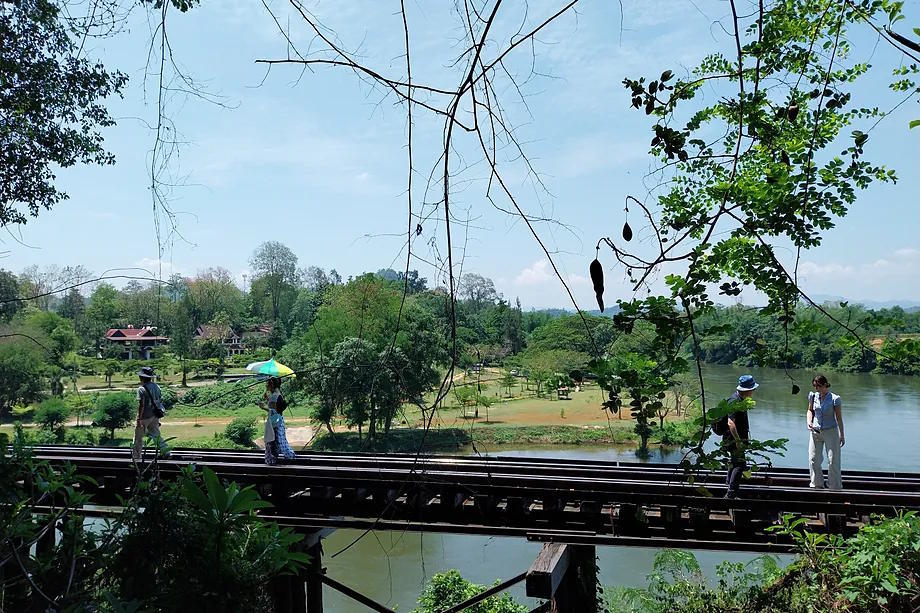
In this region, the star attraction is the bridge over the River Kwai, the same one where a battalion of brave British soldiers whistled as if nothing in David Lean's movie (1957). The famous bridge over the Kwai existed and exists, rebuilt after the American bombings of 1945. It is not the one from the classic film, which was shot in Sri Lanka, but a beautiful wrought iron structure in an idyllic setting reached after a boat ride on the river, with residential homes and accommodations tastefully built among palm trees and lush vegetation.
The bridge, which can be walked on leisurely (a few trains cross it at a retiree's pace each day), is also the point to take transportation to Hellfire Pass: just over an hour of gentle rattling parallel to the river to reach the place where one of the greatest displays of human cruelty took place.
In the project to build a railway connecting Southeast Asia with India, Imperial Japan employed hundreds of thousands of slave laborers, of whom about 200,000 died, 60,000 of them prisoners of war, mostly British and Australian. At this point, a hut recreates the harsh living and death conditions of the prisoners, and one can even walk through a trench dug by those workers and see the fragments of their drills still embedded in the rock.
A monolith commemorates this historical episode in which one can perceive the contradiction of being in an idyllic place turned into hell by someone. Those who want to learn more about the history of Hellfire Pass should forget about Lean's movie and watch the Australian miniseries The Narrow Road, starring Jacob Elordi.
A break after the passage through hell is to seek the glory of Float House River Kwai, a hotel accessed by boat. It can be said that the accommodation is an attraction in itself, with its small floating villas: three dozen cabins connected over the waters of the Kwai and a terrace from which to watch the river flow towards the sea or imitate the bolder guests and plunge into the water with a life jacket to be carried downstream. And even go canoeing. Or seek absolute relaxation by swinging on the terrace swing over the river.
Sophisticated and Traditional Chiang Mai
Another essential stop on a route through the interior of Thailand is Chiang Mai, the northern capital: a perfect mix of a city with all services and a place to relax surrounded by Thai tradition. Locals boast mainly about their nearly thousand cafes (the government promoted the replacement of opium cultivation, deeply rooted for centuries, with coffee), their milder winter climate, and their night markets.
In fact, it could be said that two Chiang Mais coexist in one. The most well-known and vibrant is the one that revolves around the Night Market, surrounded by international hotels, restaurants, and small food markets where you can try everything from typical dishes from neighboring countries to exotic meats, as in the Phaploen Market. And, mainly, buy whatever comes to mind, from technology to brand sneakers, all in "good imitations."
But there is another more introverted and increasingly sophisticated Chiang Mai, with cozy and peaceful cafes, bars with DJ music, and temples decorated with garlands and light bulbs at dusk, as if they were designed for visitors' Instagram. It is the city that is inside the grid that delimits the wall, where the atmosphere is not abandoned even on Sundays when Rachadamnoen street fills up at dusk, along more than a kilometer of all kinds of stalls, much more authentic and varied than one would expect in a tourist market. It's the time to wander around sipping pineapple juice or eating a typical sweet: mango with rice and coconut milk.
In addition to being a city, Chiang Mai is also nature and rural tradition. From there, you can book a tour to visit a local village or take the opportunity to have direct contact with elephants, a species of which there are almost 4,000 specimens in the country and with which Thailand is reconciling after years of circus abuse.
There are many elephant sanctuaries: small parks where the pachyderms live in enclosed environments, but freely. They are not in the wild, like in the Khao Yai National Park, but they receive dignified treatment and lead a peaceful life that allows visitors to get to know them firsthand.
This is the case at Elephant Ecovalley, an hour and a half from Chiang Mai by road, where visitors can touch the trunk of an elephant - which resembles a hairy tree trunk - learn how paper is exclusively made from the fibrous excrement of these animals, or participate in their daily bath and deworming in a pond where the older individuals refresh under the waterfall and the younger ones frolic and have fun spraying water at the improvised helpers, encouraged by the mahouts, their caretakers, the men who whisper to the elephants.
This reserve is close to the Ontoi community, a rural environment worth visiting to learn about the traditions of the north, from gastronomy to weaving or the use of medicinal herbs to relieve muscle pain. Precisely, combating classic back, neck, and lumbar pains is one of the specialties of Thai massage. In Chiang Mai, centers like Fah Lanna Spa, are conceived as havens of peace in the city's hustle and bustle, offering one-hour massages with different intensities (the strong one is for the daring) tailored to various muscle or skin ailments.
Lampang and its Japanese temple
The region of Lampang, also in the northern part of the country, still largely untouched by Western tourism, has since 2021 a temple with an extremely long name. It is the Wat Phra That Doi Phra Chan, known as the Japanese Temple.
This temple has a good chance of becoming one of the most Instagrammed in all of Thailand. For its giant Buddha, reminiscent of the one in Kamakura, Japan; for its climb up the mountain with a row of colorful torii gates; for the hundreds of white ceramic cat figures with red ears and scarves; for the views from the top of the rice fields dotted with white spots of herons; for that golden Thai-style gate that seems to invite you to take a photo with views of the vastness and that, amid the winter morning mists, they say, seems to float above the clouds.