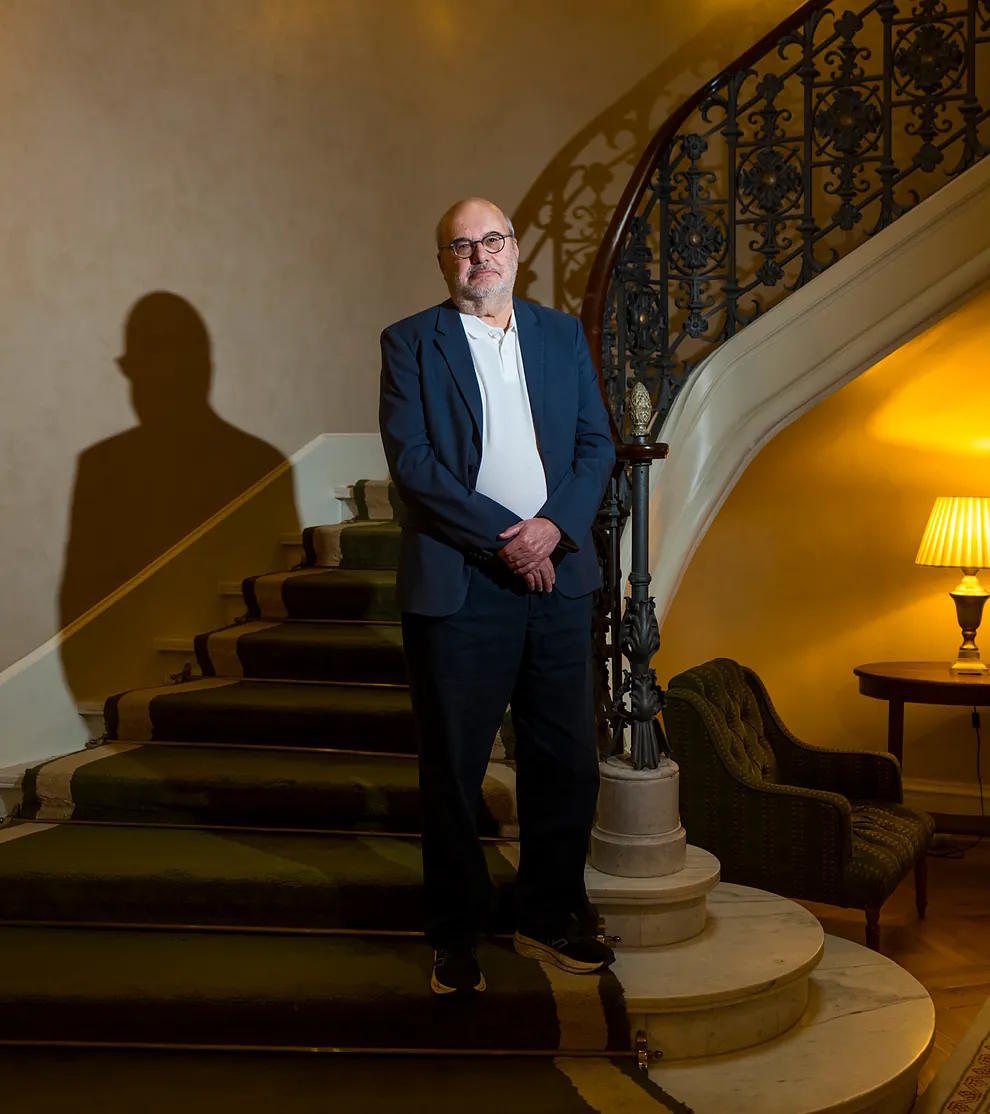
Branko Milanovic, at 73, is one of the leading experts on global inequality and a great scholar of capitalism (and communism, having been educated in Tito's Yugoslavia). Throughout his career, he has served as Chief Economist at the World Bank and as a professor at numerous prestigious institutions, the latest being the Graduate Center of the City University of New York.
Many Economics students know Milanovic for his famous elephant, a graph shaped like a pachyderm that he used to explain the clear division between the economic winners of globalization and those who did not benefit from it. In short: incomes grew globally between 1988 and 2008 for the middle and upper classes of Asia, especially China (the elephant's back), and even more notably for the small group of the very rich in high-income countries, representing the United States, Europe, and Japan (the trunk). In absolute terms, 60% of the total income gains ended up in the pockets of the top 10% of the world's highest-income population.
During his visit to Madrid, invited by the Rafael del Pino Foundation to discuss his latest book, The Great Global Transformation, Milanovic delves into the latest mutations of capitalism. From the retreat of neoliberal globalization born after 1989 and the rise of Asia to the populist reaction and the shift to a multipolar order in geopolitics.
In our society, the middle class trusted in globalization, but a large part of it feels disappointed. What went wrong?
I believe the fault lies in the expectations the middle class had when it began. They thought it would really work. We must not forget that it was Margaret Thatcher and Ronald Reagan who promoted it. Both believed it would improve the growth rates of Western economies, particularly the United Kingdom and the United States, and increase the incomes of the entire population. They were also convinced that, at that time, their economies were too oriented towards the Welfare State. Therefore, they proposed a reduction of this sociopolitical model. The truth is that they did not fully develop it, but that was the idea. What Thatcher and Reagan did not know is that their policies would lead to the outsourcing of many jobs, moving production to Asia, particularly to China. Nor did they know that they would also shatter the self-esteem of Western workers due to their falling incomes. All these factors have led to the discontent of the middle class.
Is that the cause of the rise of the far right?
I would say yes.
But there is something I do not understand. The 2008 recession was much harsher and more unequal than the current situation. However, at that time, voters supported traditional parties, not populists. Why is the far right succeeding today and not before?
I think we are talking about two effects. The political effect is always slower than the economic one. I will use an example that is not current but can serve as an explanation. In 1933, Hitler came to power in Germany. He did so when the major economic crisis that the country had suffered had ended. This means that the political consequences of the crisis, the Nazis coming to power, appeared four years later. It always happens like this. The Bolsheviks came to power in Russia in 1917, three years after the start of World War I. There are no immediate reactions. It takes time for parties to create their structures, draft a program, and set a strategy, so I am not surprised that the wave of the far right is happening now.
How can the economic strategy represented by Donald Trump and all his imitators be explained from an economic point of view? Is it possible to be neoliberal in your domestic market and advocate for tariffs for outsiders?
The basic idea is that at the national level, in the United States and I believe also in Europe, neoliberal policies will be maintained, while protectionism will grow externally. It is a return to mercantilist policies, a national market liberalism. I think we are facing a kind of return to the 17th century in that sense. If I analyze Donald Trump's policies specifically, I tend to expect that inequality in the United States will increase, as historically these policies have been linked to greater inequality.
Communism was believed to be inevitable and failed, neoliberalism was also believed to be inevitable and is in crisis. Why have no countries tried to implement the Chinese model, which is mixed and successful?
The Chinese model is very specific and has experienced many contingencies and historical accidents. The difference with the Western model is that it does not offer democracy.
Tito's Yugoslavia tried in some way a mixed model, although it did not work.
Yes. But very different from the Chinese experiment, a mishmash that failed miserably.
How can the problem of global inequality be solved if Africa does not seem to take off?
I handle data that shows that since the early 1990s, global inequality has not decreased, but has even grown. The cause is Africa. The continent is not catching up, and moreover, its population is growing. This means that more and more people are being left behind. In that sense, I do not understand the logic of the European Union.
What do you mean?
That it never thinks about instability. Let's take the example of Libya. The war there left the country completely destroyed and caused a wave of refugees.
Would freedom of movement end inequality?
It would certainly decrease significantly. The problem that poses is whether it would be politically sustainable. Europe needs workers because its population is declining and aging, but at the same time, political resistance to immigration is growing. The challenge is to achieve a balance.
How will artificial intelligence affect inequality?
No one knows for sure. We are talking about a substitution of labor, but this time, it will be much more qualified than in the past. Labor for capital, because AI is capital, as it is actually a machine. In principle, there should be an increase in inequality because the incomes of those who own shares in the companies that design it would increase. If that were to happen, very serious distribution policies would be needed. That is the most widespread opinion on the matter, but I admit that I am not 100% sure that this is what will happen.
Citizens are concerned about AI due to its impact on employment and warfare.
We are in a very positive period in terms of global technological development. On the one hand, we talk about new technologies and capabilities to do things we did not have before. But on the other hand, we are experiencing a political situation that is not only bad but is causing a transformation in thinking. In other words, we have entered an era where national competition and problems are sought to be solved through violence. And I think that is worrying. I was born in a period of peaceful coexistence between East and West. This does not mean there were no wars; there were, after Vietnam there were conflicts in Angola, Ethiopia, and, among others, Somalia, not to mention the Soviet invasion of Afghanistan. However, it was a world where there were clear rules. Everyone knew that if the Soviet Union intervened in Czechoslovakia, the United States would do nothing. Just as if the United States overthrew a government in El Salvador, it was clear that Moscow would not flinch. Despite these things, the vast majority of the population advocated for peaceful coexistence. The superpowers defended their own interests but were willing to negotiate and sign treaties because they were aware that a confrontation could be fatal for all sides.
In Spain, President Pedro Sánchez has wanted to distance himself from his European partners regarding Gaza and also in the Iran war. Do you think it is good to be independent in foreign policy and not have a common stance as a medium-sized country?
I dare not comment on Spanish politics, but I must say that Sánchez has taken a consistent stance regarding international law, while other leaders like Macron, Merz, and Starmer have not. I mean that one cannot condemn the Russian invasion of Ukraine and not do so when Israel occupies territories.
I would like to ask about Serbia, a country with traditional ties to Russia and in the center of Europe that still has not joined the European Union. What is its future?
Serbia cannot join the European Union as a full member because it will never recognize Kosovo. If Brussels were more creative, it could ignore this and rethink the formula by accepting both Kosovo and Serbia without mutual recognition. Support for joining the European Union has declined in Serbia, although I have no doubt that in a referendum, the yes vote would win. The population is somewhat fed up. My country started negotiations in 2000 and has seen Croatia and Slovenia join. The endless waiting is like dreaming of a woman you are in love with for 15 or 20 years and she does not notice you. What do you do? One day you get up and leave. So, I am in favor of the European Union finding a more stable intermediate solution. Something like a second-level community citizenship could be applied to avoid people's frustration.