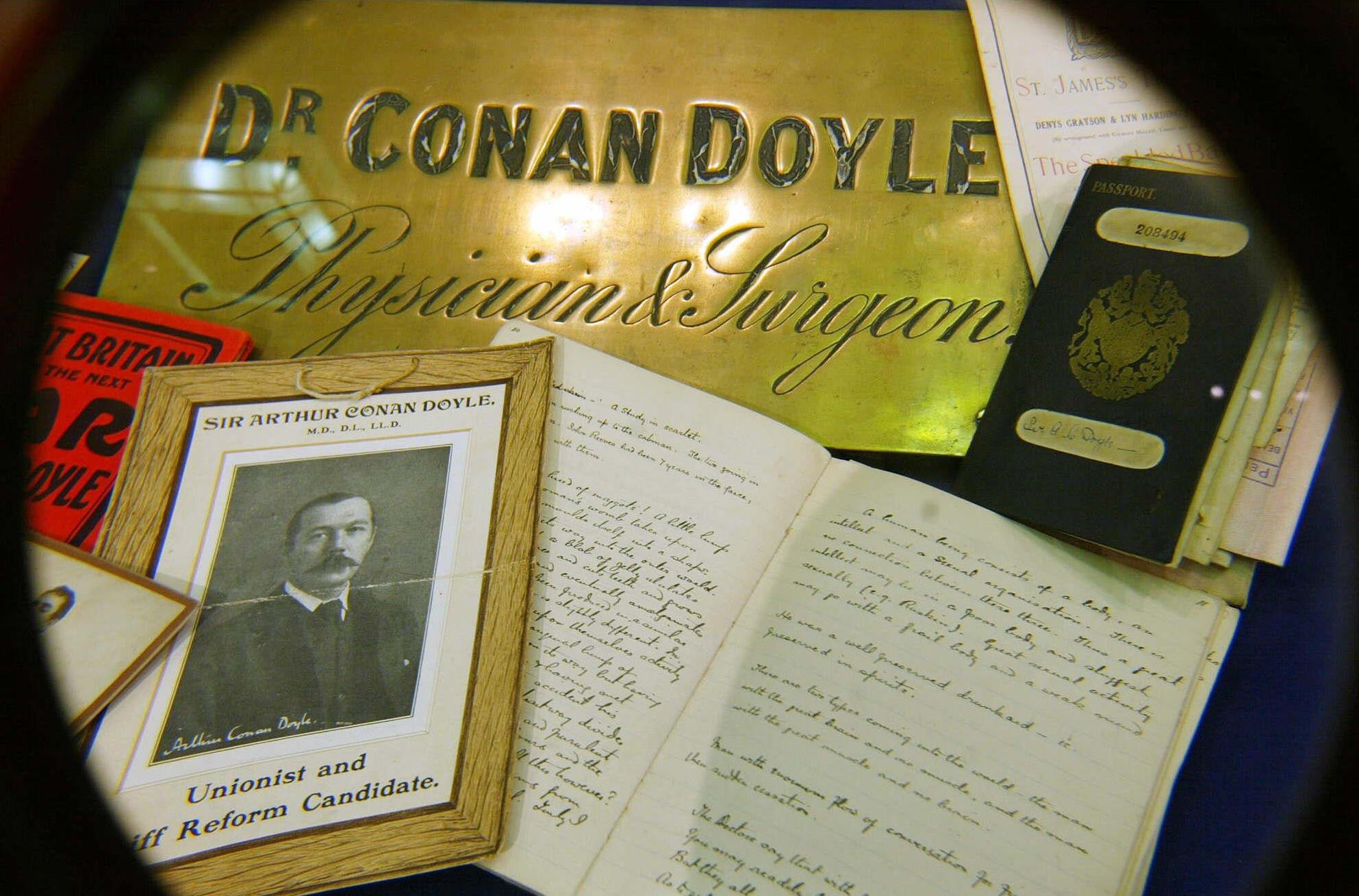
In the 1910s, American actor and playwright William Gillette sent a telegram to London addressed to Arthur Conan Doyle with the following text: "Can I marry Sherlock (Holmes)?" The writer replied: "You can marry him, murder him, or do whatever you want with him." This led to a friendship between them, the 1916 silent film with the detective as the protagonist, and above all, a mantra that creators of all kinds have embraced. With Sherlock, one can do as they please. And that's exactly what has been done.
The detective, born in 1887 through the stories Conan Doyle published monthly in The Strand Magazine, holds the Guinness World Record as the most portrayed human character in universal literature on screen. Although the exact number is not known, there are between 250 and 300 versions in film and television with nearly a hundred actors portraying him. Additionally, there are theatrical adaptations, radio dramas, fanzines, various pastiches... The detective has been in Tokyo's red-light district, wandered through India, and even reached space; he has been transformed into a dog, a mouse, and an android; he has solved black magic, been a failed actor...
Just this year, The Young Sherlock has premiered, the series by Guy Ritchie and Matthew Parkhill for Prime Video, and the musical Sherlock Holmes and the 12 Days of Christmas, which had to extend its run in Birmingham due to high demand. Also expected in 2026 is the third installment of Enola Holmes on Netflix, starring Millie Bobby Brown and Henry Cavill, and The CW is developing the second season of Sherlock&Daughter. Furthermore, rumors of a third film directed by Guy Ritchie, with Robert Downey Jr. and Jude Law reprising their roles as the Sherlock-Watson duo, have resurfaced. Now, the question is: What continues to make a character with 139 years of tradition appealing and relevant?
"People love to think that they too could understand the world at first sight. Holmes is a connoisseur of human personality, a sip and he knows what he's drinking. That is enviable. However, Holmes is also, in certain aspects, almost autistic, emotionally detached, and seemingly has only one good friend (Watson). This makes him both ambitious and, in a sense, lonely, a complex figure with whom it is easy to identify," explains Sara Lodge, a Literature and Culture professor at the University of Saint Andrews in Scotland.
Lodge, an expert in nineteenth-century literature, is the author of "The Mysterious Case of the Woman Detective," a book that highlights real women who worked as detectives in Victorian Britain and the fictional ones who shared the era with Holmes: Loveday Brooke, Dora Bell, Lois Cayley... And in the background is the analysis of Conan Doyle's great character: "Each era reinvents Holmes in its own way. We have seen him as an addict, as a war veteran, as a repressed homosexual, and as a fearless action hero engaging in Hollywood-style fight scenes. We still need a protagonist who is simply smarter than all the forces of evil that may mobilize to defeat him," Lodge begins. And continues: "Holmes is elegant, witty, a genius with astonishing intelligence and skill. He embodies the essence of cleverness. We will always see ourselves reflected in him because we too want to decipher a world that is too complex with just one glance. Who doesn't want to be the smartest person in the room?"
One of the latest creators to delve into the Victorian London universe where the detective originates is Matthew Parkhill. A British producer friend proposed a new version for Prime Video, Parkhill reread the books and gave them to his 14-year-old daughter. Due to his daughter's age, the writer wanted to explore a teenage Sherlock, before the world-renowned investigative genius. This led to The Young Sherlock, directed by Guy Ritchie. "To experiment with Sherlock, you have to give yourself permission. At first, I was scared, feeling the weight of all the brilliant writers and actors who have portrayed the character. Until I realized I couldn't write anything if I continued down that path. This became my playground, I felt a sense of freedom to explore something not found in the books," explains Parkhill in a conversation in London during the series premiere.
Victorian-era literature and its characters have traditionally provided a wealth of characters and plots for the audiovisual industry. There are countless adaptations of Dracula, Dorian Gray, and Oliver Twist. Wuthering Heights has been one of the most promoted releases in recent months. And Jane Eyre has suddenly become a global youth phenomenon. Because many of these stories contain ongoing social debates. In Sherlock's case, this identification also exists and partly explains his enduring popularity. "We're talking about a misogynistic character, a drug addict, bipolar, suffering from anxiety... I can't think of many things more current. Above all, Sherlock is not a hero, he's an antihero. Deep down, he's profoundly human, experiencing ailments and psychological issues. Even today, he remains modern because he is timeless. We could transfer any of those issues to today and they would fit perfectly," notes Eduardo Caamaño, author of "Arthur Conan Doyle: The Definitive Biography of the Creator of Sherlock Holmes," published in 2018.
A similar line of thought is explored by Daniel Tubau, a Sherlock fan since his adolescence and author of "Not So Elementary: How to Be Sherlock Holmes": "Sherlock could be connected to any era because he is a reader of signs, something that is always present in the world. In our particular era, where we often feel quite lost and uncertain, encountering someone who can find reason is appealing." The writer also addresses whether Conan Doyle's character could be considered the equivalent of artificial intelligence in the 19th century. "He could be akin to artificial intelligence because suddenly he knows a lot about blood, fingerprint analysis, or types of cigarettes. But he has terrible gaps, like not knowing that the Earth revolves around the Sun, and he doesn't have access to absolute data like AI. Above all, the most interesting aspect here is the obsession because it's a purely human concept that I'm not sure artificial intelligences will ever develop," he concludes.
The international relevance and the need for a Sherlock Holmes adaptation have resonated in various countries worldwide. Japan has embraced several versions, and Spain also has its own. In 2012, José Luis Garci decided that the detective should solve a murder attributed to Jack the Ripper but committed in Madrid. The result was the film Holmes & Watson. Madrid Days. In Barcelona, for almost three decades, a group of Conan Doyle story enthusiasts have maintained the Holmes Circle, where talks are held, books are presented, and gatherings about these stories are promoted. With the 2010 release of the BBC version starring Benedict Cumberbatch, the number of members reached a hundred, and it now remains stable at around 75 subscribers.
"One of the initial explanations for Sherlock's success is that he lives and works in London, and the spaces where he solves his mysteries were verifiable by readers who followed the plots of each new story in The Strand Magazine. People read the story, saw that one of the mysteries had occurred near their home or workplace, and went to see that place," highlights Jaime Gabaldà, a member of the Barcelona Holmes Circle. This expert on the character draws a comparison between the detective's popularity and one of the great cinematic phenomena of the last decade: the Marvel sagas with its superheroes.
What if those superheroes were descendants of a detective dressed in a cape, hat, and holding a pipe? "There are many superhero elements in Sherlock. Firstly, Sherlock and Watson always go together like Batman and Robin. Another is the idea of clothing, that visual iconography defines the characters. Everyone knows how Sherlock dresses just as they know how Superman or Batman dresses. In fact, he himself jokes about it during a story, where he scolds Watson for turning him into a character. And lastly, Batman in his origins was a kind of amateur policeman without any powers," points out Gabaldà. "It's not crazy to consider Batman as a direct descendant of his."