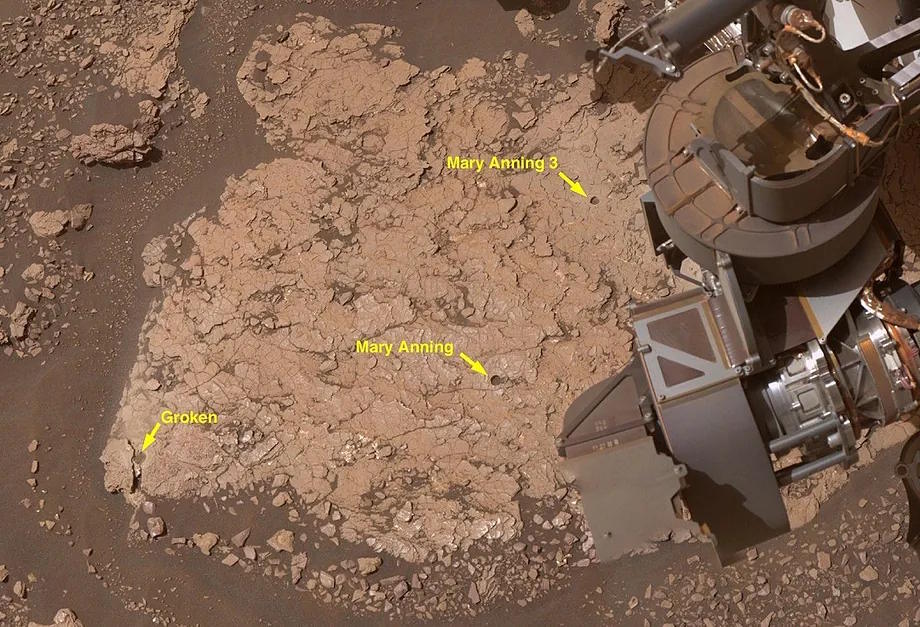
While the Moon has overshadowed Mars in recent months with the manned mission Artemis 2, which for the first time took astronauts to the Moon in over half a century, NASA's robotic vehicles (rovers) continue to explore the red planet tirelessly. While Curiosity arrived in 2012 to search for evidence that ancient Mars had conditions that could have supported microbial life billions of years ago, Perseverance landed in 2021 to look for signs of any ancient life that may have developed. This Tuesday, a new discovery made by Curiosity arrives.
As reported by the journal Nature Communications, the robot has identified through a pioneering experiment in clay rocks a diverse mixture of organic molecules, including chemical substances considered basic components that gave rise to life on Earth. In other words, those complex molecules were the building blocks for life to emerge on our planet.
Among the twenty chemical compounds identified, the robot detected a molecule containing nitrogen with a structure similar to DNA precursors, a substance that had not been observed on Mars until now. The rover also identified benzothiophene, a sulfur-containing molecule that often reaches planets through meteorites.
Amy Williams, the researcher from the University of Florida who led this experiment, believes they are observing "organic matter that has been preserved on Mars for 3.5 billion years".
"To be clear, we have not found evidence of life with this study, but we are further refining the fundamental molecules that were present on Mars," clarifies Williams to this newspaper. The analyzed samples were in the Glen Torridon region of Gale Crater. It is an area rich in clay minerals that indicate it once contained water. These clays can better retain and preserve organic compounds than other minerals, making it an ideal place to discover these substances.
The chemical experiment was conducted in 2020 with the set of instruments called Sample Analysis at Mars (SAM) carried by Curiosity. Using a chemical substance called TMAH, it broke down larger organic molecules so they could be analyzed by the onboard instruments. The study revealed that the Martian surface can preserve the types of molecules that could serve as signs of ancient life. However, it cannot distinguish between organic compounds from possible past life on Mars and those formed by geological processes or transported by meteorites.
"The experiment produced organic molecules whose origin we cannot determine. It was designed to break down larger complex organic matter (what we call macromolecular carbon) into these smaller organic molecules," details Williams. "The confirmation that we broke down a larger macromolecule that has been preserved over a long time gives us confidence that larger molecules that could derive from biological processes could also be preserved if those molecules were ever generated. It is more of a proof of concept that larger molecules could be preserved over time despite the harsh radiation environment."
To definitively identify signs of past life from any sample, the scientist says it would be necessary to bring it to Earth for analysis with the equipment available here. However, she considers it "really useful to have evidence that ancient organic matter is preserved because that is a way to assess the habitability of an environment. And if we want to search for evidence of life in the form of preserved organic carbon, this shows that it is possible."
Scientists believe that what fell on Mars in the form of meteorites is what also fell on Earth, and probably provided the basic building blocks for life as we know it on our planet.
"The Curiosity rover was built to search for habitable environments, places where life would want to live if it ever arose on Mars. This study contributes to that story: that they were habitable in the ancient past and had the ingredients for life as we know it. Now we have evidence of larger and more complex organic carbon preserved over geological timescales in the rocky bed of the red planet, and we have more evidence that some of the basic components of life were transported to Mars and were present there," the scientist points out.
The promising results come at a time when future missions - including the ESA's Rosalind Franklin robotic vehicle to Mars and the Dragonfly expedition to Saturn's moon Titan - plan to incorporate the TMAH test on board to search for organic compounds.
However, bringing samples from Mars no longer seems a viable option, at least in the short term, considering that the ambitious Mars Sample Return robotic mission has been suspended, which aimed to bring back the promising samples collected by Perseverance, the other NASA rover operating on Mars. A few months earlier, last September, the vehicle announced the most solid evidence that the red planet once hosted life. Minerals were identified in the Jezero crater whose chemistry suggests they could have formed in past microbial processes related to the presence of life.
"We still cannot say that Mars ever hosted life, but our findings further reinforce the evidence that it was a habitable world at the time life originated on Earth," she maintains.
We end by asking her if she believes it is possible that there is currently some form of life in the depths of the Martian subsurface: "That's a difficult question because we only have one reference point, which is our planet. We know that microbial life lives kilometers below the Earth's surface, within small cracks in the bedrock. If terrestrial life figured out how to do this, and perhaps if life arose on Mars, maybe it also discovered a similar survival strategy. I hope we continue to explore the red planet and that perhaps one day we make that discovery," she points out.