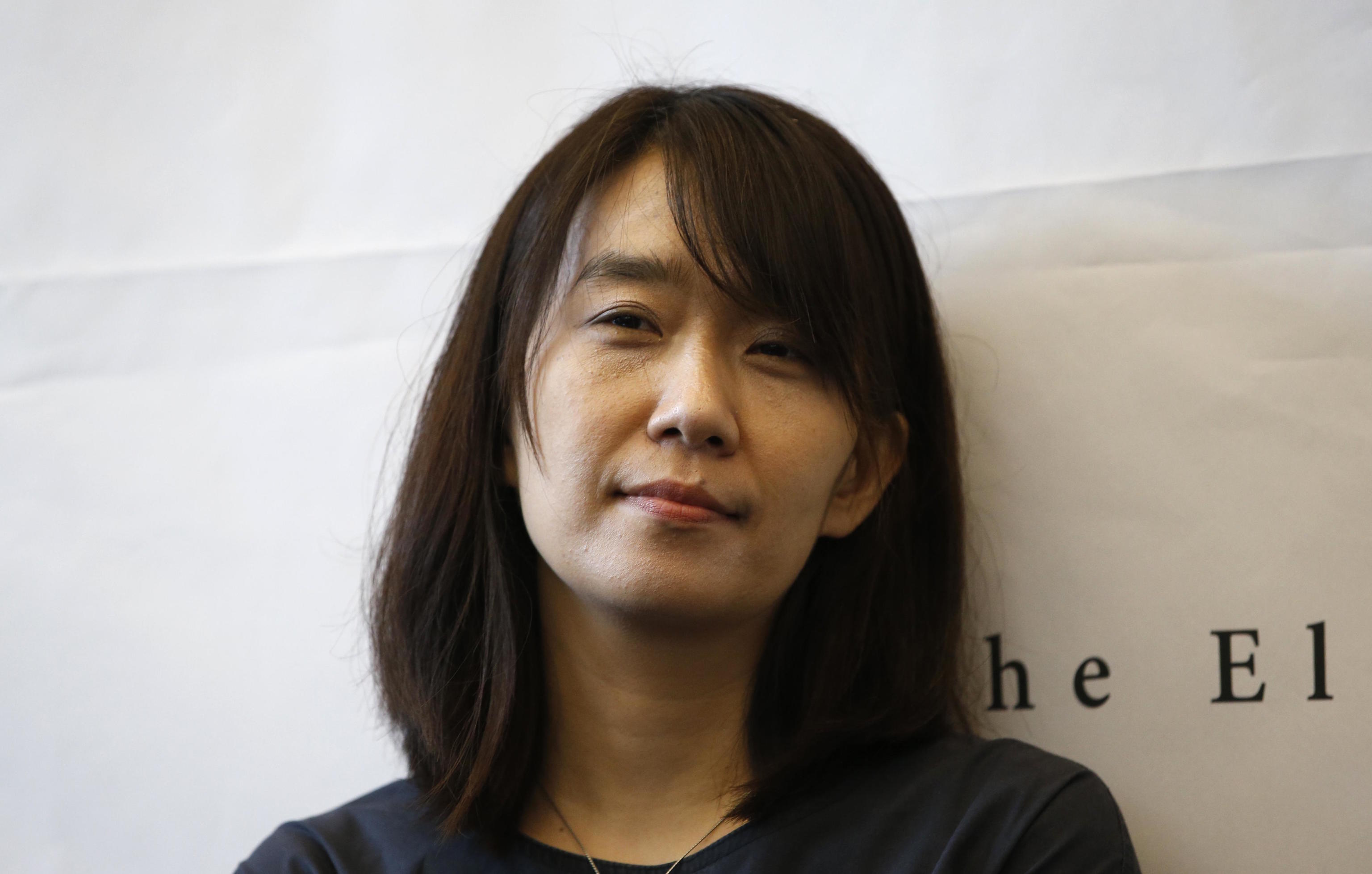
There are writers who build a body of work and others who, almost unintentionally, create their own moral territory. South Korean writer Han Kang (Gwangju, 1970) belongs to this second lineage, those who write not so much to narrate the world but to subject it to a constant form of questioning. Her arrival in Barcelona, on the eve of Sant Jordi - yesterday she gave a talk at the Centre de Cultura Contemporània (CCCB) where she even greeted in Catalan: "bona tarda a tothom" - has something of a silent event, in line with an author whose work has turned fragility, pain, and memory into materials for top-notch literary inquiry.
"I have heard about Sant Jordi's Day, I have known about it for a long time, and I am eager to see it with my own eyes," the writer began. "Those of us who love literature inevitably have a silent part, I believe, but I am very moved to know that there is a city full of people who love books," she added.
In fact, the writer worked as a bookseller for years and has unabashedly defended the importance of books and reading. "I had so much love for literature that I opened a bookstore, that says it all, doesn't it?" she stated. "I was always fascinated by the concept of a writer, how someone ventures to answer questions, to question what it means to be human and to write beautiful works with that," recalls the author, who confesses that even as a child she knew "that I wanted to be like them, part of that community."
In this sense, Han has stated that the fast-paced modern world can be an enemy. "In our daily lives, we are often very busy and do not have time to read, right?" she asked. "But when we stop reading, we become more inflexible, less human. Not reading limits our feelings, makes life more dull. When I go without reading for a while, I try to make an effort to do so to be able to regain all those feelings that I may have lost by not reading for a while," she explained.
The awarding of the Nobel Prize in 2024 has not substantially altered the nature of her literature, writing as a form of intimate resistance dedicated to answering difficult questions, but it has shifted its center of gravity. What was for years an open secret, one of the most radical and precise prose in contemporary narrative, has now taken a prominent position.
However, there is no epic of recognition in Han. Her writing remains entrenched in that uncomfortable place where language seems to grope forward, as if each sentence measured the extent of what can, and cannot, be said. "Despite receiving that award, so important and valuable, nothing within me has changed and I live daily with the same thoughts and internal sensations as before receiving it," she pointed out simply.
"If there is something different," she conceded, "it is that when I walk down the street people suddenly talk to me or want to hug me. Then I am surprised and a little confused, but I know they do it with good intentions," she said somewhat embarrassed. "But as for me, after all, they are strangers... that is new, otherwise I remain the same, I continue writing and living."
"After the Nobel, nothing has changed for me, I live daily with the same thoughts and feelings and I continue writing"
What seems to have changed more is the world. Asked about the complex international context, increasingly repressive and violent, the writer asserted firmly: "We are living in darker times, it is a difficult truth to reject that everyone knows. History always repeats itself, right?, and the current situations were also experienced in the past, but it is true that we are reaching a peak of darkness," she evaluated somberly.
"Still, one of the things that surprises me the most is that there are always people on the other side trying to survive and taking care of themselves and healing their wounds," she recalled before addressing a constant theme also present in the darkness of many of her books, hope. "Hope is not as fragile or impossible as they make us believe. We have to strive for it, cling to it," she defended.
A task in which, she assured, art can help us. "Through art and literature, people become more sensitive, and this allows us to put ourselves in the place of life instead of in the place of death. They make us more tolerant and empathetic so that we can feel more vividly the sufferings of others," she reflected. "In this world of repetitive and dramatic misfortunes, we have to try to suffer also for others. Although we are not direct participants in that pain, I believe that literature and art are always on the side of life and are doing their job of putting the people who enjoy them in the place of life."
"We are living in dark times, it is a difficult truth to reject. Art and literature serve to give us hope"
Calm and smiling, the writer also talked about her latest book published in Spain, Tinta y sangre (Random House, like all her work), a novel written between her two major works and originally published in 2010, in which the South Korean author explores how we can survive in a cosmos governed by pain, resorting to art, memory, affections, and the search for truth. "In summary, I would say it is about a woman who dedicates her entire life to discovering and being able to prove that the death of her friend, who was almost like a blood sister to her, was not a suicide," Han summarized.
"That's why it has a touch of mystery, detective-like, like a thriller, although it does not follow traditional guidelines. Ultimately, this novel is mainly about love," she confessed. "Despite being full of the sufferings and afflictions that we can all experience throughout our lives, the idea was to show that it is still worth living. I wanted to convey that message, that's why I think it is a novel full of love," she stated. And amidst the laughter of the audience, she said, "they are laughing, is it because they disagree?," she joked.
Beyond this new-old title, from the international breakthrough that was The Vegetarian, with which she won the Booker International, to subsequent titles like La clase de griego or Imposible decir adiós, Han's writing has been shaping a recognizable poetics, attentive to the body as a territory of conflict, to language as a limit, and to violence as a presence that rarely manifests directly, but conditions daily life persistently.
But reducing it to those themes would impoverish it, as what is truly distinctive in her work is the way that material is translated into prose that avoids emphasis, that advances with deceptive clarity and that, in its apparent serenity, contains a tension difficult to dispel. Born in Gwangju, a city marked by the violence of military repression that is explicitly portrayed in books like Human Acts, Han Kang has built a body of work in which historical experience and individual perception intertwine without hierarchies, giving rise to a narrative that seeks not so much to explain trauma as to make it perceptible in its complexity and in its shadowy areas.
"Every human lives in this world with a physical body, and I think that is a very important element in our lives, so when I am writing I give a lot of importance to the senses," the writer has explained about her way of narrating. "When I describe what the characters are feeling, I try to feel it myself with my own body, raw, in order to describe it in more detail. Instead of writing 'he was anxious or he was distressed', I like to be able to convey the electric currents that we all truly feel when experiencing those sensations."
In addition to the plasticity of her writing, there is ultimately something profoundly contemporary in Han's way of narrating, but not in the superficial sense of the term, but in her ability to capture a sensitivity permeated by fragility, mourning, and the need for meaning. That her voice resonates now in Barcelona is not so much a response to current trends as it is a result of the persistence of a body of work that, without making noise, has been occupying a central place in the literature of our time.
In fact, she has confessed in the conversation that she is preparing a new novel, although she did not want to reveal much. "If I talk too much, the magic disappears, so I'm not going to tell you the details. But I am writing a quite personal book. In one way or another, it would be the most personal book I have ever written, as it is about my family," she revealed cautiously, before admitting: "Every time I am writing it, I always have that thought of 'will I be able to finish the book, complete it entirely?'. But I also always have the hope that yes, I will be able to finish it and that it will be successful for me," she revealed.
While awaiting this upcoming title, for the Spanish reader who has followed her trajectory for years, Han's visit is somewhat a confirmation of one of the most unique voices in global contemporary fiction, but also an opportunity to revisit books that, read today, in the light of her international recognition, reveal with greater clarity the consistency of a literary project detached from trends and simplifications. In a time particularly given to stridency, her writing persists, with discreet firmness, in the exploration of that which resists being spoken.