The name itself is an illusion: Shangri-La was a fantasy invented by a British novelist that ended up embodied in a corner of the vast Chinese map. The literary utopia jumped from the ink to reality by a state decree. Behind the exotic label, behind the myth, lies Zhongdian, a city in the Yunnan province, in the southwest of the Asian giant, embracing Buddhism and Tibetan culture. Its original name was erased in 2001 by a marketing strategy of the Chinese government. Suddenly, Zhongdian, located on a plain at 3,200 meters above sea level, became the legendary and spiritual Shangri-La, the lost valley of eternal youth, a place near the Himalayas described by the author James Hilton in the novel Lost Horizon, from 1933.
We travel to the echo of the paradise that Hilton imagined almost a century ago and that China has turned into a theme park that welcomes thousands of tourists hooked on the mantra of earthly paradise. "The vast majority of national visitors who come to Shangri-La don't even know that the name and the modern mysticism surrounding this place came from a book by a British writer," says Yang Li, the owner of a wine shop where the star product is a barley wine from the highlands that has a yellowish color and earthy flavor.
Yang has her business in one of the picturesque mazes of cobbled streets of Dukezong, the old quarter of Shangri-La, which has a history of over 1,300 years. Much of its facade was rebuilt after a fire in 2014 that destroyed 200 wooden houses and numerous shops. "There has always been an attempt to maintain a balance between spirituality and consumption, between tradition and modernity. But the charm is being lost due to mass tourism," Yang opines, with a sigh full of resignation.
Other merchants share similar feelings. Tenzin Dor, owner of a small Tibetan craft stall, comments: "I see tourists taking photos of necklaces and prayer flags, but they don't understand their meaning. In the past, our neighbors made these pieces for their temples or homes; now they only make them to sell to visitors."
Although almost all tourists are Chinese, there are also some foreigners wandering through Dukezong, especially Western backpacker couples who are traveling through Yunnan and stop at trinket shops and yak meat stalls, a very hairy bovine native to the Tibetan plateau. Paul and Sophie, a young French couple, mention that they haven't read Lost Horizon -a bestseller that was the first book printed in mass-market paperback format-, but they did watch the Hollywood adaptation directed by Frank Capra and starring actor Ronald Colman (Oscar in 1938).
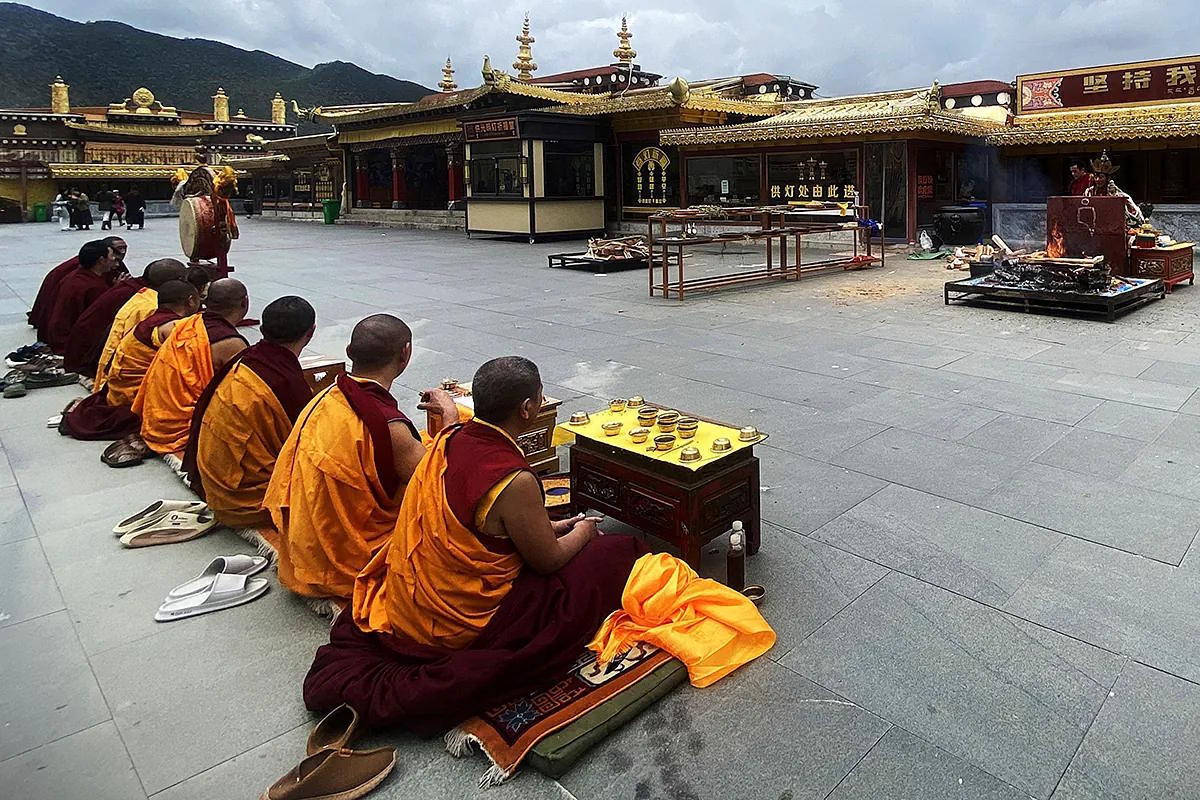
In some corners of the old city, monks in saffron robes appear, crossing paths with hordes of local tourists who observe everything through the screens of their mobile phones. Groups of young girls rent very Instagrammable ethnic costumes to stroll through the streets. Tradition, rather than disappearing, has been placed behind a showcase where the authentic and the staged try to coexist, with a fragile balance.
Chinese communist authorities claim that the name Shangri-La comes from three characters in Mandarin: shang (heart), ri (sun), and la (moon), which together symbolize perfect harmony. Tibetans, on the other hand, believe it derives from a term in Sanskrit, shambhala, which describes a spiritual utopia in Buddhism.
Hilton's work places Shangri-La in a Buddhist realm in the Himalayas, isolated from the outside world, where peace reigns and inhabitants live for hundreds of years. Although Hilton never visited the Himalayas, it is believed that he was inspired by articles from National Geographic by the American explorer Joseph F. Rock about the beauty of the Yunnan mountains in the 1920s.
For a long time, adventurers from around the world were convinced that Shangri-La was real. Various corners of the Himalayas in Tibet, India, and Nepal, aware of the tourist appeal, presented themselves as the inspiration for the literary myth and claimed to be the source of inspiration for the writer. There were even ambitious expeditions. In 1938, the Nazi German regime sent a team of scientists and adventurers in search of the land of the immortals. Japanese explorers also spent years tracing mountain routes and isolated villages.
James Hilton, the inventor of the myth, never visited the region, but Nazis and Japanese launched expeditions in search of his inspiration
"When China began to open up to the world, the local authorities of Zhongdian saw an opportunity to develop and pressured Beijing to rename the county. After several years of debate, the government declared that its scholars had located the Shangri-La described by Hilton in this Tibetan county surrounded by snowy mountains in the northwest of Yunnan," explains Li Yu, an anthropologist at the Chinese Academy of Social Sciences. "Zhongdian was a poor city that suddenly filled with visitors. Then, all kinds of tourist infrastructures began to develop."
One of the main attractions of Shangri-La is the imposing Songzanlin Monastery, with its golden copper roofs shining in the sun and its exterior walls painted in red, white, and ochre, built on the hillside under the mandate of the fifth Dalai Lama in 1674. The complex had to be rebuilt after being destroyed and looted, like many other places of worship scattered throughout the country. The arsonists were the Zhongdian locals during the turbulent Cultural Revolution. Tibetan Buddhism, with its complex hierarchical structures and religious traditions, was considered by Mao Zedong's fanatical Red Guards as a feudal superstition that had to be eliminated to make way for atheism and Marxist-Leninist ideology. Mao's government ordered locals to demolish their own places of worship.
Today, Songzanlin houses a large community of monks. Monastic life coexists with the constant flow of tourists. Inside the meditation halls, donations via QR codes are allowed, although many visitors, especially older ones, still leave bills with Mao's portrait, the man who ordered the destruction of the monastery.
As night falls, back in the old quarter, the overcrowding concentrates in a park where one of the largest Tibetan Buddhist prayer wheels in the world is located, 21 meters high and weighing 60 tons. It is made of golden bronze and contains over 100 million mantras (prayers). In Buddhist tradition, spinning the wheel clockwise has the same effect as reciting the mantras it contains, releasing blessings.
Around the city, there are several natural parks where tourist buses traverse meadows that were once only occupied by wild boars and yaks. Newlyweds travel here just to enhance their wedding album with an idyllic natural landscape in the background. And the most adventurous fill their backpacks with oxygen bottles to climb up to Meili, one of the most sacred mountains in Tibetan Buddhism, with a sacred peak reaching 6,740 meters.
The spiritual Shangri-La that Hilton imagined has been absorbed by a showcase for visitors seeking quick photos and souvenirs. Upon leaving this promised paradise, there is a feeling that, rather than having been in an ancient Tibetan village, one has toured a sacred refuge that has been disguised as a theme park.
As Tsering, one of the monks of Songzanlin, says: "Tourists take photos and buy souvenirs, but they don't feel what beats in these mountains. The silence of the monasteries, the chanting of mantras at dawn... That cannot be sold. Only those who understand can carry a piece of Shangri-La in their hearts and have an immortal soul. The rest is just a golden disguise for eyes that look without seeing."