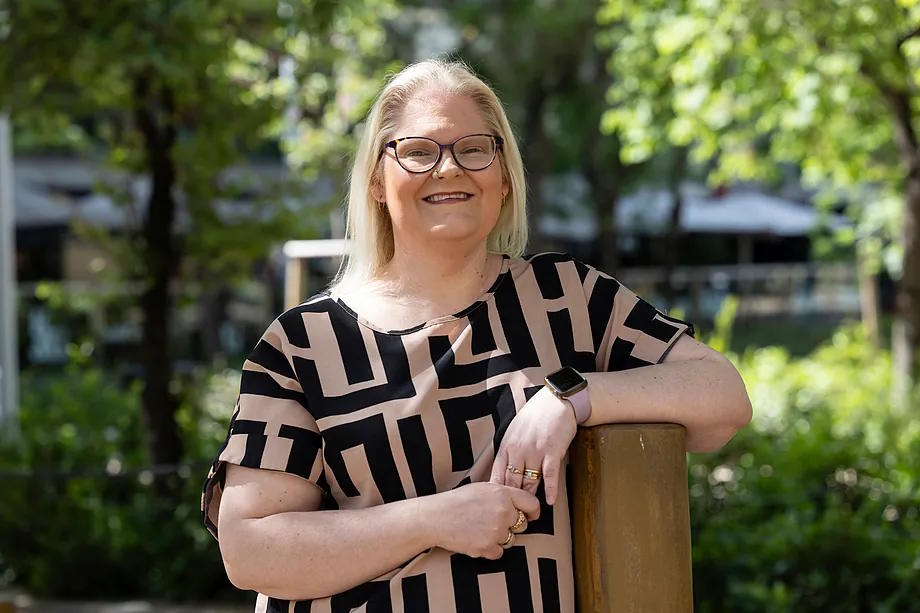
In vitro fertilization (IVF) is now a completely normalized and standardized reproductive method, but in the late 70s, it sparked a great ethical debate, along with skepticism, alongside a scientific revolution. As a result of research, the first 'test tube baby,' as she was called, Louise Joy Brown (Oldham, United Kingdom, July 25, 1978), was born. Reproductive medicine has undergone a huge technological advancement - partly driven by the birth rate crisis and the delay in motherhood - leading to a golden age, which has raised new ethical, social, and legal dilemmas. All of this is being discussed these days in Barcelona at the 6th edition of the International EBART Congress (Evidence-Based Assisted Reproductive Technology), organized by Eugin.
Amelia Rodríguez-Aranda, medical and scientific director of this international group of assisted reproduction and fertility clinics, explains that in 1978, when Brown was born, the techniques and technologies used for assisted reproduction were very basic, and the chance of success (pregnancy) was "minimal." Today, in the first cycle of assisted reproduction, pregnancies are achieved "in 50-60% of cases". At the congress, they are discussing how to improve results with the help of artificial intelligence (AI) and genetics, among other factors. Brown has witnessed all the evolution that this super-specialty has undergone. The first of the 15 million people worldwide born with this technique is attending the congress and has shared her experience with this newspaper.
In 2015, she published her autobiography. When did she become aware of the pioneering way she was conceived? At what point did she realize that this made her internationally famous from birth?
At the age of 4, I was explained, in simple words, that I was conceived through IVF, that it was a different way from the rest of the people. As I grew older, I gradually realized how important that was. I also confirmed it by traveling around the world.
Having a sister conceived in the same way (the 40th in the world), did it help you cope better?
I wanted a sister and I already knew that neither she nor I were the only ones conceived that way.
Both of you have become mothers naturally, but if you had fertility problems, would you have undergone assisted reproduction?
The first time I was asked this, I was about 14 years old and even then I said without a doubt. My parents spent 10 years trying to have a baby, and after that time, the gynecologist said he would help them, and he did.
Is it true that your parents, Lesley and John Brown, underwent IVF without knowing they would be the first case in the world?
My mother wanted a baby at all costs, and I'm sure that if it had been necessary to strip naked in the middle of a square and upside down, she would have done it. They didn't know that IVF hadn't worked before, but they went to the gynecologist and saw babies, and that's what they wanted.
Have you been able to meet and stay in touch with other people born through pioneering IVF in their respective countries; in the case of Spain, Victoria Anna Perea? What do you usually share?
I know the first one in Brazil, the first one in the United States... and in Spain, Victoria Anna. Along with her, in 2017, I received the 13th Dexeus Women's Health Foundation Award in Barcelona. I have to say that I feel a strange connection with these people; it's hard to explain.
What role did Pope John Paul II play in the public understanding of your case, especially the more conservative opinion?
The way I was born at that time was considered a sin, but the Pope said that if that technique was used to bring children into the world, it was not a sin. It was also said that those born through IVF did not have a soul, and he clarified that we did have a soul and that, like everyone else, we had a place in heaven.
At that time, I lived on the sidelines of the controversy, and my parents did the same; they were too busy with their baby at home.
There is an English movie, 'Joy,' from 2024, about your case. Would you say it is a faithful chronicle of what happened?
We were invited to attend its filming. When I saw it, I thought it was a good movie.
It allowed people to understand what happened, what the professionals involved in that first case (mine) thought. But I think regarding Jean Purdy [who implanted Louise Brown's embryo in her mother's uterus and became the world's first embryologist], what is told in the movie is not faithful. I suppose a movie needs some spice to be more attractive. But overall, it's pretty good, and it surely helped with understanding.
Your husband, Wesley Mullinder, and your two children, how have they lived with your celebrity?
They don't even realize it. My husband, who is 8 years older than me, happened to be one of the neighborhood kids who welcomed me when, after I was born, my parents brought me home to Bristol.
Do you have a message for couples who need to resort to IVF to have children?
Go for it! There are already 15 million of us born thanks to these techniques worldwide. And trust your doctors. What worked for my parents will surely work for others.