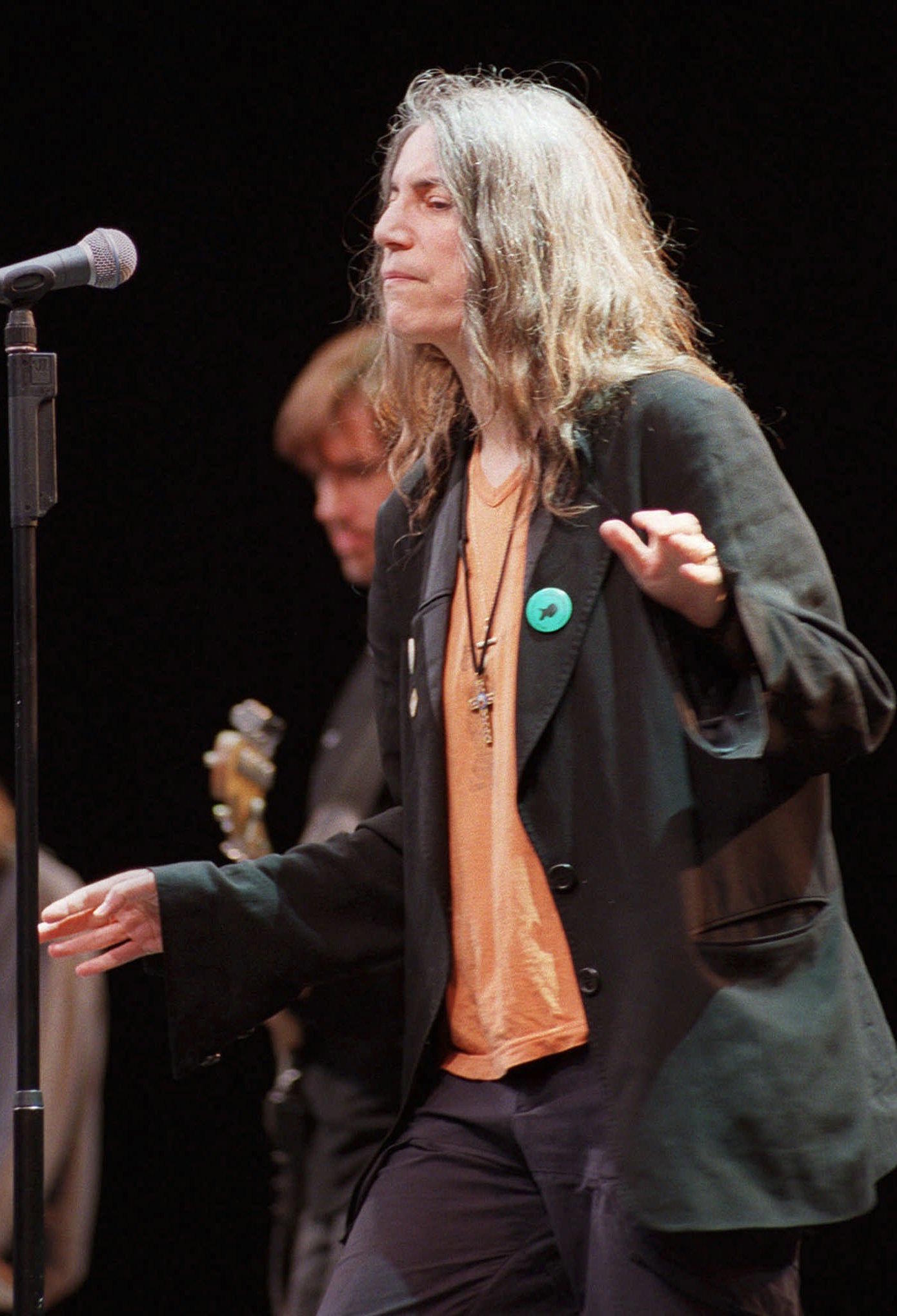
In the prologue of Bread of Angels, her autobiography, Patti Smith recounts seeing herself on tiptoes, like a child, trying to grab a crimson-colored book out of greedy curiosity and deliberate vocation. "I believed I could write the longest book in the world, record the events of each and every day. I would write it all in such a way that everyone could find something there," she writes. And, deep down, she does it because in those lines lies the very essence of a career that has always been imbued with an outward gaze.
Patti Smith, musician, poet, activist, and counterculture icon, has been chosen by the jury to receive the 2026 Princess of Asturias Award for the Arts. The child on tiptoes, recording another milestone in the book of her days. Full of her compositions, her speeches, and, of course, her gaze. Because to understand Patti Smith, who even in her childhood questioned her surroundings, the existence of God, and the color of the soul, one must delve into her as both subject and object within the world. Her world, that of a nomad from birth.
In the first four years of her life, she had eleven homes in Chicago, Philadelphia, and New Jersey. There she discovered the world and began to observe. At 20, after a pregnancy and giving her son up for adoption, she left university and moved to New York in 1967 to pursue her artistic ambitions. In '69, a year after May '68, she moved with her sister Linda to Paris before returning to New York. It was the New York bohemia that shaped Patti Smith's keen gaze, which would lay the foundation for the book of her life. There she met photographer Robert Mapplethorne, lover and friend until his death. There she began to paint, write, and carve out a place for herself in the art world. There she met the group at the Chelsea Hotel, where everyone lived: Leonard Cohen, Edie Sedgwick, Allen Ginsberg, Bob Dylan, Keith Richards, Janis Joplin, Jimi Hendrix, Dylan Thomas...
"Where does it all lead? What will we become? Those were our questions in youth, and time revealed the answers to us. It leads to the other. We become ourselves," the artist reflected on those years in the pages of We Were Kids, her autobiography about her union with Mapplethorne and her journey to becoming one of the foundational figures of punk rock. Horses, her debut album which turned 50 in 2025, with the iconic portrait of the jacketed man by Mapplethorne himself, is one of the albums that explain the phenomenon that, already transformed, spread in the second half of the 70s. Patti Smith's rawness and challenge, mixed with the influence of poets like Arthur Rimbaud, paved a new path for rock. Guitars and drums resounded, but poetry was also recited over them.
Because there, Patti Smith had already begun to publish her first poetry books, inspired by the literature of Jean Genet. The first collection of poems is Seventh Heaven, a reimagining of the evangelical tradition in which she was raised, filtered through the ambiguous sexuality she practiced at that time. In the eponymous poem, she challenges religious dogma and shatters one of humanity's foundational myths, that of Adam and Eve. "Eve's was a crime of curiosity / As the saying goes: it cost her the c**t / A rotten apple spoiled the whole thing / But rest assured it wasn't an apple / an apple looks like an a** / It's the fruit of f*gs / it must have been a tomato / or better yet, a mango," she poetically muses in the title poem of the collection.
Throughout the 70s, she alternated between her two roles, musical and poetic, releasing four albums with her band and seven poetry collections. These albums feature songs like Because the Night, Dancing Barefoot, Frederick, Free Money... And then, a hiatus followed her marriage to Fred Sonic Smith. The artist retreated to a village north of Detroit, and everything came to a halt for almost a decade. In 1988, Patti Smith had something to say, as evidenced in Dream of Life, whose main theme is People Have The Power,which has since become an unofficial anthem for civil rights marches, democracy, and anti-war movements - especially in the early 2000s during the Iraq War.
It was after her husband's death in 1994 that she reunited with the band, recorded Gone Again (1996), and returned to the stage. From that moment on, she never stepped off it again. In October of last year, she made a stop at the Teatro Real in Madrid to celebrate the 50 years of Horses and still has several dates in Europe this summer: Turkey, Ireland, the Netherlands, Norway, Sweden, and the United Kingdom ahead of her.
Beyond the artistic realm, or precisely intertwined with it, Patti Smith's perspective cannot be understood without her role in various social movements. She was one of the voices raised against the Vietnam War and the escalating violence of the Cold War. In fact, as she has revealed, it was those marches that inspired People Have The Power, which was later sung at the marches against the Iraq War in the early 2000s. In those protests, she was an authoritative voice, as she was in the Occupy Wall Street movement in New York against economic inequalities and in demonstrations against the immigration policy during Donald Trump's first term.
"She has captured the rebellion of the individual in society in pulsating songs, some of which have become icons of popular music in our time. As a writer, she has conveyed a poetic vision of life committed to offering a message of hope against injustices," states the jury's decision to award her the Princess of Asturias Award for the Arts.
The gaze, always Patti Smith's gaze.