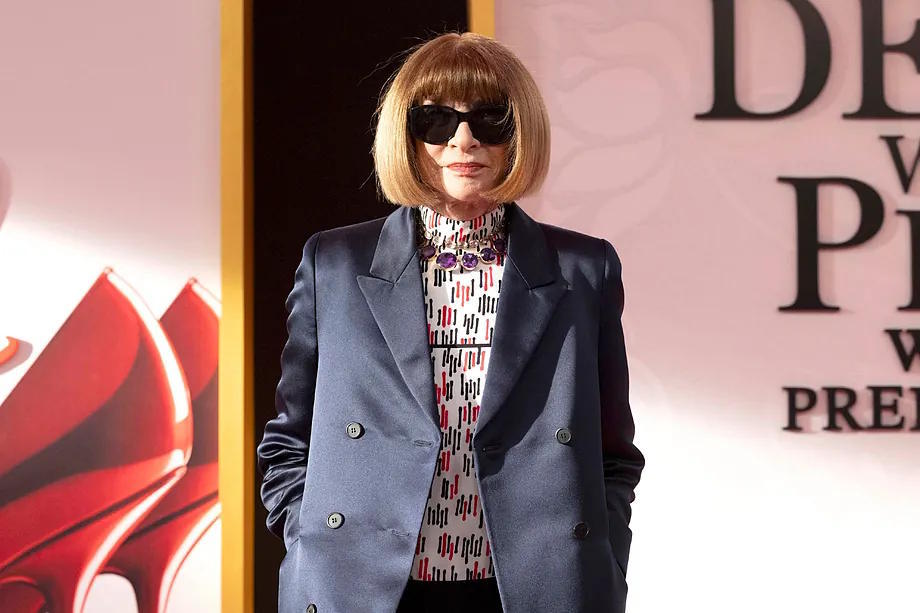
In the early 2000s, Lauren Weisberger - blonde, slim, freshly out of an elite university - spent eleven months as a personal assistant to Anna Wintour, the feared editor of Vogue. From that experience came The Devil Wears Prada, a best-selling novel that thinly veiled criticism towards her former boss.
But it's not her character, but her instinct that has truly allowed Wintour to become the most influential woman in fashion for four decades. What the book didn't show is revealed in a second anecdote: when the betrayal was adapted to film, Wintour was invited to the premiere. There was a crisis meeting and a conclusion: she not only had to attend, but she had to make it her own. So, she was... dressed in Prada. This month, she repeated the dress code in the sequel (which premieres this Thursday in Spain) and on the cover of Vogue that she shares with Meryl Streep, her alter ego in the movie. It's the first time Anna has appeared on the cover of her own magazine.
Just as she saw the phenomenon that Weisberger's story had become, Wintour has been able to read the Zeitgeist of each era. It was she who changed the covers from heavily made-up models of the 80s to girls in jeans, to Madonna in a swimsuit. Then came Hollywood stars, and eventually Kim Kardashian.
This is how she turned her magazine into a global brand. Industry popes like Bernard Arnault consult her moves. She has elevated and destroyed designers: "At the beginning, she supported me a lot, but I didn't follow her advice and, simply, she stopped informing me," Miguel Adrover told me on one occasion. No one is capable of raising as much money as she does, of turning a local event (the Met Gala) into a red carpet as anticipated as the Oscars.
She has also made mistakes. Surrounding herself with a white and privileged team (Weisberger's description is not insignificant), ignoring Vogue's digital business for years, firing even Richard Avedon...
Even her apparent retirement (stepped down as Vogue's editor-in-chief last year) is a new sign of her instinct. Wintour has left a declining business to focus on more thriving ones at Condé Nast, like the Met Gala and Vogue World, a runway show oriented towards sponsors, as explained by Amy Odell in her biography Anna. "If running a magazine no longer makes her a cultural arbiter, why bother?".
Some say that deep down she's not that interested in fashion. That she thrived in that sector because it was the only one available for a woman of her generation. The truth is, if she were a man, we would have never spent so much time on her character.