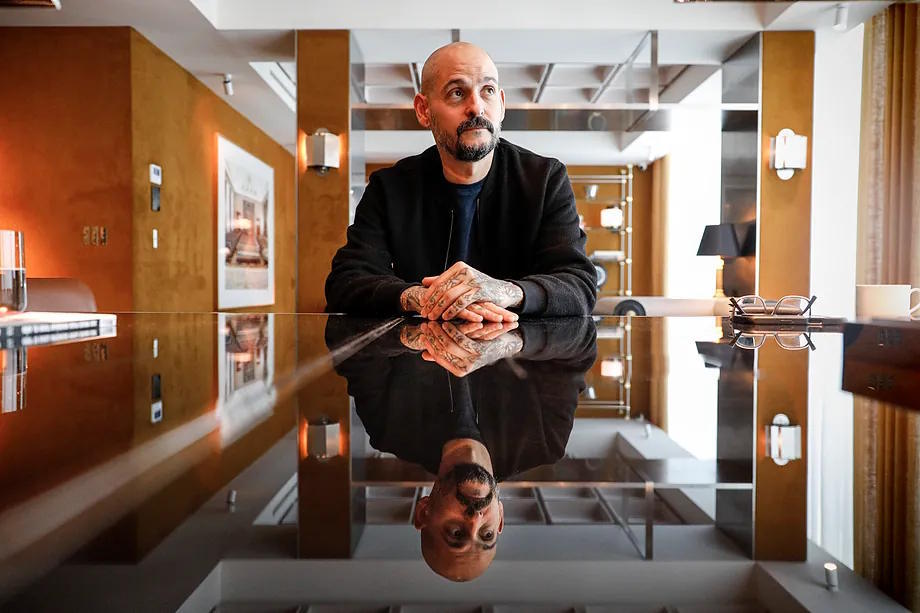
"To build a beautiful dream, the first thing is to be awake, a firm hand to hold the reins and make a project tailored to you, considering that everything shrinks," sang Joan Manuel Serrat in 1989.
Verses that caught the chef Aitor Zabala very young (Barcelona, 1979), but today, at 47, they stick to him like a second skin. Because Somni (dream in Catalan), in addition to the youthful enthusiasm of an experienced chef who once emigrated to the United States, is the restaurant in West Hollywood (California) that has taken him to the Michelin peak. With it, he has made history -yes, even if he is reluctant to use the word- beyond Los Angeles, where he has been living for a decade.
The feat? Achieving three stars at once seven months after opening (November 2024) and becoming the first Spanish three-starred chef outside our country. But far from settling in success, Aitor keeps his critical eye open.
"Excellence is far away. We have a long way to go to be perfect. I have a sign with three stars and a jacket with them embroidered, but I feel like I don't own them. Who's to say they won't take them away from me tomorrow, even though we are better than when we received them?" he jokes and speculates at the same time, knowing that life often takes him "down unexpected paths and changes my plans."
Ten months later, he still struggles with public recognition, although the industry already recognized him (he worked at Akelarre and El Bulli, among others, and for a decade was the creative director of José Andrés' hospitality group). "In the end, you understand that awards are a good thing, especially for the team and the family. For those thousand family gatherings I couldn't attend, for so many years of separation... I want them to feel it was worth it," he says as emotion and a hint of blush escape through his face and his tattooed hands. These days, he is on edge: he has just received the Chef of the Year 2026 award in Madrid, given annually by Tapas Magazine.
Between the dream and the reality of Somni, where he is the chef and owner, there has been a long journey, a lot of work, over 27 years in the profession... And even a previous Somni that opened in March 2018 (at the SLS Beverly Hills hotel) under the umbrella of ThinkFoodGroup by José Andrés. Aitor fought for it -"I spent many years pestering Jose"- and led it until COVID took it down, including its two stars.
"The pandemic broke everything." That Somni did not return, and he disassociated himself from the company. "José needed me in Washington, but I didn't want to leave Los Angeles," recalls the chef who still retains a slight Catalan accent.
Aitor stayed, "not due to lack of talent, but due to life circumstances," without a job, without a project. But not without a dream, although it took him a while to awaken it. "I went through all the phases, from depression to stubbornness, and I insisted on not letting it disappear."
In that reconstruction task, he had more than one support: "A very discreet person whom I call my patron, who helped me the most when I was at my worst, and others who told me 'whatever you need'. Today they are my partners. If they believed in me, Somni had to come out no matter how long it took." And, following Serrat's advice to build a beautiful dream, he set out to "create another one immediately."
But the times of the song and the hospitality industry do not usually go hand in hand: it took almost five years to open his gastronomic venture, although the idea had been born much earlier, almost at the same time as his vocation. "Since I started, I have always wanted to have a restaurant where I could express myself, where I could execute my ideas and the experiences lived over the years... Create my own cuisine, even if I didn't know what it would be, but I wanted this."
And "this" is an oasis in West Hollywood, a large space that revolves around a bar for 14 diners. An enjoyable and high-end experience with 25 courses (510 euros) that starts before sitting at the table in a bright patio with trees that, despite being in Californian soil, could be anywhere in the Mediterranean.
Here, Aitor performs a refined, creative, and free cuisine, where he plays with his culinary roots, textures, and techniques to evoke emotions. Or in other words, "recognizable flavors", adds the chef, who narrates at Somni the story in America of a Catalan chef with Basque ancestry.
A tale of gastronomy and emigration, like many others, that Aitor values whenever he can. He did it at the Michelin gala where, upon receiving the three-star jacket, he wore a t-shirt with the phrase "Immigrants feed the United States." And he does it face to face in this interview where he proudly advocates for them.
"They are the best of Humanity. Brave people who leave their land, their family, their language to build something new elsewhere. In the United States, there are people who ignore the talent that comes from abroad, but there are also those who believe in it and give you an opportunity. I found them, and that's why I am where I am." Even though this was not initially the planned path, despite his hospitality origins (his family had several establishments in Barcelona).
It was his scattered adolescence, not having anything clear and being a somewhat "rebellious without cause" kid that led him, first to the military and then to the kitchen. "I have always been a poor student. At 17, I didn't go to class; I stayed in the park. I was a bit of a troublemaker, without malice," he puts on the teenage skin again.
"I find it very difficult to make decisions. However, when I do, I go all in; I don't conceive half measures." And he volunteered for the military. By chance, or not -"I think it was because of my Basque surname"- they put him in the kitchen. There, he lost scatter and gained structure, organization, and vocation. "I had to take orders, store food... I loved the camaraderie there, and I focused." So much so that his grandmother wrote a letter to the colonel of the barracks -which never reached him because his mother prevented it- saying, "Keep the boy, he is behaving very well and has improved a lot," he recounts amusingly.